In this blog post, we evaluate 4G LTE vs. 5G to help you identify the right technology for your requirements. Speed is one key difference between 4G and 5G, which means applications that require faster response times will see enormous benefits with migration to 5G technology.
Another key difference is lower latency, which enables capabilities such as remote operation of machines using augmented reality and full streaming 4K video. In turn, these capabilities enable a vast range of new applications in enterprise, transportation, medicine, retail, managed home office, manufacturing, and other industrial IoT use cases. And finally, 5G promises a higher level of security, enabling more secure retail and financial transactions and better cyberdefense for 5G devices.
| Category |
LTE (4G) |
5G |
| Speed |
Fast |
Significantly Faster |
| Latency |
Low |
Ultra-Low |
| Coverage |
Widely Available |
Expanding |
| Device Density |
Moderate |
Very High |
| Infrastructure |
Mature |
Still Growing |
| Best Use Cases |
General connectivity, IoT, remote sites |
Advanced IoT, automation, real-time applications |
Key Takeaways: 4G LTE vs. 5G
- 4G LTE remains viable for many applications today. With median speeds of 30–100 Mbps and near-universal coverage, LTE is still well-suited for a wide range of IoT, industrial, and enterprise deployments — and will coexist with 5G for a decade or more.
- 5G delivers three core advantages over LTE: speed, latency, and capacity. Peak 5G speeds reach 1 Gbps today (theoretically up to 20 Gbps), latency can drop to single-digit milliseconds, and 5G supports far more connected devices per coverage area.
- The right choice depends on your use case. Applications like basic IoT sensing, mobile video, and remote monitoring may need nothing more than LTE. Applications like autonomous vehicles, remote surgery, industrial automation, and AR/VR require 5G's lower latency and higher throughput.
- 5G coverage is expanding rapidly but remains uneven. As of 2025, 5G networks cover approximately 55% of the world's population — but that drops to just 4% in low-income countries. Rural deployments still rely heavily on 4G LTE.
- 5G is projected to surpass 4G as the dominant mobile technology by 2028 (GSMA Mobile Economy 2025), with global 5G connections already exceeding 2 billion by end of 2024.
- Future-proofing matters. 5G devices with 4G LTE fallback offer the best of both worlds — full 5G capability where available, with reliable LTE connectivity everywhere else. This is especially important for transportation, manufacturing, and distributed enterprise deployments.
- Private 5G and LTE networks are accelerating. As of Q1 2025, over 1,700 organizations globally have deployed private LTE or 5G networks, led by manufacturing, education, and mining sectors.
- Not all 5G is equal. Low-band, mid-band, and high-band (mmWave) 5G serve very different use cases. Understanding which spectrum tier is available and appropriate for your deployment is critical to realizing 5G's benefits.
So, is 5G right for your business needs, and if so, when? 5G is projected to become the dominant network technology by the end of 2027. Meanwhile, 4G LTE networks have a long life ahead, so you have multiple options in network technology. On the one hand, if 4G LTE meets your performance and throughput requirements, you may be able to stay the course for the foreseeable future. However, there is also a strong argument for future-proofing your deployment with 5G devices, which include 4G fallback, in order to take advantage of the capabilities of 5G as the network build-out process is completed.
Read this blog post to learn how the networks compare and select the right technology for your purposes.
Are LTE and 5G the Same?
Many commercial operations today are assessing 3G vs. 4G vs. 5G, as they plan their deployments. With 3G networks shutting down to make way for the 5G build-out, that leaves 4G and 5G for consideration. So — what's the difference between 5G and LTE?
4G LTE technology is the predecessor of 5G. It evolved over time from LTE and LTE Advanced to LTE Advanced Pro and contributed many underlying capabilities that are still being used in 5G networks. For example, MIMO (multiple-input, multiple-output), which is the ability to use multiple antennas to transmit and receive information faster and more reliably. Or Carrier Aggregation (CA), which dynamically combines different spectrum bands into a faster data pipe.
5G is the next major step and thus generation in this long-term evolution. It uses a 5G-NR (new radio) and a new network infrastructure (5G-gNB). Along with new spectrum, up to 5G mmWave, these ingredients give 5G its flexibility to provide high-speed, low-latency, and an increased number of devices per covered area — all on the same network.
What Is LTE?
 LTE stands for “Long-Term Evolution.” The term was coined with the advent of 4G to signify the many incremental advances made during the period following the introduction of 4G. 4G LTE speeds today average between 50-250 Mbps, which is an order of magnitude more than what 3G networks could provide.
LTE describes the technological advances that 4G delivered. These have arrived in waves — from the first rollout of 4G LTE to 4G LTE-Advanced (LTE-A) to 4G LTE-Advanced Pro (LTE-AP), which is currently the fastest 4G option available.
LTE is superior to 3G and its capabilities create a continuum of performance to 5G and beyond. It is perfectly sufficient for many applications today, and in fact 4G networks share bandwidth with 5G networks and will be with us for years to come.
Benefits of LTE
The introduction of 5G has left many wondering when 4G will be phased out. There are many benefits to 4G LTE that will keep it going long after full 5G has become generally available and so 4G LTE and 5G are expected to co-exist for at least a decade. Is 5G better than 4G? Yes, 5G is better in many ways, but 5G networks don’t yet have the coverage to exist on their own without the backbone of the 4G LTE network and all that it provides. And 5G devices today only address the high-end, high-speed portion of the 5G vision, with middle and low-tier devices following in the coming years.
Here are some key benefits of LTE:
- Inexpensive radio: 100 Mbps or more are overkill for simple radio applications, which can operate adequately at 3G performance levels. Utilizing low frequencies of the LTE network allows a wide range of products to operate with greater cost-effectiveness.
- Broad coverage for IoT: 4G LTE network availability is nearly universal in most countries of the world. For the majority of wireless IoT deployments, reasonably priced network access is an essential element of the business case for any application.
- Mobile video: Previously, 3G could play videos on the go, but with low resolution and frequent buffering, making for a poor user experience. LTE’s superior performance relative to 3G has been responsible for the steady spread of high-quality mobile video streaming.
The Future of LTE
The future of 4G LTE is still bright. Some capabilities of 5G will not be needed right away for existing applications that are functioning well with the bandwidth and latency offered by 4G LTE networks. 4G LTE devices will continue to work and can often wait to upgrade to 5G. And private LTE networks based on CBRS (Citizens Band Radio Service) enable many new 4G LTE use cases today.
Because 4G LTE and 5G share spectrum, and 5G devices offer failover to 4G for areas where 5G is not yet established, the migration from LTE to 5G will occur over a period of a decade or more.
What Is 5G?
5G stands for “Fifth Generation” and eclipses 4G’s speed of a couple of 100 Mbps with 1 Gbps today, and will eventually deliver single-digit millisecond latency.
You may first see true 5G in urban areas for fixed wireless access (FWA), connecting homes and businesses to the Internet. Trenching wires is expensive, and wired connectivity can be unreliable. That’s why today, many customers are using 4G LTE as a wireless backup connection. With 5G’s higher performance and more resilient infrastructure, more customers are cutting the cord and transitioning to 5G FWA as their primary Internet connection, without the need for cellular backup. This reduces cost and complexity. And because speed and throughput are exponentially higher with 5G than older networks, the possible applications for 5G are almost limitless.
Benefits of 5G
The benefits of 5G include higher bandwidth, more devices, and increased reliability. But the greatest advantage for many applications is the decrease in latency, allowing devices to communicate with each other in the span of just a few milliseconds. Aside from better cellular coverage, 5G will enable some industry-changing advances in the Internet of Things (IoT).
- Virtual reality: Virtual reality (VR) and augmented reality (AR) are not only for gamers but have uses in the medical field and in a multitude of training applications, where experts will be able to guide trainees remotely. High bandwidth and low-latency are key for this application.
- Autonomous cars: Self-driving cars will need to be able to communicate with each other, and with traffic management systems — and also detect the presence of pedestrians and obstacles — in fractions of a second. 5G’s lower latency will reduce the time vehicles need to react to potential dangers, road construction, signage and other variables.
- Industrial automation: In precision automation applications, machines must be able to detect abnormalities in components, send alerts, stop conveyor belts, and other actions in real time. Having the capability to send these signals within milliseconds of a detected problem will significantly increase safety and efficiency in automation.
- Telemedicine and remote surgery: With its high speed and low latency, 5G will accelerate the development of telemedicine applications such as remote surgery. Using high-definition cameras and 5G connectivity, an operation performed by surgeons in one city can be livestreamed to a specialist in another city to advise the surgical team in real time as the operation takes place.
Is 5G Available Everywhere?
5G has moved well beyond early rollout — but coverage remains meaningfully uneven across regions and income levels. According to the ITU Facts and Figures 2025, 5G networks now cover approximately 55% of the world's population, up from just 17% in 2020 — a remarkable expansion in just five years.
Access, however, is far from uniform. The ITU reports that 84% of people in high-income countries have access to 5G, compared with only 4% in low-income countries. Leading markets include the Gulf Cooperation Council (GCC) states, Nordic countries, developed Asia Pacific, China, and the United States, where 5G Standalone deployment and network density are most advanced, according to the GSMA Intelligence State of 5G 2026 report.
Globally, 5G connections surpassed 2 billion by the end of 2024, with the GSMA Mobile Economy 2025 report projecting 5G will overtake 4G as the dominant mobile technology by 2028. For enterprise and IoT deployments, this means 5G is increasingly viable as a primary connectivity layer in major markets, while 4G LTE remains essential for coverage in rural regions and emerging economies where 5G build-out is still underway.
Is 5G Better Than LTE?
Many people ask what’s faster, 5G or LTE? Today, users of handheld devices may not be able to tell the difference. This is, of course, deceptive. In the commercial and industrial world, where Digi operates, our customers are seeing the capabilities of 5G bear. Consider, for example, the organization that has a workforce distributed worldwide, all of whom need to be securely connected into the corporate network.
With an upgrade to high-performance 5G enterprise routers, that workforce will experience dramatically improved performance and productivity. And as we have discussed, the applications in development now to take advantage of that increased performance will leap lightyears ahead with the full deployment of 5G, and will be able to communicate across the world in a fraction of a second.
Types of 5G
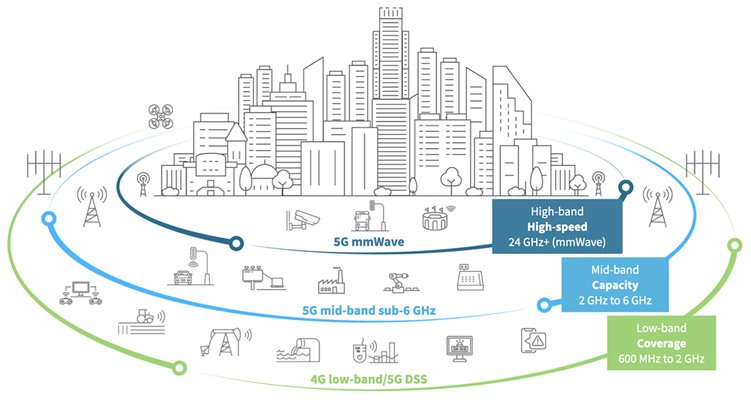
There are three different types of 5G network spectrum: high band, mid band, and low band. The spectrum is divided among the three major wireless companies in the U.S., T-Mobile, AT&T, and Verizon. Each has its own plan for how to build out 5G to meet the needs of their customers.
- High-band 5G: High-band or millimeter wave (mmWave) delivers the highest frequencies of 5G, ranging from 24 GHz to 100 GHz. High-band 5G is capable of reaching speeds up to 10x higher than LTE. But because high frequencies do not easily travel through walls or dense foliage, it is used mainly in short range applications.
- Mid-band 5G: Mid-band operates in the 2-6 GHz range and provides a capacity layer for urban and suburban areas. This frequency band has peak speeds in the hundreds of Mbps.
- Low-band 5G: 5G low-band operates below 2 GHz and offers speeds roughly 20% faster than 4G LTE. This band uses spectrum that is already in use today and supports 5G devices on the market now.
Download our White Paper on 5G Frequency Bands
Learn about differences between 5G frequency bands, their benefits, and applications.
Download PDF
How Does LTE Work?
Unlike 2G/3G networks that were using different technologies to transport voice and data, LTE is only using IP traffic, enabling faster transfer speeds and lower latency. LTE is an improvement on the 3G network, and an evolution of 4G, that helps to streamline service and allows you to do things on mobile devices that are not possible at slower network speeds.
The following diagram, from our 5G Network Architecture blog shows how LTE works from an architecture perspective:
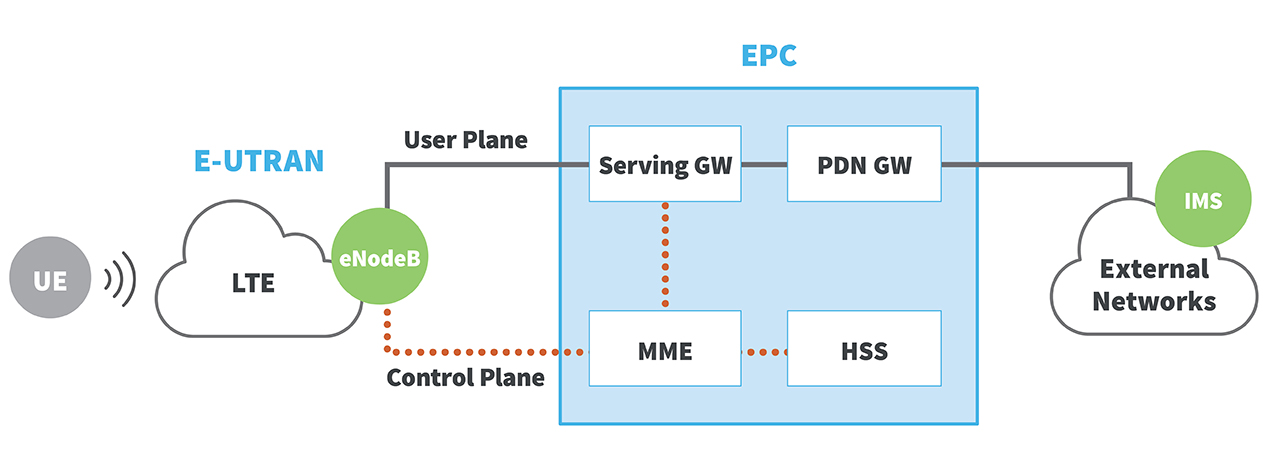
Source: 3GPP
LTE Speed
LTE speeds range between the 20 Mbps of 3G coverage and the 100 Mbps of true 4G. Speeds typically vary depending on the wireless provider and proximity to a cell tower. While it may not be as fast as 5G, LTE performance is adequate for many commercial applications.
LTE Network
What is the difference between LTE and Wi-Fi? Most consumers switch back and forth without even realizing it. When one doesn't work, the other usually connects automatically. Wi-Fi is connected to a router, so its range is limited to the range of the local router, typically about 300 ft (100 meters), whereas the range for LTE is virtually limitless.
How Does 5G Work?
5G operates on a dense infrastructure of cellular towers that are currently being installed by the major wireless companies. The network can piggyback on the existing 4G towers for basic coverage but will need many more, smaller towers to bring its high-band speeds to major cities, especially for applications such as autonomous vehicles.
The following diagram, from our 5G Network Architecture blog shows how 5G works in comparison with 4G:
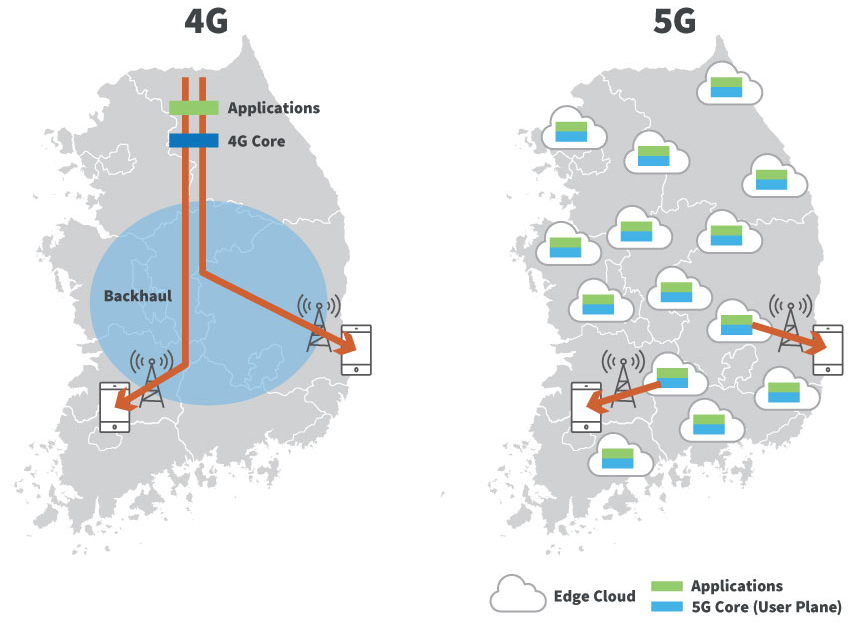
Source: Techmania
5G Speed
How fast is 5G? Maximum 5G speed depends on a number of factors, including proximity to the tower, the amount of spectrum needed for the application, backhaul, antennas, and the processing speed available. Theoretically, 5G Internet speeds can reach 20 Gbps in ideal conditions. Realistically, 5G aims to provide speeds of 1 Gbps when users are within range of a tower.
These capabilities are still years down the line, but you may start to see speeds pick up as new towers are installed in major cities. Rural areas receiving 10 Mbps could see their speeds reach 100 Mbps as 5G’s low band coverage begins to replace 4G LTE.
The 5G Network: Applications and Use Cases
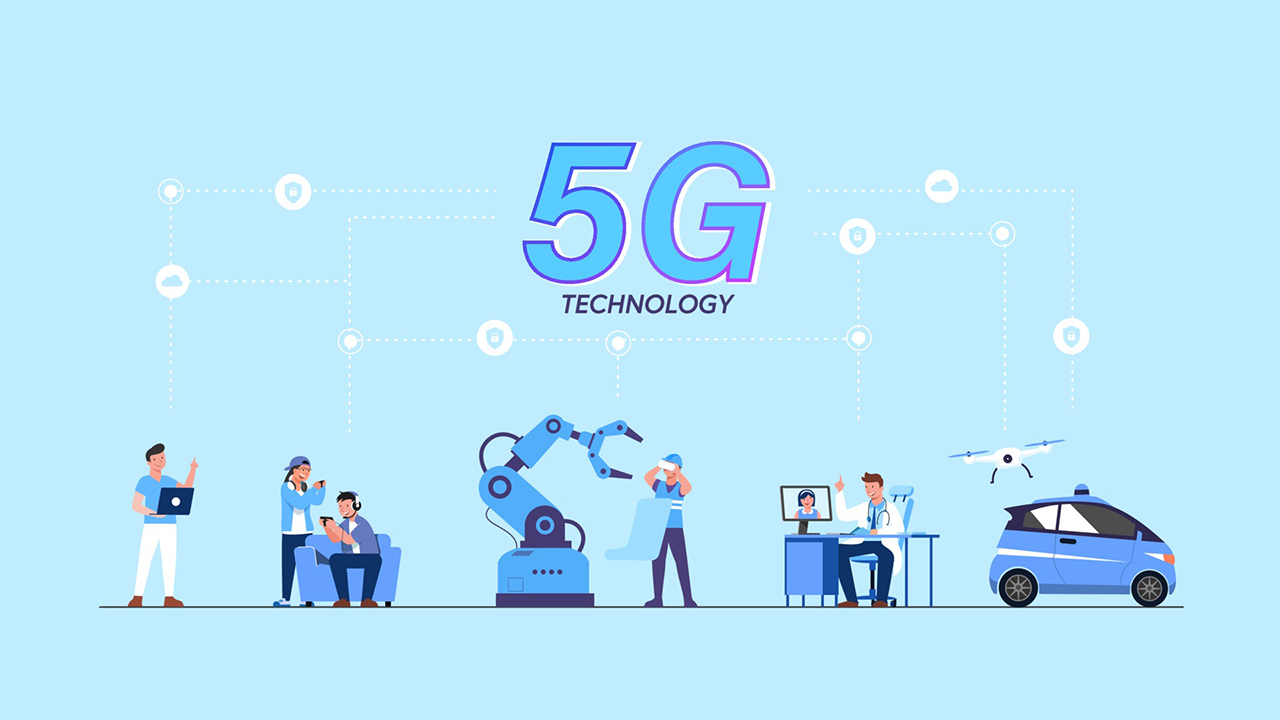
The network architecture of 5G will be tightly knit, as the high-frequency waves used for faster connection have a shorter range than the lower frequency waves used by 4G and its predecessors. Devices optimized for 5G networks will provide true, next-generation functionality.
Major cities will see cellular antennas pop up on telephone poles or streetlamps where an instant connection is needed for traffic management and autonomous vehicle applications, as mentioned earlier. The mid band will be used in the suburbs and the low band in rural areas where proximity to cellular towers is limited.
Mobile transportation systems like buses and railways will be able to integrate more bandwidth-hungry systems like high-definition security video — and consolidate many different onboard systems into fewer devices that have vastly improved speed and functionality — with solutions like Digi’s 5G-native transportation routers. With 4G LTE fallback, these solutions enable persistent connectivity across their routes, even where 5G networks are still under development.
Additionally, enterprises such as retail and banking, as well as manufacturing facilities and IT-managed home offices will see an enormous boost in speed, reliability and security with 5G-native cellular routers, such as Digi’s EX50 5G with Wi-Fi 6.
Learn More about the Future of 5G Today
We have only scratched the surface of 5G’s potential to accelerate the growth of technology and innovative new solutions.
Download our white paper and sign up for our newsletter to stay at the forefront of 5G innovation with the knowledge and resources compiled by Digi experts. Or contact us to start a conversation.
The Bottom Line: Which Should You Choose — LTE or 5G?
The 4G LTE vs. 5G decision isn't really a question of which technology is better. It's a question of what your applications demand today and where you need to be tomorrow.
If your current deployments run reliably on 4G LTE, there's no urgent reason to rip and replace. LTE networks will remain operational and supported well into the 2030s, and for many IoT, industrial, and enterprise use cases, LTE delivers all the speed and reliability the application requires.
But if your roadmap includes anything latency-sensitive — autonomous systems, real-time machine control, immersive video, or telemedicine — 5G isn't a future consideration. It's a present one. With global 5G connections surpassing 2 billion and coverage reaching more than half the world's population, the infrastructure is here and expanding rapidly.
The smartest path for most organizations is a 5G-capable deployment with 4G LTE fallback. You get the performance headroom of 5G where it's available, the reliability of LTE everywhere else, and a hardware investment that won't be obsolete in three years.
Digi's portfolio of 5G routers and gateways, including solutions purpose-built for transportation, manufacturing, retail, and enterprise, is designed exactly for this transition. Whether you're maintaining a robust LTE deployment today or planning a 5G-native rollout, Digi has the connectivity solutions to meet you where you are.
Ready to find the right solution for your network? Contact Digi or explore our 5G product portfolio to start the conversation.
4G LTE vs 5G FAQs
Is 5G always faster than LTE?
5G is capable of higher speeds, but actual performance depends on network coverage, spectrum availability, and device compatibility.
Does 5G replace LTE?
No. LTE and 5G often work together, with LTE providing coverage and fallback connectivity where 5G is unavailable.
Should businesses upgrade from LTE to 5G?
Organizations should evaluate their connectivity requirements, performance goals, and coverage availability before deciding to migrate.
Is 4G or 5G better for IoT applications?
The best choice depends on the use case. LTE suits many current IoT deployments, while 5G enables more advanced, data-intensive applications.
What is the difference between 5G low-band, mid-band, and high-band (mmWave)?
Low-band 5G offers the widest coverage but speeds only modestly faster than LTE. Mid-band delivers the best balance of speed and coverage for urban and suburban deployments. High-band mmWave provides the fastest speeds but has limited range and struggles to penetrate walls, making it best suited for dense, short-range environments like stadiums, warehouses, and city blocks.
What is 5G Standalone (SA) and why does it matter?
5G Standalone uses a fully native 5G core network, unlocking the full benefits of 5G including ultra-low latency and network slicing. Most early 5G deployments used Non-Standalone (NSA) architecture, which relies on a 4G core and limits performance. SA deployments are now accelerating and represent the path to true next-generation 5G capability.
What is a private LTE or private 5G network?
A private network is a dedicated LTE or 5G deployment built for a single organization rather than shared with the public. Private networks offer greater security, reliability, and control — making them popular in manufacturing, logistics, mining, and campus environments. As of Q1 2025, more than 1,700 organizations globally have deployed private LTE or 5G networks.
How does 5G improve industrial IoT and Industry 4.0 applications?
5G's ultra-low latency and high device density support real-time machine control, predictive maintenance, automated guided vehicles, and high-definition machine vision — applications that exceed what LTE can reliably deliver. Combined with edge computing, 5G enables data to be processed at or near the factory floor rather than routed to a distant data center.
What is the latency difference between 4G LTE and 5G?
4G LTE typically delivers latency of 50–100 milliseconds. 5G is engineered to reach latency as low as 1 millisecond under optimal conditions, with real-world deployments today commonly achieving 10–20 milliseconds. That gap is critical for applications like remote machine operation, autonomous vehicles, and real-time video collaboration.
Can 5G devices fall back to 4G LTE?
Yes. Most 5G devices support automatic fallback to 4G LTE when 5G coverage is unavailable. This makes 5G-capable routers and gateways a practical choice even in areas where 5G rollout is still in progress, protecting the hardware investment while ensuring continuous connectivity.
What is Fixed Wireless Access (FWA) and how does 5G enable it?
Fixed Wireless Access uses cellular connectivity — increasingly 5G — to deliver broadband internet to homes and businesses without a physical wired connection. 5G FWA is gaining traction as an alternative to fiber and cable, particularly in areas where trenching infrastructure is cost-prohibitive, and as a primary or backup connection for enterprise locations.
How does 5G affect network security?
5G introduces stronger encryption standards, improved authentication protocols, and network slicing — which allows organizations to isolate their traffic on a dedicated virtual network segment. These capabilities make 5G well-suited for security-sensitive applications in retail, finance, healthcare, and critical infrastructure.
Editorial note: This blog post was initially published in May of 2022, and was updated and republished in August, 2026.