Summary
Digi TX65 is a ruggedized 5G router built specifically for connected vehicles — buses, fleets, first responders, and transit systems. It consolidates multiple devices (router, switch, GNSS, serial adapters) into one platform, supports Wi-Fi 7, edge computing, and dual-modem redundancy for maximum uptime. Managed through Digi Remote Manager as part of the Digi 360 solution, it offers remote provisioning, monitoring, and lifecycle management at scale. It's also procurement-ready for public sector with TAA compliance, FIPS 140-3 certification, and major carrier certifications.
Digi TX65: A Purpose-Built 5G Router for Transportation
Transportation networks are evolving rapidly. Commercial fleets, transit agencies, and vehicle integrators are deploying more connected technologies than ever before — from real-time telematics and video systems to passenger Wi-Fi and digital fare collection.
But with these innovations comes a new challenge: how to reliably connect and manage all of these systems inside a moving vehicle without increasing complexity.
The Digi TX65 transportation router family was designed to solve that problem and more. This all-in-one solution with integrated Digi Remote Manager provides the remote management and key features transportation and smart city organizations need for public transit connectivity, intelligent transportation systems including traffic management and transit signal priority, paratransit vehicle connectivity, and the always-on, secure mission critical connectivity for first responder vehicles.
Digi TX65 consolidates multiple connectivity functions into a single ruggedized 5G platform — reducing installation complexity, improving uptime, and enabling scalable fleet connectivity through Digi 360, Digi’s integrated solution approach.
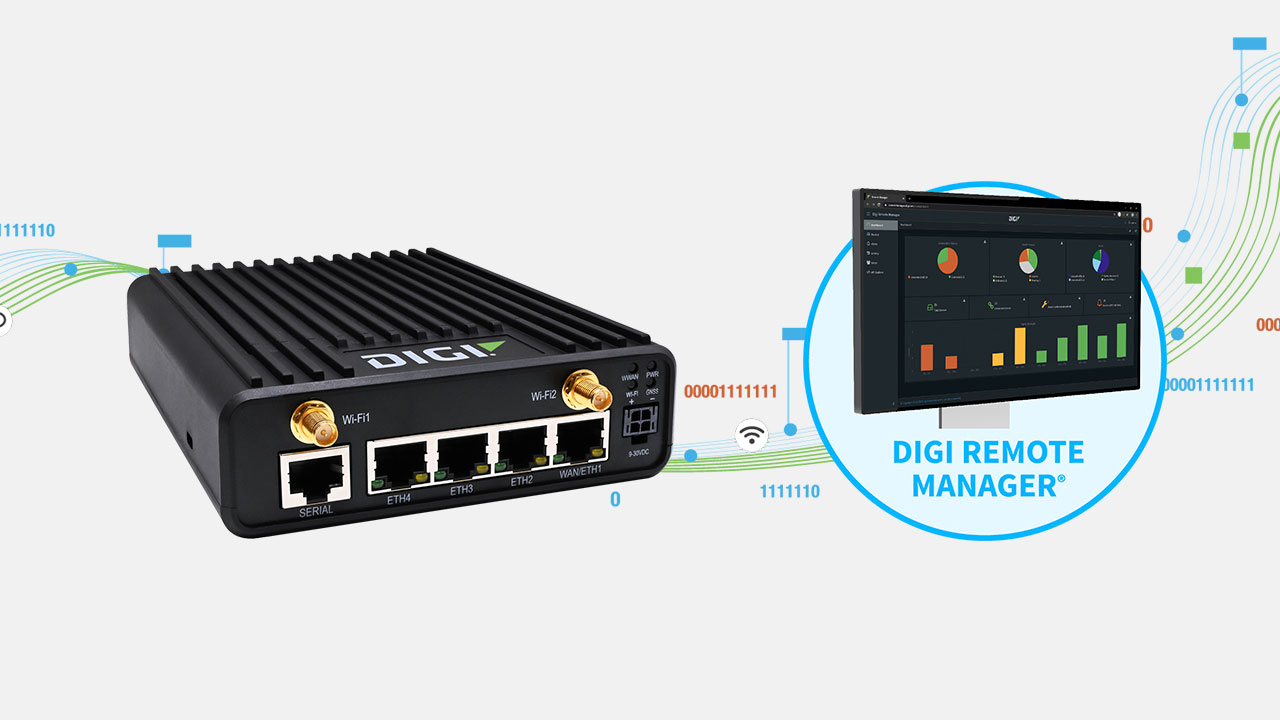
A Transportation Router Designed for Real Vehicle Environments
Vehicles present some of the most challenging networking environments: vibration, extreme temperatures, unstable power, and constant mobility across cellular networks.
The Digi TX65 family is engineered to meet those conditions while delivering the bandwidth and intelligence modern fleets require.
Key capabilities include:
- 5G eMBB connectivity with LTE fallback
- Tri-band dual concurrent Wi-Fi 7 support for high-capacity passenger or vehicle networks
- Integrated GNSS with NMEA and TAIP forwarding
- 1× 2.5 GbE WAN/LAN + 4× 1 GbE LAN ports
- RJ50 serial (RS232/RS485) for legacy telematics
- Vehicle-grade power design (9–36 V Molex with ignition sense)
- Containerized edge compute on Digi Accelerated Linux (DAL)
This architecture allows fleets to replace multiple devices — router, switch, serial adapters, and gateways — with a single rugged platform, reducing points of failure and simplifying installation.

Built for Fleet Uptime and Operational Resilience
Connectivity downtime in transportation operations can disrupt everything from passenger services to mission-critical telemetry.
The TX65 platform is designed to maximize uptime with vehicle-aware engineering:
- Ignition-aware power management
- Reverse polarity protection
- Dual power inputs (Molex + locking USB-C)
- Vehicle-grade thermal tolerance from −40 °C to +75 °C
- Rugged metal enclosure with heatsink design
For fleets that need resilient, always-on connectivity, Digi TX65 offers Dual SIM Dual Standby (DSDS): the router actively monitors a secondary carrier SIM while operating on the primary, enabling proactive, carrier-aware failover that swaps only when the secondary carrier is available and fails back when the primarily back online.
For the highest-availability deployments, the TX65-5B5A-2N model steps up to dual-modem operation. With two cellular modems running concurrently, fleets gain both greater aggregate throughput and true hardware-level redundancy: the two carrier connections operate at the same time, so a failure on one path has no impact on the other. This delivers carrier diversity, higher combined bandwidth, and seamless failover for the most demanding mission-critical applications.
Consolidating the Vehicle Networking Stack
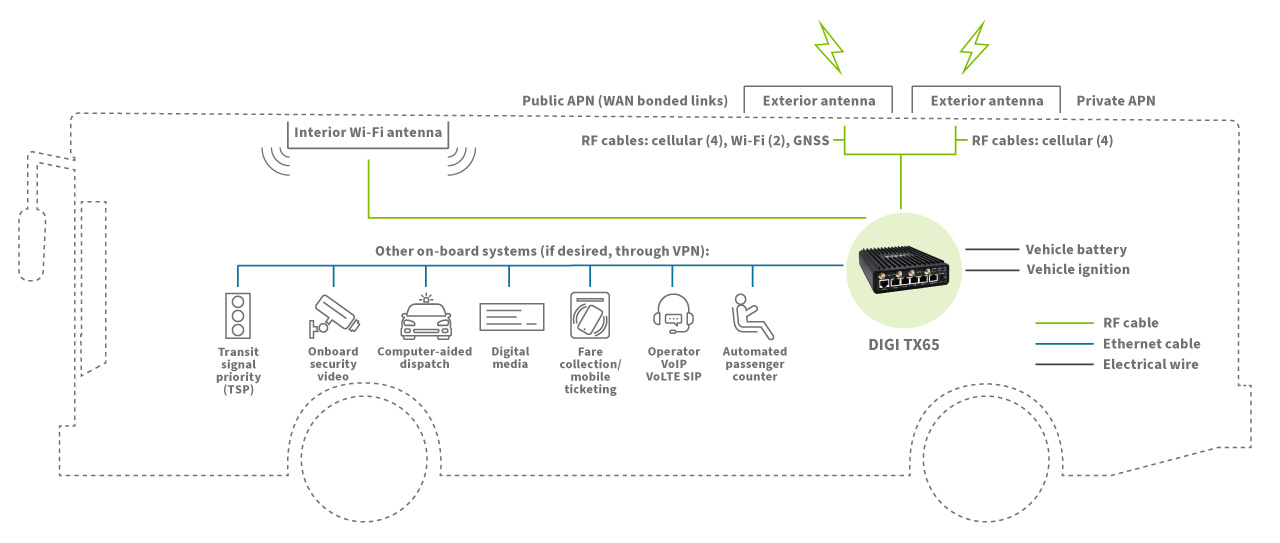
Many vehicle deployments today rely on a fragmented collection of devices: routers, Ethernet switches, serial converters, and GNSS modules. This increases installation complexity and maintenance overhead.
Digi TX65 simplifies this architecture with:
- Multi-port Ethernet switching
- Integrated GNSS
- Serial connectivity for legacy systems
- High-performance 5G WAN
- Local edge compute capabilities
By consolidating these functions into one platform, organizations can:
- Reduce installation time
- Simplify wiring and spare parts management
- Lower total cost of ownership (TCO)
- Improve overall system reliability
Edge Intelligence Inside the Vehicle
Connected vehicles are generating increasing volumes of data — video streams, telemetry, diagnostics, and passenger usage analytics.
Rather than sending all of that data to the cloud, Digi TX65 supports containerized edge applications using Digi Accelerated Linux (DAL).
This enables fleets to run local workloads such as:
- Video preprocessing
- Telemetry filtering
- Edge analytics
- Operational automation
Processing data closer to its source reduces bandwidth consumption, lowers cloud costs, and enables faster operational decision-making.
A Complete Connectivity Solution with Digi 360
Connectivity hardware alone is not enough to operate large-scale fleets and city-wide traffic management installations. Devices must be deployed, monitored, updated, and secured throughout their lifecycle.
That’s why Digi TX65 is delivered as part of the Digi 360 solution, combining hardware, software, lifecycle management, and expert support.
Digi Remote Manager (DRM)
At the center of Digi 360 is Digi Remote Manager, Digi’s cloud-based device management platform.
With DRM, fleet operators can: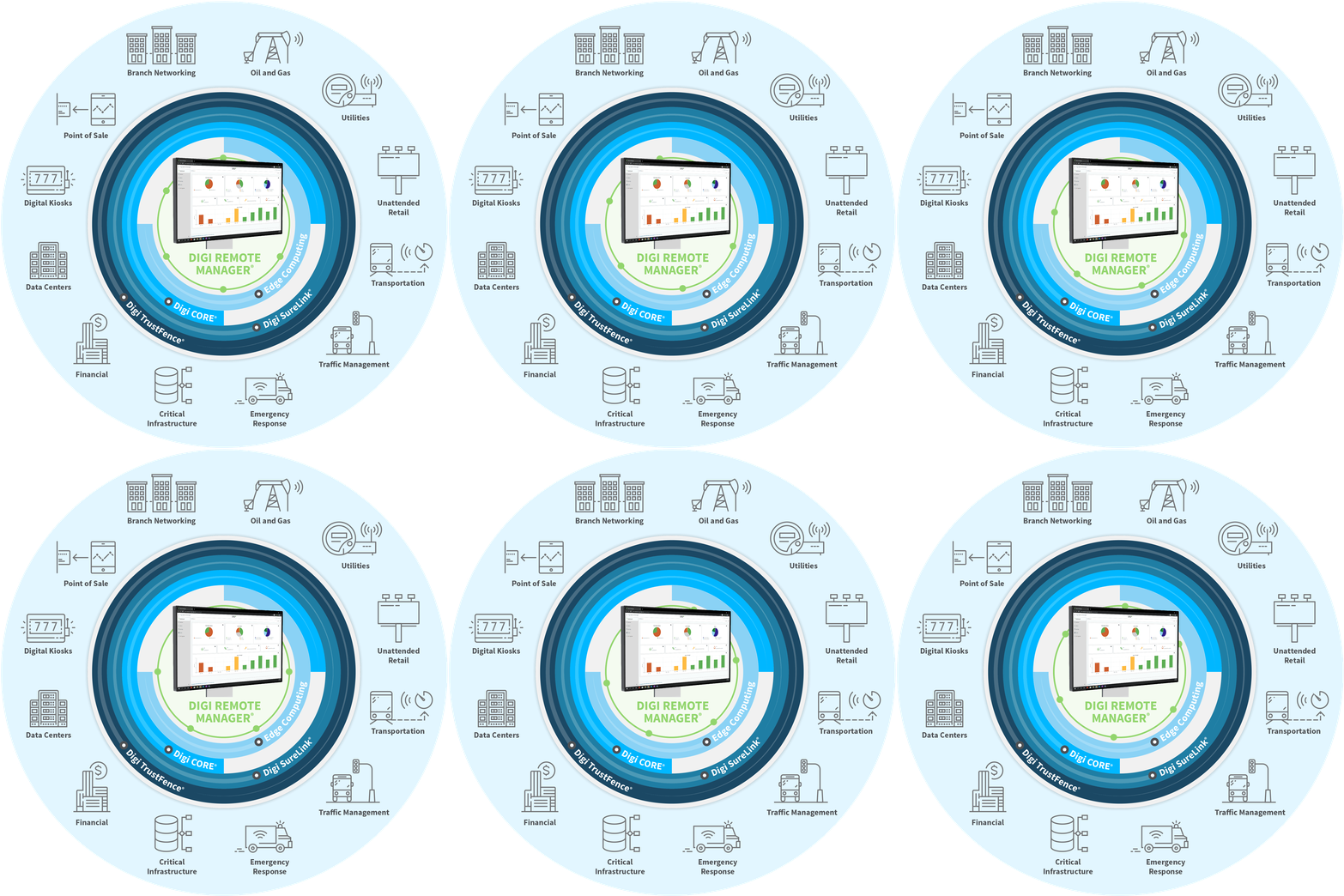
- Provision devices remotely
- Configure firmware, APNs, and policies
- Monitor modem health and connectivity
- Track GPS location and routes
- Deploy edge applications and containers
- Perform remote diagnostics and troubleshooting
This centralized visibility helps organizations scale deployments from a handful of vehicles to thousands — while minimizing truck rolls and operational disruptions.
Industry-Leading Warranty and Customer Care
Digi 360 also includes industry-leading warranty coverage and expert customer support, ensuring fleets receive assistance throughout the lifecycle of their deployments.
Transportation customers benefit from:
- Extended warranty protection
- Access to Digi technical experts
- Deployment guidance and troubleshooting support
- Long-term lifecycle reliability
For organizations running mission-critical vehicle networks, this combination of hardware, management tools, and support services provides peace of mind and operational continuity.
Procurement-Ready for Public Sector and Transit Deployments
Public-sector fleets and transit agencies often face strict procurement requirements around security, sourcing, and certifications.
The TX65 family addresses these needs with:
- Western modem options
- TAA compliance, FTA Buy America, and a BABA compliant assembly path
- Carrier certifications for North America (PTCRB, FirstNet, T-Mobile, Verizon)
- Secure boot, secure element, and SBOM/VEX support
- FIPS 140-3 validation for cryptographic security compliance
This ensures the platform can be deployed across government, public transit, and regulated transportation environments.
Digi TX65 Family Overview
The TX65 transportation platform is available in multiple configurations to support different vehicle networking needs:
- TX65-5B-1N – Single modem, tri-band dual concurrent Wi-Fi 7, GNSS
- TX65-5B-2N – Single modem, two tri-band dual concurrent Wi-Fi 7 radios, GNSS
- TX65-5B5A-2N – Dual-modem, two tri-band dual concurrent Wi-Fi 7 radios, GNSS
Each model delivers the same rugged vehicle design and Digi 360 integration while allowing customers to select the configuration that best matches their connectivity requirements.
A New Platform for Connected Transportation
As transportation systems become increasingly digital, the need for reliable, scalable, and manageable connectivity continues to grow.
Digi TX65 brings together high-performance 5G networking, rugged vehicle engineering, edge computing, and centralized lifecycle management through Digi 360.
The result is a platform designed not just to connect vehicles — but to simplify operations, improve uptime, and future-proof fleet connectivity.
Digi TX65 Transportation Router — Frequently Asked Questions
What is the Digi TX65 transportation router?
Digi TX65 is a rugged 5G router designed specifically for connected vehicle environments such as commercial fleets, transit vehicles, and mobile service vehicles.
It consolidates multiple vehicle networking functions into a single, compact platform, delivering high-speed 5G connectivity, integrated Wi-Fi, GNSS positioning, Ethernet switching, serial connectivity for telematics systems, and edge compute capabilities.
Digi TX65 is designed to support modern vehicle applications such as passenger Wi-Fi, fleet telemetry, video systems, fare collection, and driver communication platforms.
What types of vehicles is Digi TX65 designed for?
Digi TX65 is designed for a wide range of transportation environments, including:
- Commercial trucking fleets
- Police, fire and ambulance
- Delivery and logistics vehicles
- Public transit buses
- Light rail and rail systems
- Municipal and public safety vehicles
- Service fleets (utilities, field service, maintenance)
Its rugged design supports vehicle operation across extreme temperatures and challenging power conditions commonly found in transportation deployments.
What are the most common use cases for Digi TX65?
The Digi TX65 transportation router supports a variety of connected vehicle applications, including:
Passenger connectivity
- Passenger Wi-Fi for buses and transit systems
- Internet access for riders and onboard staff
Fleet operations
- Real-time vehicle telemetry
- GPS location tracking
- Fleet diagnostics and remote monitoring
Safety and video systems
- Uploading security camera footage
- Video streaming to fleet management platforms
Payment and fare systems
- Connectivity for fare validators and ticketing devices
- Real-time transaction validation
Driver productivity
- Driver tablets and dispatch communication
- Electronic logging devices (ELD)
Traffic management systems
- Connectivity for intersections, video monitoring and ITS/V2X applications
- Integration of traffic controllers and edge computing applications to help optimize signal timing, reduce congestion, and adapt to changing traffic conditions
By supporting multiple applications on a single platform, Digi TX65 helps simplify in-vehicle networking.
How does Digi TX65 simplify vehicle installations?
Many vehicle deployments rely on several separate devices such as routers, switches, and serial adapters. This increases installation time, wiring complexity, and potential points of failure.
Digi TX65 simplifies installations by integrating these functions into a single device:
- High-speed 5G cellular connectivity
- Multiple Ethernet LAN ports for onboard systems
- Wi-Fi connectivity for passengers and devices
- Serial connectivity for legacy telematics equipment
- Integrated GNSS for location tracking
This consolidation reduces installation complexity, speeds deployment, and simplifies spare device management.
How is Digi TX65 deployed in vehicles?
Deployment of the Digi TX65 transportation router is designed to be straightforward and fleet-friendly.
Typical installation steps include:
- Mount the router inside the vehicle using standard mounting brackets.
- Connect vehicle power using the Molex vehicle power connector.
- Attach antennas for cellular, Wi-Fi, and GNSS.
- Connect onboard systems such as cameras, tablets, and fare systems via Ethernet or serial.
- Activate the device, which automatically connects to the management platform.
Once powered on, the device can automatically retrieve configuration settings and begin operating.
Can fleets deploy and configure Digi TX65 devices remotely?
Yes. Digi TX65 integrates with Digi Remote Manager (DRM), Digi’s cloud-based device management platform.
Using Digi Remote Manager, organizations can:
- Configure devices before deployment
- Apply firmware updates remotely
- Monitor connectivity and device health
- Track GPS location and routes
- Push software updates and edge applications
- Troubleshoot devices without visiting the vehicle
This centralized management capability helps organizations scale deployments efficiently while reducing maintenance costs.
How does Digi Remote Manager help manage large-scale mobile router deployments in transit and fleet environments?
Digi Remote Manager (DRM) is a cloud-based platform that provides secure, centralized management for Digi networking devices, making it especially valuable for complex deployments such as mobile routers used in transit systems and vehicle fleets.
For transportation operators managing hundreds or thousands of connected vehicles, DRM enables teams to:
- Provision devices at scale before or after installation
- Monitor connectivity and modem performance across the fleet
- Track GPS location data and vehicle routes
- Apply and enforce configuration policies across all devices
- Deploy firmware updates and edge applications remotely
- Diagnose and troubleshoot connectivity issues without a truck roll
By providing a single interface for monitoring and managing distributed devices, Digi Remote Manager helps transit agencies and fleet operators maintain visibility, improve operational efficiency, and keep connected vehicle systems running reliably.
Does Digi TX65 support edge computing?
Yes. Digi TX65 supports containerized applications that can run directly on the device.
This allows fleets and roadside applications to process data locally rather than sending all information to the cloud.
Common edge use cases include:
- Filtering telemetry data before sending it upstream
- Preprocessing video feeds
- Running operational analytics
- Supporting industrial IoT applications
Edge computing can reduce bandwidth usage, lower cloud costs, and enable faster operational responses.
How does Digi TX65 help improve fleet uptime?
Digi TX65 is designed specifically for vehicle environments, with features that improve operational reliability.
These include:
- Ignition-aware power behavior
- Protection against vehicle power fluctuations
- Rugged construction designed for vibration and temperature extremes
- Optional Dual SIM Dual Standby (DSDS) redundancy for failover connectivity, which allows TX65 to actively monitor a secondary carrier SIM while using the primary carrier for intelligent failover and can monitor when the primary carrier is back online to avoid blind failback
These capabilities help ensure that critical applications remain connected even in demanding operating conditions.
How does Digi TX65 help reduce operational costs?
Digi TX65 reduces operational costs in several ways:
Simplified hardware
- Replaces multiple devices with a single platform
Remote management
- Reduces the need for on-site maintenance visits
Edge computing
- Lowers cloud bandwidth and storage costs
Centralized lifecycle management
- Simplifies updates and device maintenance
Together, these benefits help lower the total cost of ownership for fleet connectivity deployments.
What support services are included with Digi TX65?
Digi TX65 is delivered as part of the Digi 360 solution, which includes:
- Digi Remote Manager for device management
- Industry-leading warranty coverage
- Access to Digi technical support experts
- Long-term lifecycle reliability
This combination of hardware, software, and support services helps organizations deploy and operate connected vehicle networks with confidence.
How can organizations get started with Digi TX65?
Organizations typically begin by identifying their key connectivity requirements, such as:
- Passenger Wi-Fi
- Telematics connectivity
- Video systems
- Fleet management platforms
From there, systems integrators or Digi partners can help design the vehicle networking architecture and deploy TX65 devices across the fleet.
Once installed, devices can be managed and monitored through Digi Remote Manager for ongoing operations.
Next Steps