Meet Digi IX25, a purpose-built industrial router for enterprises and critical infrastructure that require secure, reliable, always-on connectivity. Designed primarily for utilities, energy, manufacturing, transportation, and distributed retail networks, IX25 combines rugged hardware, advanced routing, and containerized edge intelligence in a single platform.
Digi IX25 is offered in five models that share a common architecture, providing flexible options for LTE, 5G RedCap, and 5G eMBB connectivity to meet diverse deployment needs. From SCADA and telemetry in the field to branch failover and private LTE/5G deployments, Digi IX25 delivers industrial-grade reliability with enterprise-class routing, while reducing portfolio complexity and lowering costs.
What Are the Challenges Digi IX25 Solves?
In many organizations, customer IT/OT teams often must patch together multiple low-end or over-featured cellular routers, typically adding external switches or accessories when outfitting cabinets and kiosks with several Ethernet devices. The challenges include:
- Insufficient ports requiring extra hardware — Devices with only one or two Ethernet ports often require external switches, adding wiring complexity, space constraints, and cost.
- Temperature and durability limitations — Enterprise-oriented models rated 0 to 40 °C are unsuitable for utility cabinets and industrial environments that demand −40 °C to +75 °C operation.
- Portfolio spread — In the case of Digi’s solutions, overlapping legacy SKUs increase complexity. Digi IX25 offers a consolidation strategy to simplify decision making and deployment strategies.
Digi IX25 offers a rugged, cost-optimized, four-port TAA-compliant platform with integrated edge computing, supporting LTE Cat 4, 5G RedCap, and 5G eMBB cellular technologies with four 1 GbE ports (1× WAN/LAN + 3× LAN), locking USB-C, serial, GNSS and optional Wi-Fi 6E, and central fleet control via Digi Remote Manager (DRM).
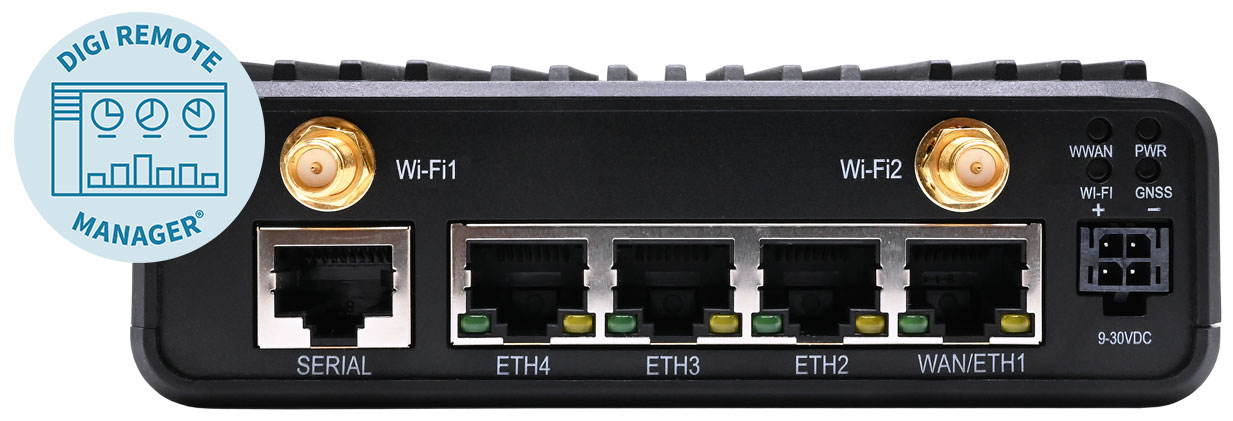
Digi IX25 is purpose-built for critical use cases — from predictive maintenance, asset monitoring, machine control, and smart manufacturing to branch failover, unattended retail, lottery machines, ATM, POS, digital signage, and traffic management. Digi IX25 delivers always-on secure connectivity with industrial-grade reliability and enterprise-class flexibility to address the majority of industrial and enterprise use cases while reducing SKUs, installation time, and lifecycle costs.
Why Digi IX25 is the Right Choice Compared to Other Alternatives
- Ports and simplicity — Offers 4x Ethernet, reducing external switches and points of failure.
- Rugged mechanical design — Operates -40 °C to +75 °C with industrial certifications (MIL-STD, IP30, C1D2/ATEX).
- Cost — Digi IX25 costs are at or below comparable competitive offerings.
- Management and security — It includes DRM and DAL OS (Digi Accelerated Linux operating system) support plus the Digi TrustFence framework to align with existing ops practices.
- Rugged, secure, and reliable — A four-port industrial cellular IoT router reduces total installed cost by eliminating add-on switches or PLCs. It simplifies fleet operations with Digi Remote Manager and standardizes deployments across both utility and retail footprints — all without compromising temperature ratings, certifications, or product longevity.
- Trusted and compliant — Built with a Western cellular module and manufactured in a TAA-compliant country, Digi IX25 supports supply-chain transparency and regulatory compliance.
- Future-ready and flexible — Supports a growing ecosystem of modular accessories to meet evolving needs, including additional serial ports, expanded Ethernet, fiber (SFP) connectivity, remote reboot capability, and more.
Built for Trust: IX25 Security and Compliance
Digi IX25, combined with Digi Remote Manager, is built to meet the highest security and compliance standards required by enterprise and critical infrastructure deployments. The solution supports FIPS 140-3 validated cryptography, ensuring robust protection of sensitive data in transit and at rest, while Digi Remote Manager is compliant with SOC 2 Type 2 standards, providing independently audited assurance of security, availability, and data integrity. At the device level, Digi TrustFence strengthens protection through secure boot, centralized certificate management, and encrypted storage, helping safeguard devices from tampering and unauthorized access. Together, these capabilities enable organizations to confidently deploy and manage secure, scalable IoT networks in even the most demanding environments.
Product/Platform Description
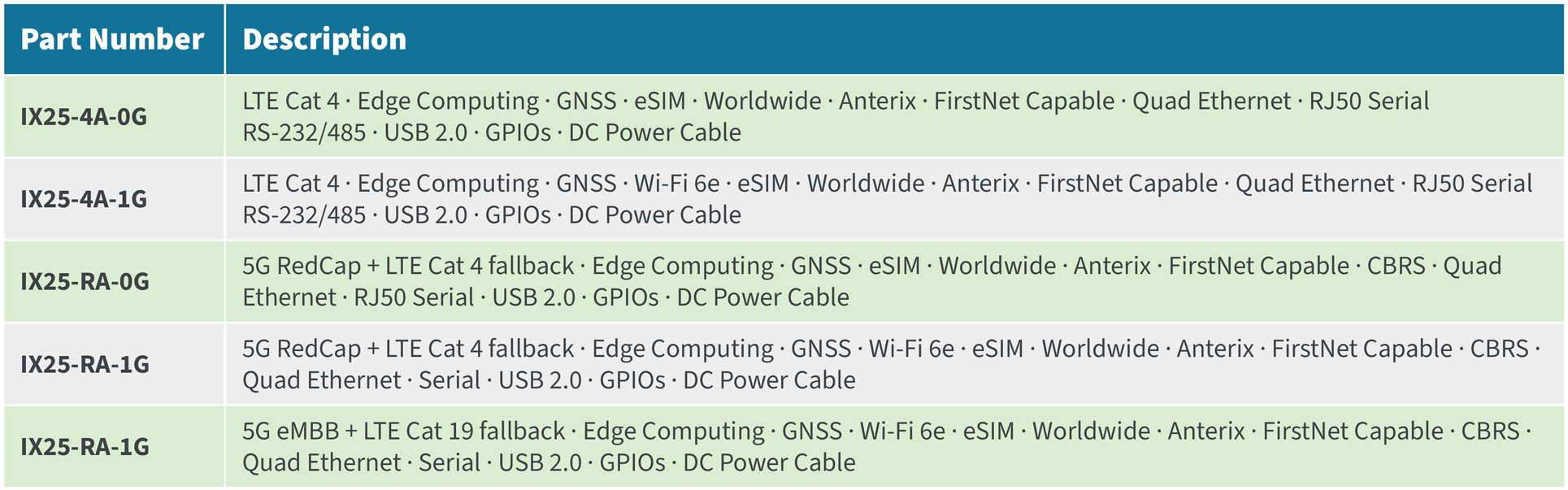
The IX25 platform is built for flexibility and cost efficiency, with five SKUs sharing a common PCB, BOM, and mechanical design. This unified architecture drives economies of scale, reduces supply-chain risks, enhances production agility, and lowers costs. At launch, the portfolio includes LTE routers in both cellular-only and cellular + Wi-Fi variants, 5G RedCap routers in both cellular-only and cellular + Wi-Fi variants, and a 5G eMBB router available exclusively as a Wi-Fi variant.
Designed for mission-critical deployments, Digi IX25 combines hardened environmental protection with versatile integration options including four GigE Ethernet ports, a serial port, dual nano SIMs, and an eSIM with eUICC support. Through DRM, customers can deploy custom applications via Linux containers, enabling advanced IIoT platforms such as Ignition Edge by Inductive Automation, eACM by Autosol, AWS IoT Core, AWS IoT Greengrass, Microsoft Azure, and more. Powered by DAL OS and seamlessly integrated with Digi RM, Digi IX25 delivers an end-to-end, secure, and scalable solution that ensures long-term value and deployment flexibility as customer needs evolve.
Digi IX25 strikes the optimal balance of performance, scalability, and affordability, making it a compelling choice for diverse industrial and enterprise connectivity applications.
Router SKUs — Digi 360 Cellular Solution Package (1 Year)
The Critical Importance of Edge Computing
Edge computing is an essential capability of the Digi IX25 platform, delivering key benefits that improve performance, efficiency, and operational effectiveness.
- Reduced latency: Edge computing processes data closer to its source, minimizing the time it takes for information to travel back and forth. This reduced latency ensures quicker decision-making and faster responses in time-sensitive applications.
- Bandwidth optimization: By processing data locally, edge computing filters out unnecessary information before sending relevant data to the cloud. This optimization conserves bandwidth, reduces data transmission costs, and eases the burden on the network.
- Improved reliability: Edge computing allows critical applications to continue functioning even if the cloud connection is lost temporarily. This ensures uninterrupted operations, preventing costly downtime in industrial environments.
- Enhanced security: With edge computing, sensitive data remains within the industrial premises, reducing exposure to external threats. This local processing adds an extra layer of security and helps protect against potential cyberattacks.
- Compliance and privacy: Edge computing addresses data compliance and privacy concerns by keeping sensitive information within the organization's control and locality. It ensures adherence to regulatory requirements and avoids data sovereignty issues.
- Scalability and flexibility: The distributed architecture of edge computing enables easy deployment of Industry 4.0 applications in various locations with specific needs. This scalability and flexibility allow businesses to adapt quickly to changing requirements.
- Cost efficiency: Edge computing minimizes data transmission costs and cloud service expenses by processing and storing data locally. This cost-efficient approach positively impacts the bottom line.

What Industries and Applications Does Digi IX25 Support?
Digi IX25 is designed for optimal flexibility to support a broad range of use cases with one rugged, integrated platform. IX25 offers both LTE and 5G connectivity, as well as integrated edge computing, and a lifecycle designed for extended deployments. With TAA-compliant Western cellular modules, it is an excellent choice for public, private and hybrid cellular networks.
Additionally, it is fully integrated with Digi Remote Manager and Digi Artificial Network Intelligence (DANI), enabling organizations to operate their networks more intelligently at scale.
The platform includes a 5G RedCap variant to provide customers with the flexibility to get the right solution to meet their cost, performance and functionality needs.
Utilities
With 5G connectivity, Digi IX25 enables advanced monitoring and control of energy and utilities infrastructure by leveraging high-speed, low-latency networks for real-time management of power grids, water distribution systems, and renewable energy sources. This enables efficient grid optimization, proactive maintenance, and rapid response to outages or emergencies, ensuring reliable and sustainable utility services. Some of the use cases include:
- Smart grid distribution automation: Grid operators rely on cellular routers to communicate with remote substation equipment, SCADA systems, reclosers, capacitor banks, and other transmission equipment.
- Demand response and consumer engagement: Smart energy management and demand response systems enable energy device control and the real-time measurement and verification necessary for demand response applications.
- Commercial and industrial metering: Digi IX25 provides an industrial connectivity solution for commercial and industrial metering systems, supporting automation and remote management.
- Renewable energy: Wind, solar, and hydropower installations benefit from industrial connectivity and remote monitoring, including the ability to assess device health in the field and send technicians and truck rolls only when repairs are needed.
- Real-time monitoring: Managing and maintaining various infrastructure components, such as power grids, water distribution systems, and remote facilities requires an integrated solution like Digi IX25 with Digi Remote Manager. It empowers utility companies with valuable insights into their operations, enhances overall efficiency, reduces downtime, improves security, enables proactive maintenance, and ensures compliance with environmental regulations. Examples include remote equipment monitoring, data telemetry and SCADA, security and surveillance, environmental monitoring, predictive maintenance, and emergency response and disaster recovery.
- Remote control: Utilities can efficiently manage and control their infrastructure and assets from a central location. This capability enhances operational flexibility, minimizes response times, optimizes resource utilization, and contributes to overall system reliability and performance. Examples include remote equipment control, grid management, valve and pump control, SCADA integration, security and safety applications, load balancing, and demand response.
- Distributed Energy Resource Management System (DERMS): DERMS serve as the central nervous system for the modern energy grid, allowing for the efficient management of distributed energy resources, grid stability, resilience, and the integration of renewable energy sources. These systems are vital in optimizing the integration and operation of various DERs, such as solar panels, wind turbines, energy storage systems, and electric vehicle chargers. Some of the use cases include DER integration, real-time monitoring, load forecasting, optimal dispatch, grid stability, demand response, smart grid integration, asset optimization, and fault detection and self-healing.
- Supervisory Control and Data Acquisition (SCADA): This critical technology is used by utilities to monitor and control various aspects of their operations, particularly in the management of energy production, distribution, and infrastructure. It provides real-time monitoring, control, data acquisition, and historical data storage, making it an essential technology for maintaining the safety and reliability of utility infrastructure. Digi IX25 supports real-time monitoring, data acquisition, remote control, alarm management, data visualization, historical data storage, load management, energy efficiency, water and wastewater management, and cybersecurity applications.

Oil and Gas
Upstream, midstream, and downstream oil and gas operations depend on highly distributed, mission-critical infrastructure. From wellheads and compressor stations to pipelines, refineries, and storage facilities, reliable and secure connectivity is essential. Industrial cellular routers deliver resilient communication in remote and hazardous locations, ensuring operational efficiency, worker safety, and regulatory compliance. By enabling real-time data exchange, control, and automation, cellular routers empower oil and gas operators to optimize production, reduce downtime, and respond rapidly to incidents. Digi IX25 routers can help in several key use-cases:
- Pipeline and field automation: Operators rely on cellular routers to connect remote well sites, pumping stations, compressor stations, and block valves to central control systems. This connectivity supports pipeline monitoring, leak detection, cathodic protection, and automated shutdown systems.
- Drilling and production monitoring: Real-time data from drilling rigs, production equipment, and artificial lift systems is transmitted via cellular routers to SCADA platforms. This enables continuous optimization of drilling operations, production flow rates, and equipment utilization.
- Asset integrity and safety systems: Oil and gas facilities must maintain strict safety and compliance standards. Routers certified for hazardous environments (C1D2/ATEX) connect gas detectors, flame sensors, and emergency shutdown systems to central safety controllers. This ensures quick detection and immediate response to safety-critical events.
- Real-time monitoring: Monitoring is essential for maintaining operational safety and efficiency in upstream, midstream, and downstream assets. Industrial cellular routers enable secure and always-available connections across harsh environments. This includes remote equipment monitoring, pipeline monitoring and leak detection, SCADA data telemetry, security and surveillance, environmental-conditions monitoring, predictive maintenance, and emergency responses
- Remote control: Remote control is vital for maintaining operational continuity and safety across oil and gas infrastructure. With industrial cellular routers in place, operators can manage and control distributed assets from central control rooms or mobile operations centers. Digi IX25 can help with valve and pump control, well site automation, compressor station control, SCADA integration, and safety and emergency shutdowns.
- SCADA: Oil and gas SCADA systems control upstream, midstream, and downstream processes, including drilling operations, production fields, pipelines, and refineries. Industrial cellular routers serve as the communications layer, supporting real-time monitoring, data acquisition, remote control of pump operations and refinery processes, alarm management, data visualization and storage, and cybersecurity.

Enterprise and Distributed Retail/Branch Operations
Enterprises with large numbers of distributed branch locations — such as retailers, quick-service restaurants (QSRs), banks, and service organizations — require always-on, secure, and cost-efficient connectivity to maintain business continuity. To support POS systems, kiosks, digital signage, and IoT devices, these organizations depend on resilient branch connectivity, secure failover, and increasingly, private LTE/5G deployments.
Traditional wireline connections are often supplemented or replaced by cellular to reduce downtime, enhance security, and accelerate digital transformation initiatives. Digi IX25 helps these organizations with a variety of challenges: branch and failover connectivity; POS, ATMs, and payment systems; unattended retail, smart kiosks, and lottery machines, digital signage and in-store media; building automation and security; private LTE/5G deployments; and temporary and mobile sites for pop-up stores, seasonal branches, and construction offices that need cellular-first connectivity.

Industry 4.0
Industry 4.0 refers to integrating advanced digital technologies into industrial processes to create "smart factories" and enhance productivity, efficiency, and connectivity across the entire value chain. 5G technology plays a crucial role in enabling the realization of Industry 4.0 by providing high-speed, low-latency, and reliable wireless connectivity.
The deployment of 5G industrial cellular routers facilitates seamless data transfer, enables real-time communication, and supports automation and intelligent decision-making. Digi IX25 is an excellent choice for the following areas of Industry 4.0 applications:
- Manufacturing process automation: With 5G connectivity, the IX25 cellular router enables ultra-low latency and high-bandwidth communication, facilitating real-time monitoring, control, and optimization of manufacturing processes.
- Industrial automation and control: Digi IX25 provides a robust wireless infrastructure, unlocking the full potential of smart factories. The low latency and high capacity of 5G enable real-time data exchange between machines, robots, and control systems, empowering seamless integration and enabling rapid decision-making for improved operational efficiency and productivity.
- Precision monitoring: These systems leverage data from various machines, processes, and systems to dynamically adjust the manufacturing process. This involves analyzing vast amounts of data for precise monitoring and control of manufacturing assets. Edge computing is essential for collecting, aggregating, and filtering the data before sending it to a central server.
- Condition-based monitoring: Manufacturers often struggle to gather and analyze data from their machines, processes, and systems due to the lack of compatibility between different proprietary systems used in plants. Extracting data from multiple machines in a factory generates a large volume of raw data. Edge computing enables manufacturers to filter and reduce the data before sending it to a central server.
- Predictive maintenance: Data analytics help detect potential machine failures in advance and conducting maintenance before a breakdown occurs. Despite being a concept in the industry for some time, manufacturers have struggled to implement it effectively. The limitations include the inadequate measurement of variables and the immaturity of machine learning platforms in generating meaningful insights. Edge computing assists in processing data near the device, avoiding data transportation costs to remote clouds and ensuring reliable data access.
- Advanced robotics: Robotics today support improved efficiency, reduced costs, and optimized industrial processes in various sectors. As technology continues to advance, these applications are likely to expand further, revolutionizing the way industries operate.
- Robots — In Industry 4.0, robots are employed for tasks that require precision and consistency, such as assembling delicate electronic components, welding, and 3D printing. These robots are equipped with advanced sensors and vision systems to ensure accurate execution and can work tirelessly without the need for breaks, leading to increased production efficiency and reduced errors.
- Cobots — Cobots work safely alongside humans to enhance productivity. In an Industry 4.0 scenario, cobots can assist workers in assembling complex products, handling heavy objects, or performing repetitive actions. The cobots' sensors detect human presence and adjust their movements accordingly, creating a safer and more efficient working environment.

Smart Cities
Smart cities today are connecting citywide systems, utilities, traffic systems and other infrastructure with cameras, sensors and central incident management to improve efficiency and emergency response. Here are two important use-cases:
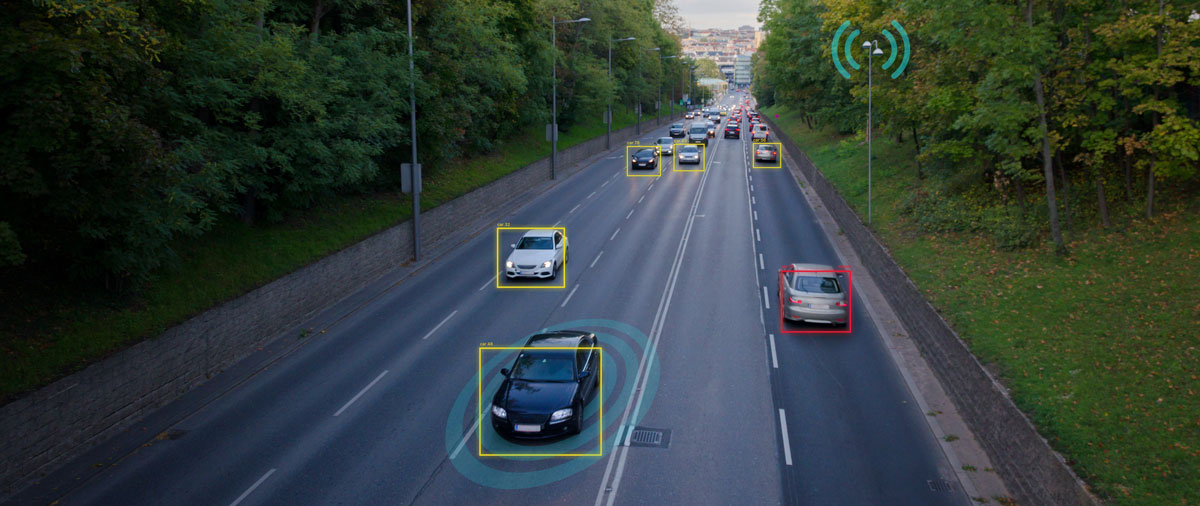
- Traffic management: Transportation routers support real-time communication between traffic control centers, surveillance cameras, and intelligent transportation systems. Support applications such as traffic monitoring, congestion management, intelligent signal control, and automated toll collection.
- Digital signage: The Digi IX25 cellular router expands the capabilities and versatility of the signage systems, enabling faster connectivity, real-time updates, high-quality media, remote management, and interactive experiences.
To learn more about Digi IX25, visit the solution page or contact us to reach a Digi expert.
Frequently Asked Questions (FAQ) — Digi IX25 Industrial Cellular Router
What is the Digi IX25 industrial cellular router?
Digi IX25 is a rugged, industrial-grade cellular router designed for mission-critical applications in utilities, energy, manufacturing, transportation, smart cities, and distributed retail environments. It combines secure 4G LTE, 5G RedCap, or 5G eMBB connectivity with four Gigabit Ethernet ports, edge computing, and centralized cloud management via Digi Remote Manager® (DRM).
It is purpose-built for secure, always-on connectivity in harsh environments ranging from −40 °C to +75 °C.
What industries is Digi IX25 designed for?
Digi IX25 is optimized for:
- Utilities (smart grid, SCADA, DERMS, distribution automation)
- Oil and gas (pipeline monitoring, compressor stations, hazardous sites)
- Manufacturing and Industry 4.0 (robotics, predictive maintenance, automation)
- Enterprise and retail (branch failover, POS, ATMs, kiosks, digital signage)
- Transportation and smart cities (traffic systems, surveillance, connected infrastructure)
It supports both industrial operational technology (OT) and enterprise IT deployments.
What cellular technologies does Digi IX25 support?
Digi IX25 is available in five models supporting:
- LTE Cat 4
- 5G RedCap (with LTE Cat-4 fallback)
- 5G eMBB (with LTE Cat 19 fallback)
All models include dual SIM capability, eSIM with eUICC support, and are FirstNet Capable and CBRS-ready (model dependent).
What makes Digi IX25 different from enterprise cellular routers?
Unlike enterprise routers rated for office environments (0–40 °C), Digi IX25 is designed for harsh industrial conditions:
- Operating temperature: −40 °C to +75 °C
- Industrial certifications including MIL-STD, IP30, C1D2, and ATEX
- Four integrated Ethernet ports (reduces need for external switches)
- Industrial serial connectivity (RS-232/485)
- GNSS for location-based applications
It is engineered specifically for cabinets, kiosks, substations, and remote field deployments.
How does Digi IX25 reduce total cost of ownership (TCO)?
Digi IX25 lowers deployment and lifecycle costs by:
- Eliminating external Ethernet switches with four built-in ports
- Consolidating multiple legacy SKUs
- Supporting remote configuration and monitoring through Digi Remote Manager
- Enabling containerized edge applications to reduce cloud data costs
- Offering a shared hardware architecture across five SKUs to simplify standardization
This reduces installation time, field service complexity, and inventory management overhead.
Does Digi IX25 support edge computing?
Yes. Digi IX25 supports Linux container-based edge computing powered by Digi Accelerated Linux (DAL OS).
Organizations can deploy applications such as:
- Ignition Edge
- AWS IoT Core and Greengrass
- Microsoft Azure IoT
- eACM by Autosol
- Custom containerized applications
Edge computing improves latency, reliability, bandwidth efficiency, data privacy, and operational continuity during WAN outages.
How is Digi IX25 managed?
Digi IX25 integrates with Digi Remote Manager (DRM), a centralized cloud platform that enables:
- Secure device provisioning
- Remote configuration and firmware updates
- Real-time monitoring and alerting
- Application deployment and lifecycle management
- Fleet-wide policy enforcement
This simplifies large-scale industrial and retail deployments.
Is Digi IX25 secure?
Yes. Digi IX25 incorporates multiple layers of security:
- Digi TrustFence security framework
- Secure boot and encrypted firmware
- FIPS 140-3 verified
- SOC 2 Type 2 attestation
- VPN support
- Role-based authentication
- Secure cloud management through DRM
- Western-sourced cellular module
- TAA-compliant manufacturing
It is designed for critical infrastructure and regulated environments.
Can Digi IX25 be used for private LTE or 5G networks?
Yes. Digi IX25 supports:
- CBRS deployments
- Anterix spectrum
- Private LTE and private 5G networks
This makes it suitable for utilities, campuses, industrial sites, and enterprises deploying private wireless infrastructure.
What connectivity interfaces are included in the Digi IX25 platform?
Digi IX25 includes:
- 4× 1 GbE Ethernet ports (1 WAN/LAN + 3 LAN)
- RJ50 serial (RS-232/485)
- USB 2.0 (locking USB-C power interface)
- GNSS
- GPIO
- Optional Wi-Fi 6E
- Dual nano SIM + eSIM (eUICC)
What are common use cases for Digi IX25?
Common deployments include:
- SCADA communications
- Pipeline monitoring and leak detection
- Predictive maintenance
- Smart grid automation
- Branch failover
- POS and ATM connectivity
- Unattended retail kiosks
- Digital signage
- Traffic signal control
- Robotics and industrial automation
What is the importance of the Digi IX25 5G RedCap variant?
5G RedCap (Reduced Capability) is a cost-optimized 5G technology designed for industrial IoT and enterprise applications that do not require full 5G eMBB performance.
It provides:
- Lower power consumption
- Lower hardware cost
- Optimized throughput for IoT workloads
- 5G longevity and network evolution support
This makes it ideal for industrial automation, utilities, and retail deployments.
Where can I buy Digi IX25 or request a demo?
You can:
- Visit the Digi IX25 solution page
- Contact a Digi expert for architecture guidance
- Request pricing or managed service options (MPaaS or MCaaS)
- Speak with your Digi sales representative