For the United States, cybersecurity is all about resilience. That’s why the U.S. National Institute of Standards and Technology (NIST) maintains standards and guidelines, in particular for connected systems in use by the government and government contractors. The organization maintains the Federal Information Processing Standards (FIPS). The current version is
FIPS 140-3. The strategy aims to strengthen critical infrastructure, global cyberspace and U.S. intelligence against cyberattacks.
At a time when new technologies such as artificial intelligence and quantum computing offer both opportunities and threats, FIPS 140-3 has an important role to play in enhancing cybersecurity.
While this cybersecurity standard is employed by the U.S. and Canadian governments, anyone can adopt it. This article describes the purpose of this standard, as well as important use cases and recommend FIPS-validated products that can support your needs.
Jump to:
NIST developed the FIPS 140 standard to help protect sensitive government information from hackers. The organization provides FIPS 140-3 implementation guidance to ensure OEMs and others who produce and use connected systems that handle sensitive data fully understand the requirements and how to ensure compliance. FIPS 140-3 covers all cryptographic hardware, software and firmware that implements approved security functions.
In other words, for cryptographic modules to comply, they must integrate the features outlined in the standard. Therefore, if your cryptographic modules do not meet validation requirements, you cannot sell your solutions to the government. If you’re wondering what these requirements look like, here’s a brief overview.
FIPS 140-3 has 4 increasing security levels, which you can read about in our FIPS 140-3 Technical Brief.
FIPS 140-2 defines four increasing levels of security for cryptographic modules. Each level builds on the previous one, allowing organizations to choose the appropriate balance between cost, complexity, and security assurance based on their risk profile and regulatory requirements.
Level 1: Basic Cryptographic Security
FIPS 140-2 Level 1 provides the lowest level of security assurance. It requires the use of approved cryptographic algorithms but does not mandate physical security mechanisms beyond basic production-grade components.
Common characteristics include:
- Software-based cryptographic modules
- Approved encryption algorithms
- No physical tamper resistance
Typical use cases:
Non-critical applications where encryption is required but physical access is not a major threat, such as general IT infrastructure or internal applications.
Level 2: Tamper Evidence and Role-Based Authentication
Level 2 builds on Level 1 by introducing tamper-evident mechanisms and role-based authentication. This level helps detect unauthorized physical access to cryptographic components.
Common characteristics include:
- Tamper-evident coatings or seals
- Role-based authentication (e.g., user vs. administrator)
- Increased protection for cryptographic keys
Typical use cases:
Enterprise systems and network equipment where devices may be deployed in shared or semi-controlled environments.
Level 3: Tamper Resistance and Identity-Based Authentication
FIPS 140-2 Level 3 significantly enhances security by requiring tamper-resistant hardware and identity-based authentication. Physical attacks trigger mechanisms that prevent access to sensitive cryptographic material.
Common characteristics include:
- Strong physical tamper resistance
- Automatic zeroization of cryptographic keys upon tampering
- Identity-based authentication
- Separation between cryptographic interfaces and plaintext data
Typical use cases:
Government, defense, healthcare, and financial systems where sensitive data must remain protected even if devices are physically compromised.
Level 4: Highest Level of Physical Security
Level 4 offers the highest level of FIPS 140-2 assurance, protecting against a wide range of physical and environmental attacks. Cryptographic modules must detect and respond to abnormal conditions such as voltage, temperature, or environmental manipulation.
Common characteristics include:
- Active environmental failure protection
- Immediate key zeroization upon attack detection
- Protection against extreme physical intrusion attempts
Typical use cases:
Highly sensitive or classified environments where cryptographic compromise is unacceptable under any circumstances.
Ensuring that cryptographic modules (hardware and software) handling communications and data adhere to the FIPS 140-3 standard helps government agencies and government contractors alike conform to a standard framework for protecting data, operations, and assets against cyberthreats. In addition to the required government applications, other use cases include critical infrastructure, manufacturing, transportation and more. In the following section, we will dig into some use cases in government and beyond.
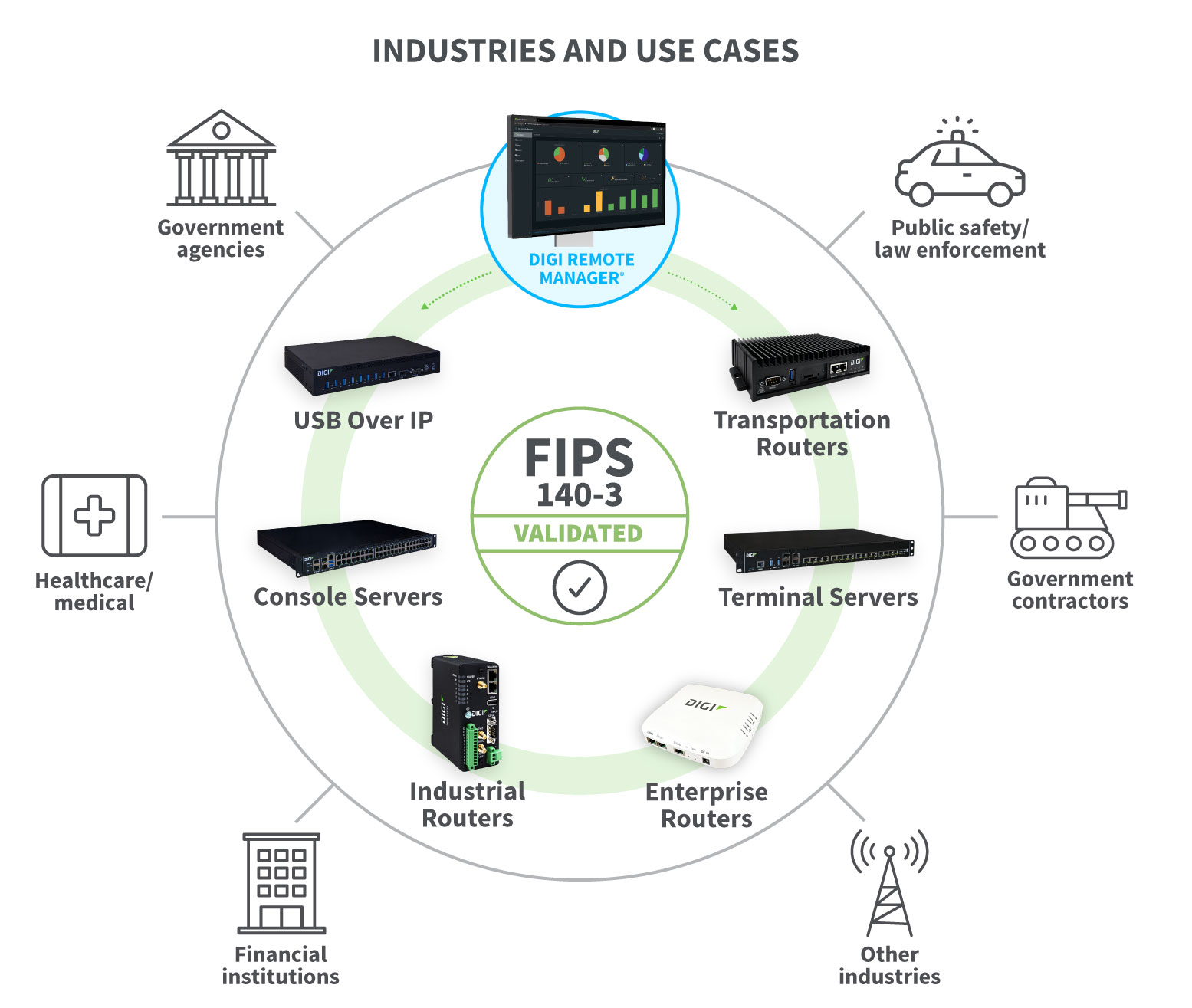
Applications Where FIPS 140-3 Validation Is Required
- Government agencies and contractors: The U.S. government represents one of the largest digital data consumers and producers. Data security is of paramount importance. For this reason, FIPS 140-3 validation is required for all entities handling Controlled Unclassified Information (CUI), which includes hundreds of government agencies, including the FBI, the Department of Defense, and U.S. Border Patrol, as well as all defense contractors and other services that contract with the government.
- Law enforcement: Law enforcement agencies utilize the Criminal Justice Information System (CJIS) which means they access highly sensitive information. For this reason police forces are required to use FIPS 140-3 validated devices. Additionally, they use devices like automated license plate readers (ALPRs) as part of their arsenal of in-vehicle technologies that transmit and share data. Compliance with the FIPS 140-3 standard ensures secure ALPR data during license plate data storage and transmission.
- Financial services: The financial industry is one of the most regulated industries in the world. Financial institutions that are part of the federal government, including the IRS and Federal Reserve, are required to use FIPS 140-3 validated devices to protect financial data from cyberthreats. Increasingly, other financial services and institutions are adopting the standard as well as a benchmark for cybersecurity.
- Medical institutions: Similar to financial institutions, those under government jurisdiction are required to use FIPS 140-3 validated devices. Additionally institutions that are required to be HIPAA compliant must follow the standard, and most healthcare institutions must be compliant for the protection of patient data. The risks are high. For example, Quest Diagnostics became a victim of cyber theft with over 12 million sensitive patient records stolen when attackers hacked a vendor payment web page. Compliance with FIPS 140-3 can help medical device manufacturers and healthcare software providers ensure that their encryption methods protect sensitive patient data and the security of medical devices patients’ lives depend upon.
Additional Applications Where FIPS 140-3 Compliance Is Beneficial
The benefits of FIPS 140-3 compliance cannot be understated, as every organization today must bolster its cybersecurity in the face of the increasing sophistication of hackers. FIPS 140-3 dramatically reduces the attack profile of organizations that handle everything from consumer data to financial transactions
- Manufacturing Plasma Ruggedized Solutions manufactures conformal coatings, potting and encapsulation services specifically designed for FIPS approval. In other words, its products coat sensitive electronics to prevent access to data stored on treated printed circuit board assemblies. In fact, it even offers special measures to ensure that the product self-destructs if it detects further tampering such as unauthorized entry, modification, or reverse engineering.
- Energy and utility companies:Energy infrastructure, including gas, water and power utilities are central to everything we do. They’re critical for our economy and way of life. They’re also highly connected to thousands of endpoints that include power generation, energy providers and even smart meters. That’s why they need to be secured against increasingly sophisticated cyber-attacks. Beyond negative press and reputational damage, hackers can inflict financial damage and steal valuable intellectual property. For example, recent cyberattacks in the energy sector disabled remote controls for wind farms and led to data breaches of sensitive customer information. Preventing cyber threats means providing the highest levels of protection for all endpoints and data. Utilities that want to build resilience against cyberattacks can gain FIPS 140-3 validation on all encryption modules.
- Cloud data centers: Cloud services providers such as Google Cloud, IBM, AWS, Dell and Microsoft all use FIPS 140-3 validated encryption. This means that both data transmitted and stored data get encrypted using FIPS validated encryption.
- Unmanned vehicles: Unmanned vehicles range from unmanned aircraft such as drones to underwater unmanned vehicles and even self-driving cars. Because computer systems control virtually all unmanned vehicle operations, securing the data and information transferred remains a top priority. DJI, a drone and robotics company, sought FIPS 140-3 validation for some of its drones. According to DJI, all drones with the DJI Core Crypto Engine ensure that customers are “treated to trusted, authoritative, and globally recognized security standards.” Many DJI customers represent the federal government or work on government contracts, so it makes sense that DJI would seek FIPS validation for its products.
- Autonomous vehicles: As autonomous driving technologies improve, software-driven artificially intelligent vehicles will become more important to the future of mobility. These vehicles rely heavily on data and communication for safe operations, so cybersecurity remains a huge risk. The U.S. Department of Transportation’s 2022 pre-final report called Cybersecurity Best Practices for the Safety of Motor Vehicles cites FIPS 140-3 as a way to ensure that “cryptographic techniques should be current and non-obsolescent for the intended application.”
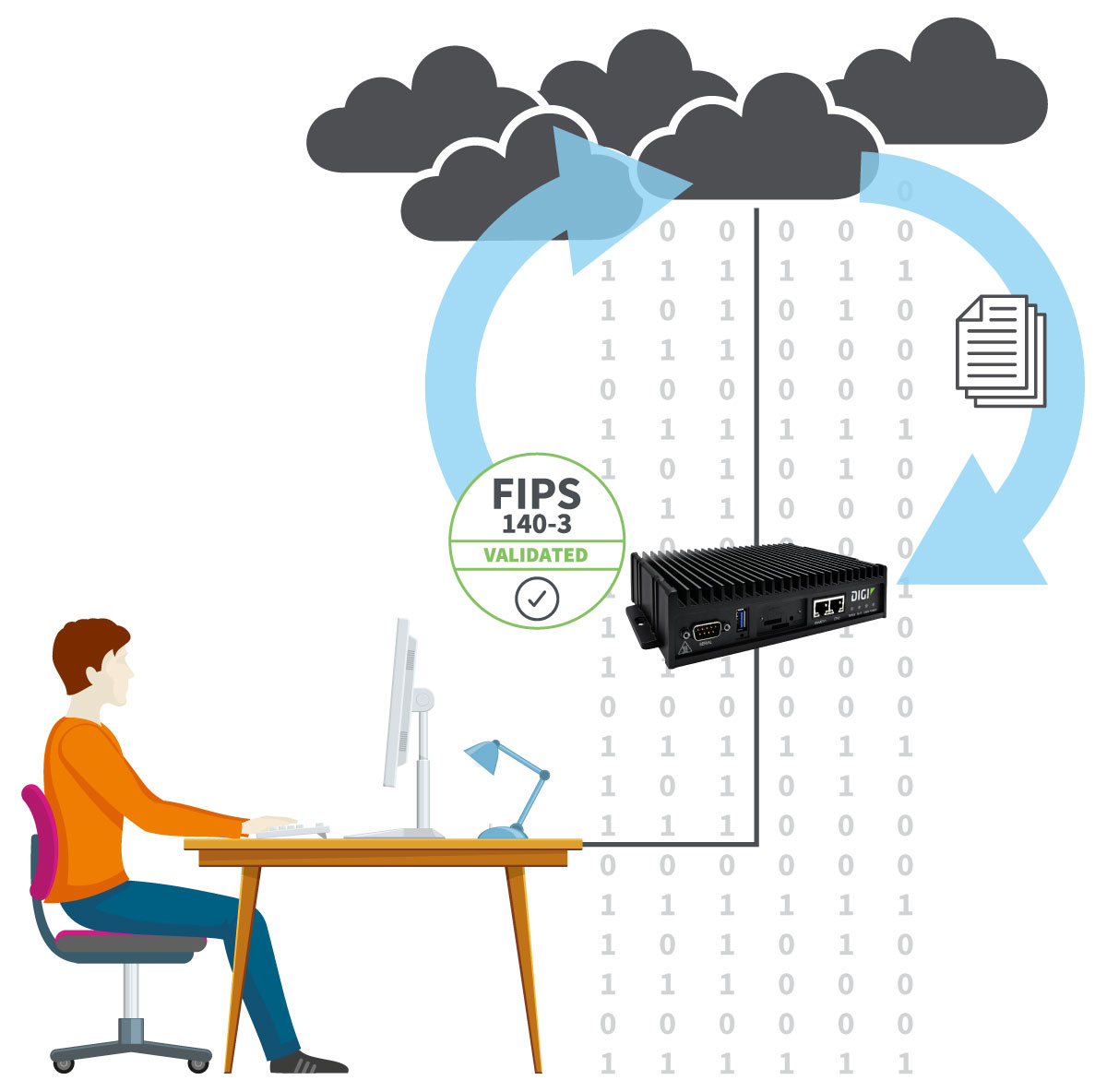 Although working within or as a vendor for the federal government means complying with FIPS 140-3 requirements, any organization that needs a robust level of cybersecurity protection can adopt the standard. That’s where Digi can help. Since 1985, Digi has been pioneering wireless communication. Today, Digi provides everything from sensor-based solutions and a sophisticated remote monitoring platform to full-service professional design, implementation and certification teams. When it comes to cybersecurity, we’ve got you covered.
Digi solutions support FIPS 140–2 on the entire suite of devices based on the Digi Accelerated Linux operating system (DAL OS):
Encryption is easy to implement. Digi Remote Manager, Digi's cloud-based solution for monitoring and managing devices, enables a simple process for keeping devices up-to-date. Simply upgrade your firmware and turn on FIPS. That’s it. Don’t get stuck with expensive and complicated solutions. Digi’s approach means your systems receive regular updates easily and at no extra cost.
Frequently Asked Questions About FIPS 140-3
Why is FIPS 140-3 important?
FIPS 140-3 is critical because it strengthens cybersecurity resilience for government systems and critical infrastructure. It helps organizations protect sensitive information from cyberattacks and ensures a standardized approach to encryption security.
Who is required to comply with FIPS 140-3?
FIPS 140-3 compliance is required for:
- U.S. government agencies
- Government contractors handling Controlled Unclassified Information (CUI)
- Law enforcement agencies using CJIS systems
- Federal financial and healthcare institutions
Organizations that fail to meet FIPS validation cannot sell cryptographic solutions to the U.S. government.
Can private companies use FIPS 140-3?
Yes. While it is mandated for government use, any organization can adopt FIPS 140-3 as a cybersecurity benchmark to improve data protection and reduce risk exposure.
What are the differences between FIPS 140-2 and FIPS 140-3?
FIPS 140-3 is the successor to FIPS 140-2, aligning U.S. cryptographic standards with international ISO/IEC requirements. While FIPS 140-2 remains widely deployed, new validations are transitioning to FIPS 140-3, which introduces updated testing methodologies and security requirements.
What does FIPS 140-3 cover?
FIPS 140-3 covers all cryptographic modules, including:
- Hardware security modules (HSMs)
- Encryption software
- Firmware-based security systems
It ensures these components meet strict security requirements for protecting data at rest and in transit.
What are the security levels in FIPS 140-3?
FIPS 140-3 defines four increasing security levels:
- Level 1 – Basic encryption requirements
- Level 2 – Tamper-evidence and role-based authentication
- Level 3 – Tamper-resistance and stronger identity controls
- Level 4 – Highest level with physical security and environmental protection
Higher levels provide stronger protection against physical and cyber threats.
What industries benefit from FIPS 140-3 compliance?
Beyond government, many industries benefit from adopting FIPS 140-3, including:
- Financial services
- Healthcare and medical devices
- Manufacturing
- Energy and utilities
- Cloud service providers
- Autonomous and unmanned vehicles
These sectors rely on secure data transmission and storage to prevent breaches and maintain trust.
How does FIPS 140-3 improve cybersecurity?
FIPS 140-3 reduces vulnerabilities by enforcing standardized encryption practices. It minimizes the attack surface for organizations handling sensitive data and ensures consistent protection across systems and devices.
Is FIPS 140-3 required for cloud services?
Many leading cloud providers (such as AWS, Google Cloud, and Microsoft) use FIPS 140-3 validated encryption to secure customer data. While not always mandatory, it is widely adopted as a best practice for cloud security.
How can organizations achieve FIPS 140-3 compliance?
Organizations can achieve compliance by:
- Using FIPS-validated cryptographic modules
- Following NIST implementation guidelines
- Working with trusted solution providers
Working with experienced vendors like Digi can simplify certification and ongoing compliance management.
Why should organizations adopt FIPS 140-3 now?
With the rise of advanced threats, including AI-driven attacks and evolving cyber risks, adopting FIPS 140-3 helps organizations future-proof their security posture and align with globally recognized standards.
Next Steps
Editorial note: This blog post was first published in October 2023 on the topic of FIPS 140-2 and was updated to FIPS 140-3 in April 2026.