Summary
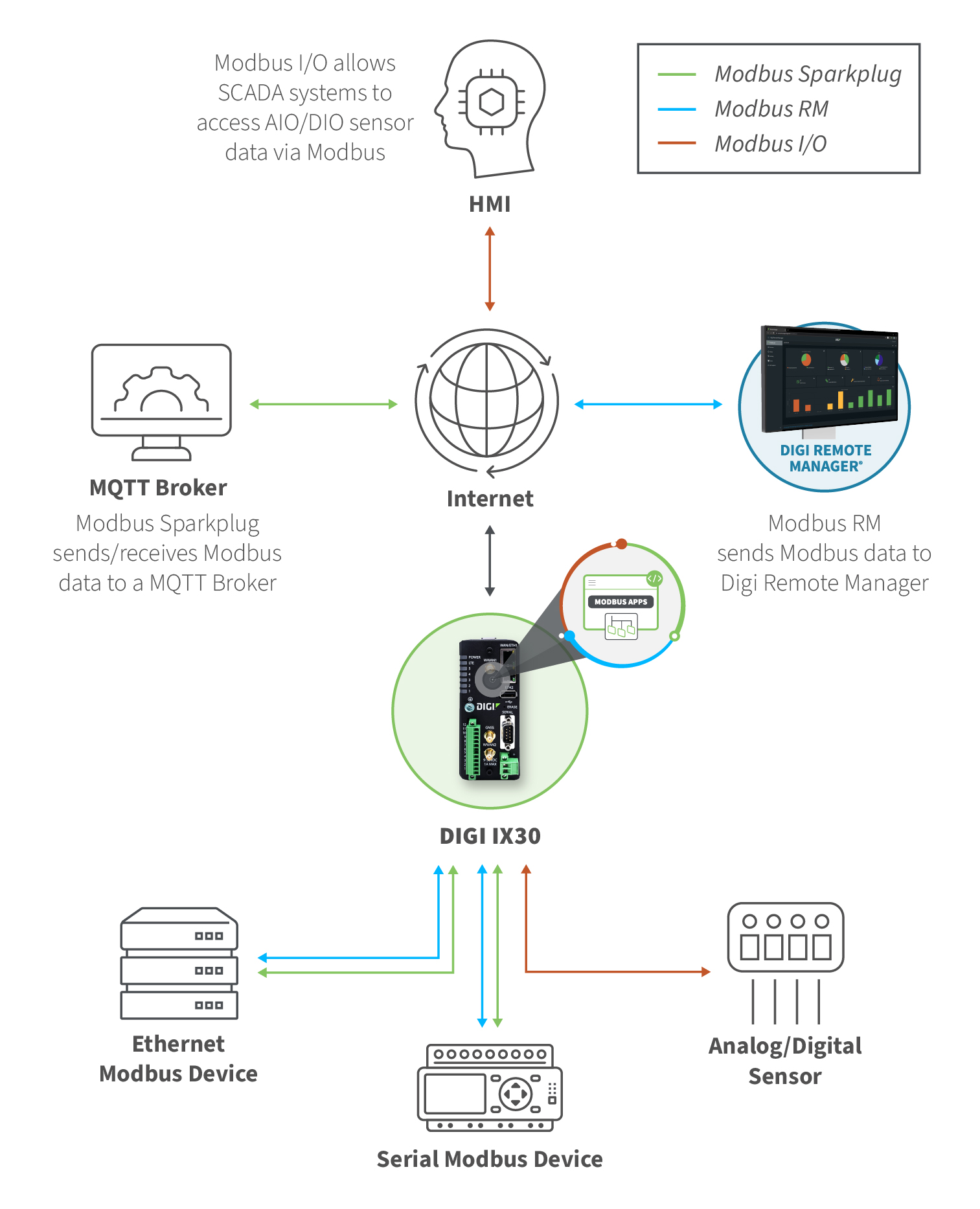
Digi Modbus Sparkplug is a subscription-based application that runs natively on Digi DAL OS devices, including Digi IX25, Digi IX30, and Digi Connect EZ. The application polls Modbus registers from connected industrial equipment and publishes the data in Sparkplug B format to an MQTT broker. It supports both Modbus TCP and serial (RTU/ASCII), enables bidirectional read/write control, and uses exception-based reporting to minimize cellular bandwidth costs. No extra servers, middleware, or custom code is required.
Bringing Modbus Into the Modern IIoT World
If you're working with industrial equipment in the field, there's a good chance Modbus is already part of your world. From PLCs to drives, meters, and flow controllers, the list of Modbus-speaking devices in any industrial installation is long. The protocol works. It's proven. But it was never designed for the connected, data-hungry world that modern operations teams now need to navigate.
That's where Digi Modbus Sparkplug comes in.
What Is Digi Modbus Sparkplug?
Digi Modbus Sparkplug is a Python-based application that allows users to poll Modbus registers from devices connected to Digi hardware and send that Modbus data in Sparkplug format to a given MQTT broker. It runs as a subscription-licensed, value-added service (SKU: DG-PSPY-MBSP) directly on any Digi DAL OS device, adding a capability that doesn't exist natively on any of these platforms out of the box. No additional servers, middleware, or custom scripting are required.
The Hardware It's Built For
Digi Modbus Sparkplug runs on any Digi DAL OS device, but three product families represent the most common deployment scenarios in industrial environments.
Digi IX25 — Next-generation 5G Industrial Router
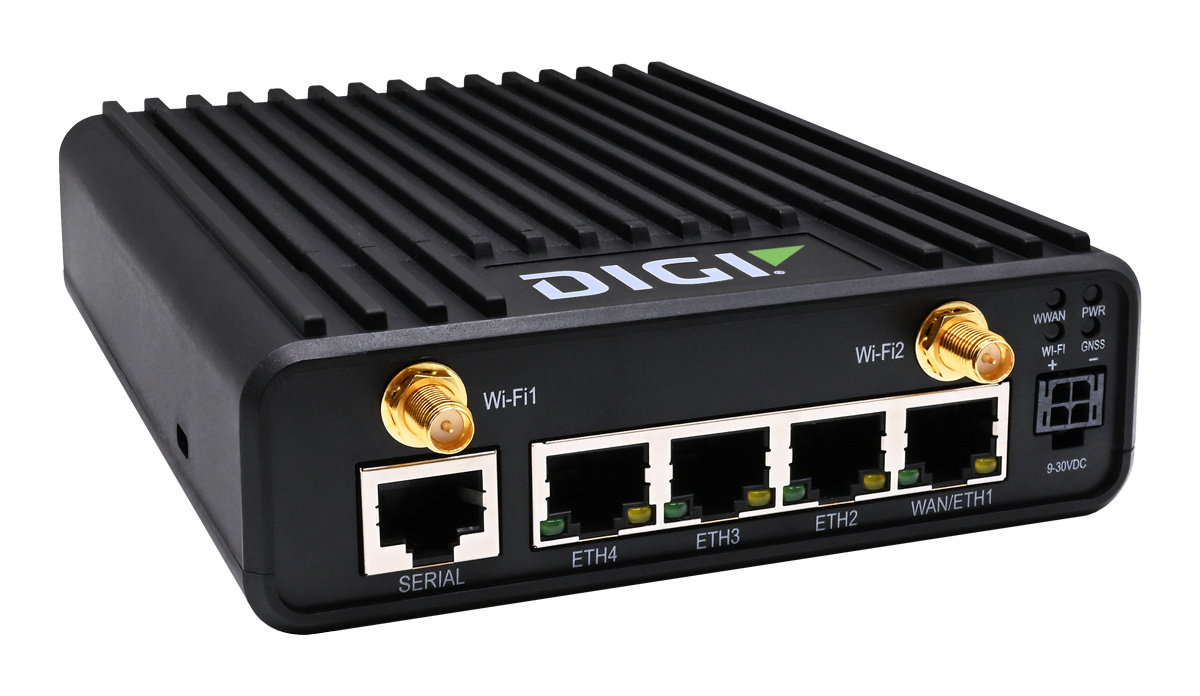
Digi IX25 is a purpose-built industrial router solution for enterprises and critical infrastructure that require secure, reliable, always-on connectivity. IX25 is designed primarily for utilities, energy, manufacturing, transportation, and distributed retail networks. Managed with SOC 2, Type 2 verified Digi Remote Manager (DRM), IX25 is easy to manage at scale.
Physical interfaces include four Gigabit Ethernet ports, a single RS-232/485 serial port, and a USB-C port, with DIN rail mounting and an IP30 ingress protection rating. IX25 operates from -40 °C to +75 °C and carries certifications including C1D2, ATEX, E-Mark, and MIL-STD-810H. For engineers deploying into demanding environments where Modbus devices need to feed into modern IIoT platforms over a fast, resilient WAN link, IX25 provides that connectivity along with the edge compute headroom to run Modbus Sparkplug natively.
Digi IX30 — Proven 4G LTE Industrial Router
Digi IX30 is an intelligent 4G LTE router with Ethernet, serial I/O, and Modbus bridging built in, along with patented Digi SureLink technology, VRRP+, and dual SIM slots for an extremely resilient cellular connection. Like all Digi cellular solutions, IX30 fully integrates remote monitoring, management and rapid firmware updates via DRM.
Additionally, Digi IX30 features dual Ethernet ports, an RS-232/422/485 serial port, digital and analog I/Os, a rugged IP30 aluminum enclosure, and integrated industrial edge computing for hosting containerized applications and custom solutions. IX30 is already widely deployed across critical infrastructure worldwide, making it a natural fit for adding Modbus Sparkplug capability to existing installations without touching the underlying hardware.
Digi Connect EZ — Dedicated Serial Device Servers
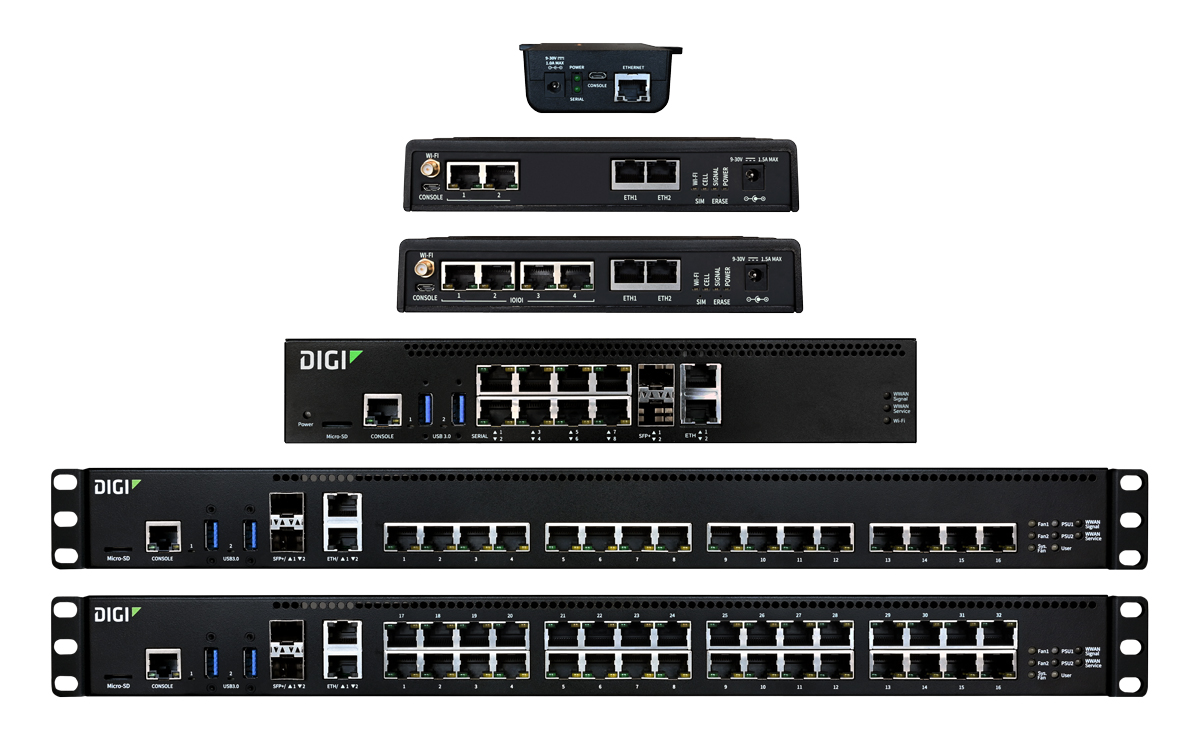
For sites where the primary requirement is bridging serial Modbus devices onto the network, without the footprint or cost of a full cellular router, the Digi Connect EZ family is the purpose-built answer. Digi Connect EZ is a click-to-connect solution that integrates Digi Remote Manager for rapid configuration and ongoing management.
Digi Connect EZ is available with 1, 2, or 4 serial ports, software-selectable for RS-232, RS-422, and RS-485 communication, with optional LTE, Wi-Fi, and industrial specifications including extended temperature and C1D2 rating. Running Digi Modbus Sparkplug on a Connect EZ server transforms it from a serial-to-network bridge into an active IIoT data publisher — delivering Sparkplug B payloads to your MQTT broker directly from the device, with no additional infrastructure.
Flexible Connectivity: TCP and Serial Modbus
Real-world Modbus infrastructure is rarely uniform. Some devices communicate over Ethernet via Modbus TCP. Others sit on RS-232 or RS-485 serial buses running Modbus RTU or ASCII. Digi Modbus Sparkplug handles both, allowing a single deployed device to poll registers across your mixed Modbus environment and publish everything through one unified MQTT stream.
This matters in practice. A single installation might have a TCP-connected PLC alongside RS-485 serial devices on one or more buses. Modbus Sparkplug bridges all of it to the same broker, under the same structured Sparkplug namespace.
Why Sparkplug B? Because Not All MQTT Is Equal.
Publishing data to MQTT is easy. Publishing it in a way that downstream systems can reliably consume, at scale, without custom integration work for every new subscriber is the harder problem Sparkplug B solves.
Built on top of MQTT, Sparkplug B defines a standardized topic namespace, device session lifecycle management via birth and death certificates, and efficient binary encoding using protocol buffers. What that means practically: your broker receives structured, self-describing payloads that any Sparkplug-aware platform can consume immediately, whether that's Ignition SCADA, AWS IoT, Azure IoT Hub, a custom historian, or your own analytics pipeline. The integration work happens once. New subscribers connect to the same stream without rework.
The application supports enhanced data processing in Sparkplug format, enabling visualization of your data by sending it to Sparkplug MQTT servers.

Read and Write: Bidirectional Modbus Control
Most edge data solutions stop at read-only visibility. Digi Modbus Sparkplug supports writing values back to connected Modbus devices via the same MQTT interface, enabling closed-loop workflows and remote control from upstream systems.
For OT engineers, this opens up practical use cases that go well beyond monitoring:
- Pushing setpoint changes to drives and controllers from a cloud SCADA or manufacturing execution system
- Remote commissioning and parameter configuration without dispatching a technician to the field
- Automated control responses triggered by upstream analytics or alarm management systems
- Fleet-wide configuration updates across distributed sites from a central operations center
Smarter Data, Lower Bandwidth Costs
For deployments on cellular connections, which is a common scenario on both Digi IX25 and IX30, bandwidth efficiency directly affects operating costs. The application enables reporting by events and exceptions rather than heartbeat reporting, keeping data costs low by sending only important data. Instead of flooding your MQTT broker with constant polling output on a fixed interval, you get intelligent, change-driven publishing: relevant data when it matters, not noise all the time.
The Bottom Line
Digi Modbus Sparkplug gives OT engineers a production-grade, supported path to unlock the data in their Modbus devices and deliver it in a modern, standards-based format to any system that needs it without replacing hardware, writing custom code, or locking into a proprietary platform. Whether you're adding a new IX25 to your network and pushing data over 5G from a utility substation, deploying a field-proven IX30 in an industrial cabinet with a mix of serial and networked Modbus devices, or using a Connect EZ to bridge RS-485 serial equipment directly to your network, Modbus Sparkplug runs natively and handles the translation to Sparkplug B automatically.
Frequently Asked Questions About Digi Modbus Sparkplug
What is Digi Modbus Sparkplug?
Digi Modbus Sparkplug is a Python-based application that runs on Digi DAL OS devices and converts Modbus data into Sparkplug B messages for publishing to an MQTT broker. It allows industrial organizations to connect legacy Modbus equipment with modern IIoT platforms without custom middleware, additional servers, or custom application development.
What is Sparkplug B, and why is it important for industrial IoT?
Sparkplug B is an open specification that standardizes how industrial data is published over MQTT. It defines topic structures, device state management, and payload formats so SCADA systems, historians, cloud platforms, and analytics applications can automatically discover and consume data. This eliminates much of the custom integration work required with standard MQTT deployments.
How does Digi Modbus Sparkplug work?
Digi Modbus Sparkplug polls registers from Modbus devices using Modbus TCP, Modbus RTU, or Modbus ASCII. It converts the collected data into Sparkplug B payloads and securely publishes them to an MQTT broker. The application runs directly on supported Digi edge devices, eliminating the need for external protocol converters or gateway servers.
Which Digi devices support Digi Modbus Sparkplug?
Digi Modbus Sparkplug runs on any Digi DAL OS device. Common deployment platforms include:
Running the application directly on these devices simplifies deployment while reducing hardware requirements.
Does Digi Modbus Sparkplug support both Modbus TCP and Modbus RTU?
Yes. Digi Modbus Sparkplug supports Modbus TCP over Ethernet as well as Modbus RTU and Modbus ASCII over RS-232 and RS-485 serial connections. This allows organizations to collect data from mixed industrial environments using a single edge device.
Can Digi Modbus Sparkplug write data back to Modbus devices?
Yes. Digi Modbus Sparkplug supports both reading and writing Modbus registers. This enables remote configuration, setpoint updates, equipment control, commissioning, and automated closed-loop control from SCADA systems, manufacturing execution systems, or cloud applications.
What are the benefits of using Sparkplug B instead of standard MQTT?
While MQTT provides a lightweight messaging protocol, Sparkplug B adds standardized data models, device lifecycle management, and automatic discovery capabilities. These features improve interoperability, simplify system integration, reduce engineering effort, and make industrial data easier to consume across multiple applications.
Can Digi Modbus Sparkplug reduce cellular data usage?
Yes. Digi Modbus Sparkplug supports event-driven and exception-based reporting instead of continuously transmitting unchanged values. By sending only meaningful data changes, organizations can significantly reduce bandwidth consumption and lower operating costs on cellular-connected industrial networks.
What types of industrial equipment can Digi Modbus Sparkplug connect?
Digi Modbus Sparkplug can communicate with virtually any equipment that supports the Modbus protocol, including:
- Programmable logic controllers (PLCs)
- Variable frequency drives (VFDs)
- Power meters
- Flow meters
- Remote terminal units (RTUs)
- Sensors
- Environmental monitoring equipment
- Industrial controllers
Which MQTT brokers are compatible with Digi Modbus Sparkplug?
Digi Modbus Sparkplug publishes standards-based Sparkplug B messages that can be consumed by Sparkplug-compatible MQTT brokers and applications. These include platforms such as Ignition SCADA as well as cloud services including AWS IoT, Azure IoT Hub, and other Sparkplug-enabled industrial software platforms.
Does Digi Modbus Sparkplug replace existing Modbus equipment?
No. Digi Modbus Sparkplug extends the value of existing Modbus infrastructure by making legacy devices accessible to modern IIoT applications. Organizations can continue using proven field equipment while integrating operational data into cloud, SCADA, analytics, and enterprise systems.
Why run Digi Modbus Sparkplug at the network edge?
Running Digi Modbus Sparkplug directly on Digi edge devices reduces system complexity by eliminating separate protocol conversion servers and middleware. Edge processing also lowers latency, minimizes bandwidth usage, simplifies deployment, and creates a more reliable architecture for distributed industrial operations.
Is Digi Modbus Sparkplug suitable for utilities and critical infrastructure?
Yes. Digi Modbus Sparkplug is designed for industrial deployments across utilities, energy, manufacturing, transportation, water and wastewater, and other critical infrastructure environments where Modbus remains widely deployed and secure, reliable data integration is essential.
How is Digi Modbus Sparkplug licensed?
Digi Modbus Sparkplug is available as a subscription-based value-added application (SKU: DG-PSPY-MBSP) that runs directly on supported Digi DAL OS devices. Organizations can add Sparkplug functionality without purchasing additional gateway hardware or deploying separate edge servers.
How does Digi Modbus Sparkplug simplify industrial digital transformation?
Digi Modbus Sparkplug provides a straightforward path for modernizing existing Modbus installations. Instead of replacing field devices or developing custom integration software, organizations can securely publish operational data in Sparkplug B format, enabling faster integration with SCADA systems, cloud platforms, historians, analytics tools, and enterprise applications.
Ready to explore Digi Modbus Sparkplug for your deployment? Contact Digi's Professional Services team at professional.services@digi.com or visit the Digi Modbus Value-Added Applications page to learn more.
Next Steps