Summary
Digi EX60 is an enterprise 5G branch router that combines cellular, wired and satellite connectivity with Wi-Fi 7, five Ethernet ports, edge computing, serial connectivity, security and centralized management in one platform. Dual SIM Dual Standby delivers failover up to 10X faster than traditional cellular backup, helping distributed enterprises keep branches, retail sites and remote locations online. Digi Remote Manager and Digi Remote Reach let IT teams reach and manage devices remotely, reducing truck rolls across many sites.
Many distributed enterprises still run branch connectivity built for LTE. It was reliable at launch, but it was not built for today's cloud-first, always-on operations, and remote management was often an afterthought. Digi EX60 changes that. It combines 5G performance, up to 10X faster failover than traditional cellular backup and the flexibility to use cellular, wired and satellite connectivity on a single platform. With fully integrated, AI-enabled remote monitoring and management through Digi Remote Manager and Digi Remote Reach, IT teams get the wireless WAN (WWAN) reliability distributed enterprises need for real business continuity.
Digi EX60 is an advanced enterprise branch router designed for organizations that need fast, secure, highly available connectivity across distributed locations. Built for modern enterprise networking, Digi EX60 brings together centralized management, high-performance 5G, Wi-Fi 7, integrated routing and switching, edge computing, serial connectivity and enterprise-class security in a single platform. It is designed for branch offices, retail and point-of-sale (POS) environments, remote facilities, managed service deployments and other locations where cloud applications, connected devices, payment systems, video and real-time communications depend on reliable network access.
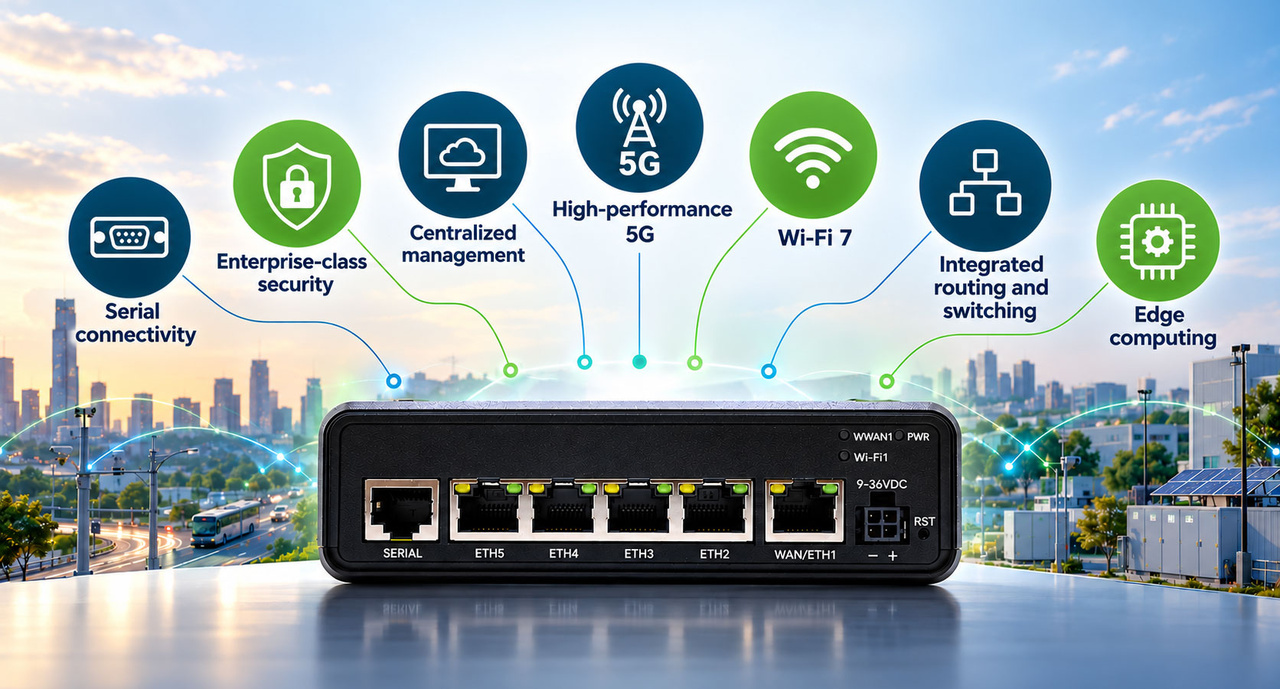
At the cellular layer, Digi EX60 supports 5G enhanced mobile broadband (eMBB) based on 3GPP Release 17, with Cat 20 LTE fallback and carrier aggregation for increased throughput and network efficiency. Dual SIM Dual Standby (DSDS), dual Nano-SIM support, eSIM capabilities and multicarrier operation provide added flexibility for organizations that cannot afford to rely solely on a single network connection.
At the LAN edge, Digi EX60 incorporates Wi-Fi 7 and five Ethernet ports, including one 2.5 GbE interface, helping remove performance bottlenecks associated with traditional 1 GbE WAN connections. The platform also runs Digi Accelerated Linux (DAL OS), supports containerized edge applications and integrates with Digi Remote Manager for centralized management, including Digi Remote Reach for direct, peer-to-peer access to connected devices such as point-of-sale terminals and modems.
The result: a consolidated enterprise connectivity platform that simplifies distributed networking while supporting increasingly demanding workloads.
What Are the Challenges Digi EX60 Solves?
Distributed enterprises face increasingly demanding networking challenges: business-critical applications are moving outward from headquarters while expectations for uptime, performance, security and centralized control continue to rise.
A branch office, store, financial location, field office or temporary site may support payment transactions, SaaS applications, voice and video communications, digital signage, surveillance systems, connected equipment and guest networks simultaneously. Yet many organizations still manage those locations through combinations of separate routers, switches, wireless access points, gateways and carrier connections.
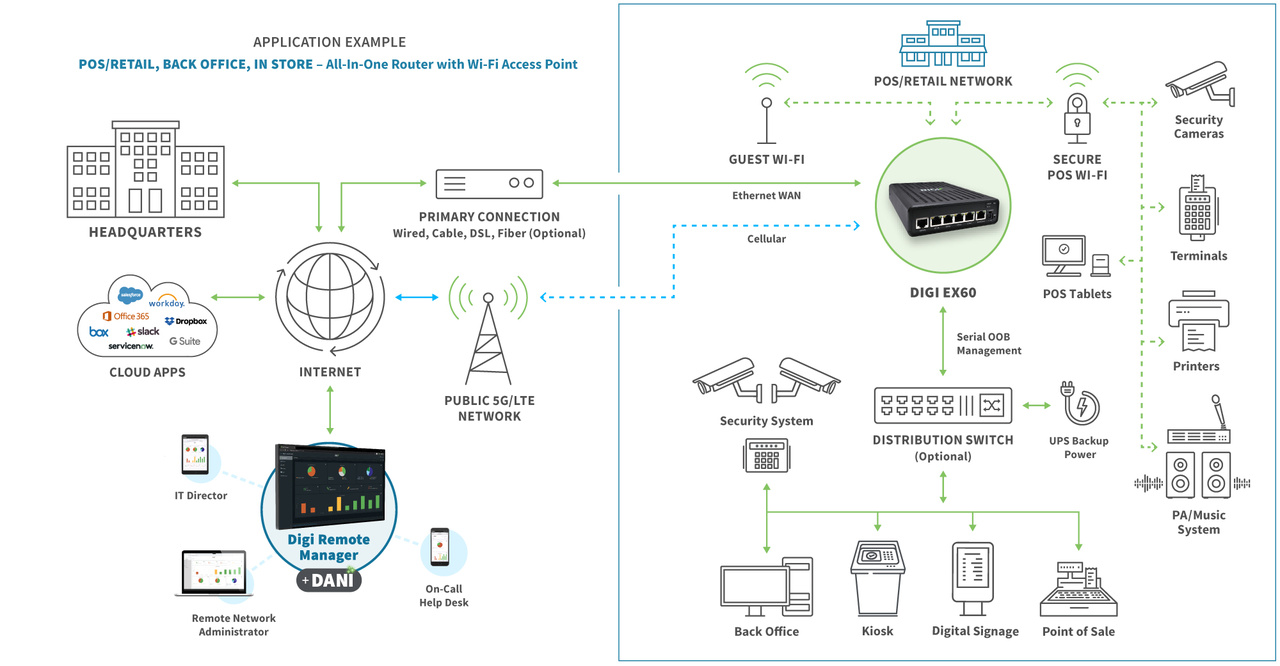 Digi EX60 addresses three recurring challenges.
- Reliable connectivity and redundancy: Enterprise applications increasingly depend on always-on access, and the cost of getting it wrong compounds quickly. A carrier outage, deteriorating signal or wired WAN failure can interrupt transactions, disconnect employees from cloud applications, stop connected systems from reporting and degrade the customer experience. Digi EX60 combines wired, cellular and satellite WAN options, such as an Ethernet-connected Starlink terminal, with multicarrier capabilities, Digi SureLink connection monitoring and Dual SIM Dual Standby. This provides an additional layer of network resilience and business continuity for locations where network uptime is operationally critical.
- Network complexity: Adding independent routers, access points, switches and gateways increases hardware count, installation effort, configuration requirements and points of failure. Distributed deployments also become more difficult to support when individual locations use different hardware or require on-site intervention. Digi EX60 integrates routing, switching, Wi-Fi, cellular connectivity, serial I/O, security and edge computing, while Digi Remote Manager provides centralized visibility and control. The result: a simpler branch architecture that can be standardized across many locations.
- Performance constraints: Modern branches routinely carry workloads that were considered exceptional only a few years ago. Cloud applications, large file transfers, unified communications, video surveillance, digital media and connected devices all compete for bandwidth that legacy branch connections were never sized for. Digi EX60 pairs ultra-capacity 5G with a 2.5 GbE WAN/LAN interface, so a single 1 GbE Ethernet port does not become the limiting factor for that traffic.
Why Digi EX60 Is the Right Choice Compared to Alternatives
Organizations evaluating an enterprise 5G router are not simply comparing peak cellular speeds. The greater question is how well a platform combines connectivity, resilience, local networking, management, security and lifecycle scalability.
- High-throughput 5G connectivity: Digi EX60 uses 5G eMBB based on 3GPP Release 17 with Cat 20 LTE fallback and carrier aggregation. That architecture supports bandwidth-intensive enterprise applications such as cloud services, high-resolution video, file transfers and other traffic that can strain lower-capacity connections.
- Low-latency application performance: Faster cellular connectivity is particularly valuable when applications are interactive or time-sensitive. Combining 5G connectivity with local edge processing can reduce cloud round trips and help applications respond closer to where data is created.
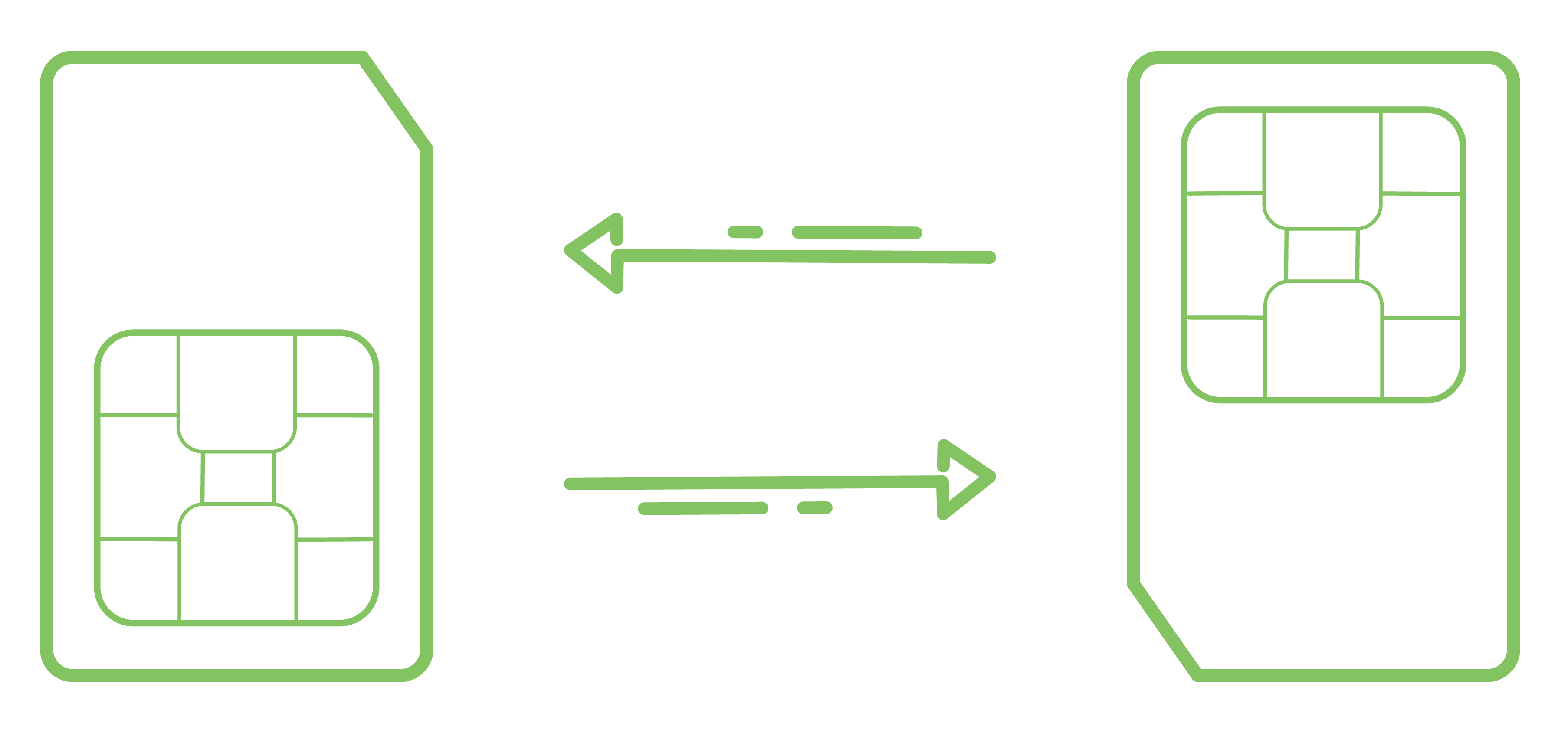 Intelligent WWAN resiliency: Dual SIM Dual Standby (DSDS) keeps the secondary carrier connection live and running in the background, rather than dormant until a failure occurs, supporting both primary and failover connectivity from the same platform. This enables nearly instant failover, up to 10X faster than traditional failover approaches, which must first detect a primary connection loss and then establish a secondary link. Combined with WAN failover and Digi SureLink connection monitoring, this network resilience helps reduce the risk that a single service disruption will isolate a branch. For sites that need an additional layer of diversity, a satellite terminal such as Starlink can connect through the Digi EX60 Ethernet WAN/LAN port, giving IT teams a third WAN path alongside cellular and wired connections.
- Wi-Fi 7 plus integrated branch networking: Digi EX60 provides tri-band Wi-Fi 7 with dual-concurrent operation, pairing 2.4 GHz with either 5 GHz or 6 GHz. Multiple SSIDs enable organizations to separate employee, operational and guest traffic, while five Ethernet ports support wired equipment. This reduces the need for separate routing, switching and wireless components in smaller branch environments.
- Edge computing built into the platform: DAL OS and Digi Containers enable your applications to run directly on the router. You can process, filter, aggregate or act on data locally instead of sending every event to a cloud platform, helping reduce latency, WAN utilization and dependency on continuous cloud access.
- Centralized, secure remote management: Digi Remote Manager enables IT and operations teams to configure devices, monitor network health, distribute updates, automate tasks and maintain geographically dispersed deployments from a centralized platform. Digi Remote Reach, included with Digi Remote Manager, gives IT and OT teams direct, peer-to-peer access to devices connected behind Digi EX60, such as point-of-sale terminals and modems, without routing session traffic through a vendor cloud. Digi Remote Manager also includes an MCP (Model Context Protocol) server built for enterprise control, exposing fleet data such as device status, signal metrics, event logs and configuration compliance across a customer's environment, including every Digi EX60 device, so organizations can connect the AI assistant of their choice to query that data and automate workflows, with access governed through Digi Remote Manager's existing API keys and role-based permissions. For teams that want a ready-to-use AI experience on that same foundation, Digi Artificial Network Intelligence (DANI) is available as a value-added service, adding AI-powered network intelligence for analyzing telemetry and assisting with troubleshooting using natural language.
- Multi-carrier flexibility: Dual Nano-SIM support, eSIM/eUICC capabilities, over-the-air provisioning, DSDS and support for major U.S. carriers give your enterprise options for carrier diversity and deployment standardization. Instead of tying each location permanently to one connectivity path, you can design a more adaptable cellular strategy.
The Critical Importance of Edge Computing
Edge computing is an important part of the Digi EX60 architecture because modern enterprise sites generate increasing volumes of data while depending heavily on cloud services. Remote processing introduces unnecessary and unacceptable latency, consumes bandwidth and makes local applications more dependent on continuous WAN connectivity.
Running applications closer to where information originates changes that model.
- Reduced latency: Local processing removes unnecessary cloud round trips. Applications can evaluate data and react at the site, which is useful when response time affects operations.
- Bandwidth optimization: Raw sensor, device or application data can be filtered or aggregated before transmission. Rather than sending every event upstream, the edge application can forward only useful information, reducing WAN utilization and cellular data consumption.
- Improved reliability: Local workloads do not necessarily have to stop simply because cloud connectivity is temporarily interrupted. Appropriate applications can continue operating at the site and synchronize when upstream connectivity returns.
- Enhanced security: By keeping selected processing local, you can reduce the volume of sensitive operational information transmitted to external platforms. Edge processing is not a replacement for broader cybersecurity controls, but it can become one component of a layered data strategy.
- Compliance and privacy: Some organizations have requirements governing where information is processed, transmitted or retained. Local processing can provide greater control over selected data flows where application architectures and regulatory requirements permit.
- Scalability and flexibility: Containerized workloads let you deploy repeatable edge logic across many sites. This scalability and flexibility allow you to adapt quickly to changing requirements, as you manage and update distributed edge applications through Digi Remote Manager.
- Cost efficiency: Filtering, aggregation and local decision-making can reduce cloud processing requirements and unnecessary data transmission, particularly across large fleets of sites.
For distributed enterprises, the significance of edge computing isn’t limited to running an application on a router. It’s the ability to distribute intelligence throughout the network while retaining centralized lifecycle management.
What Industries and Applications Does Digi EX60 Support?
Digi EX60 is designed for indoor enterprise and distributed-site applications that need a combination of high-performance 5G, resilient WAN connectivity, Wi-Fi, wired networking, edge computing, serial connectivity and centralized management, whether that site is called a branch office, a retail store, a remote facility or something else entirely. Managed service providers (MSPs) and integrators use that same platform to standardize across hundreds of customer sites at once.
 Branch, Retail and Remote Site Connectivity
A corporate branch office, a retail storefront and a remote or rural facility are, in practice, the same problem wearing different names. All three may depend on any combination of cloud applications, point-of-sale and payment systems, video and other connected devices, and a WAN outage at any of them can disrupt the business immediately, even at a small or single-employee location.
Digi EX60 can serve as the primary 5G broadband connection where wired service is unavailable, slow to install or operationally inconvenient, or as a resilient secondary path that fails over automatically when an existing wired connection goes down. Dual SIM Dual Standby adds carrier diversity on the cellular side, and for locations with no practical wired or a weak cellular option, a satellite terminal such as Starlink can connect through the Ethernet WAN/LAN port as an additional primary or backup path.
The local network matters just as much as the WAN. Five Ethernet ports and tri-band Wi-Fi 7 let a branch, store or remote site connect wired systems and wireless endpoints from one platform, with multiple SSIDs separating staff, guest and operational traffic, including point-of-sale terminals, digital signage and surveillance systems, without adding hardware. An integrated RS-232/RS-485 interface also supports legacy or specialized serial equipment already in place.
That consolidation matters for reducing expensive truck rolls to service in person. Digi Remote Manager gives administrators visibility into the fleet to monitor connection health, distribute configurations and firmware and troubleshoot remotely, and Digi Remote Reach extends that further with direct, peer-to-peer access to connected devices, including a point-of-sale terminal, a modem or a satellite terminal's own management interface, so most issues can be resolved without a truck roll.
Why Digi EX60 Fits Branch, Retail and Remote Sites Alike
- Primary or automatic failover connectivity across cellular, wired and satellite links
- Wi-Fi 7 and five Ethernet ports consolidate the local network into one platform
- Digi Remote Manager and Digi Remote Reach reduce truck rolls at hard-to-reach sites
- RS-232/RS-485 serial support protects existing point-of-sale and legacy equipment
Connectivity for Managed Service Providers and Integrators
Managed service providers and systems integrators face a different version of this challenge: supporting many separate customers, each with their own sites, rather than just one location. Digi EX60's common architecture, cellular, Ethernet, Wi-Fi, serial connectivity, security and edge computing, lets integrators standardize deployment across customer accounts while adapting configuration to each one. Bulk preregistration and zero-touch provisioning simplify large-scale rollouts, and Digi Remote Manager's MCP server lets MSPs build AI-assisted monitoring into their own tooling across every customer deployment, with DANI available as a ready-to-use alternative.
Built for Enterprise Security and Management
Distributed networks increase the number of locations and devices your organization must protect. Security must be incorporated into the platform, rather than treated solely as a perimeter function at headquarters.
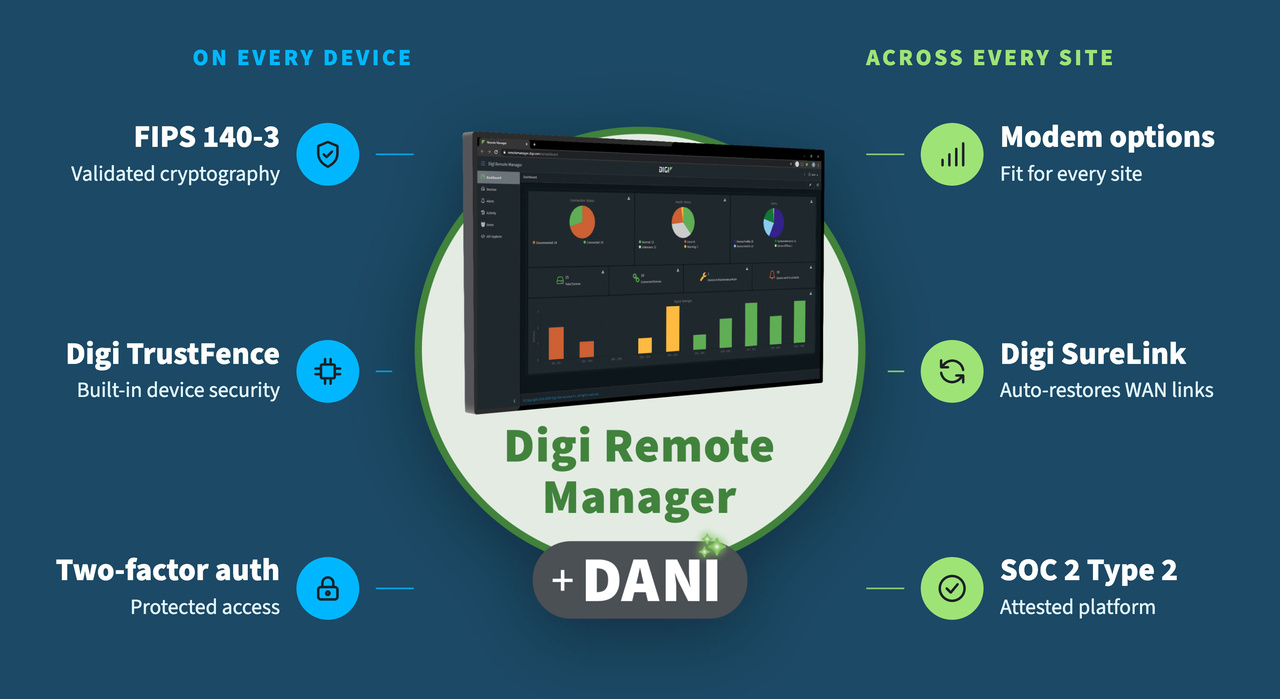 FIPS 140-3 validated cryptography and Digi TrustFence, along with two-factor authentication and Western modem options combine to provide the required level of device security. Digi SureLink continuously monitors connection health and can help restore disrupted WAN connections automatically. Digi Remote Manager itself is SOC 2 Type 2 attested, extending that same assurance to how the management platform is operated and audited.
Digi Remote Manager complements the device-level capabilities by providing centralized administration. Instead of relying on local access to every router, IT teams can apply configuration and maintenance practices across multiple sites from a common management environment.
Frequently Asked Questions: Digi EX60 Enterprise 5G Router
What is Digi EX60?
Digi EX60 is a compact indoor enterprise cellular router designed for distributed branch, retail, remote-site and managed-service deployments. It combines 5G eMBB, Cat 20 LTE fallback, Wi-Fi 7, five Ethernet ports, serial connectivity, edge computing, security capabilities and centralized management through Digi Remote Manager.
What cellular technology does Digi EX60 support?
Digi EX60 supports 5G eMBB based on 3GPP Release 17 with Cat 20 LTE fallback and carrier aggregation. Dual Nano-SIMs, eSIM/eUICC support, DSDS and CBRS Band 48/n48 are also in the specification.
Can Digi EX60 be used for both primary and failover connectivity?
Yes. Digi EX60 can serve as the primary wireless WAN (WWAN) connection at a site, or as an automatic cellular failover for an existing wired WAN link, giving IT teams the flexibility to deploy the same platform either way. Dual SIM Dual Standby keeps a secondary carrier connection live and running in the background, supporting both primary and failover roles with the same network resilience. For added WAN diversity, Digi EX60 also supports satellite connectivity, such as a Starlink terminal connected through its Ethernet WAN/LAN port, so organizations can combine cellular, wired and satellite links into a single primary-and-failover strategy.
Does Digi EX60 support Wi-Fi 7?
Yes. Digi EX60 supports tri-band Wi-Fi 7 with dual-concurrent operation, combining 2.4 GHz with either 5 GHz or 6 GHz. Multiple SSIDs can support separated wireless networks for different user and application groups.
How many Ethernet ports does Digi EX60 have?
Digi EX60 includes five Ethernet ports: one 2.5 GbE WAN/LAN interface and four 1 GbE LAN ports. The 2.5 GbE interface helps avoid the throughput limitation that a traditional 1 GbE WAN port could impose on a high-speed 5G connection.
Does Digi EX60 support edge computing?
Yes. Digi EX60 runs Digi Accelerated Linux and supports containerized edge applications. Local processing helps reduce latency, optimize bandwidth usage, improve operational continuity during WAN interruptions and reduce unnecessary cloud processing.
How is Digi EX60 managed?
Digi EX60 integrates with Digi Remote Manager for centralized configuration, monitoring, firmware management, automation and troubleshooting across distributed deployments. Digi Remote Reach, included with Digi Remote Manager, provides direct, peer-to-peer access to devices connected behind Digi EX60, such as point-of-sale terminals and modems, without routing traffic through a vendor cloud. Digi Remote Manager also includes an MCP server built for enterprise control, exposing fleet data such as device status, signal metrics, event logs and configuration compliance across a customer's environment, including every Digi EX60 device, so organizations can connect the AI assistant of their choice to query that data and automate workflows, with access governed through Digi Remote Manager's existing API keys and role-based permissions. Digi Artificial Network Intelligence (DANI) is available as a value-added service for teams that want a ready-to-use AI experience on that same foundation.
Can Digi EX60 provide remote access to connected devices like POS systems and modems?
Yes. Digi Remote Reach, included with Digi Remote Manager, gives IT and OT teams direct, peer-to-peer access to devices connected behind Digi EX60, such as point-of-sale terminals, modems and other connected equipment, without routing session traffic through a vendor cloud.
What are common Digi EX60 applications?
Common applications include primary 5G broadband, WAN failover, branch-office connectivity, retail and POS networking, staff and guest Wi-Fi, digital signage, surveillance backhaul, temporary-site connectivity, remote-site communications, serial device connectivity, edge processing and managed connectivity deployments.
Next Steps
Ready to see what Digi EX60 can do for your organization? Here's where to start: