Summary
The Digi IX25 family of industrial cellular routers now supports private networks on Anterix’s 900 MHz spectrum, with five LTE, 5G RedCap and 5G eMBB models. Paired with Digi Remote Manager, it gives utilities secure, reliable, multi-carrier connectivity that reaches remote grid locations with less infrastructure. The post covers why private networks matter for utilities, the key benefits of the IX25, four utility use cases, and answers to common questions.
Digi recently launched the Digi IX25 platform, a new family of industrial cellular routers optimized for private cellular networks operating on Anterix’s 900 MHz spectrum. Digi IX25 is designed to provide utilities and other industrial operations with the ability to seamlessly deploy private networks and multi-network connectivity solutions to enhance flexibility and reliability. And with Anterix™ Active designation, this intelligent, resilient and secure platform is built to support robust and secure private cellular networks at the edge.
The IX25 platform includes five SKUs, all supporting Anterix:
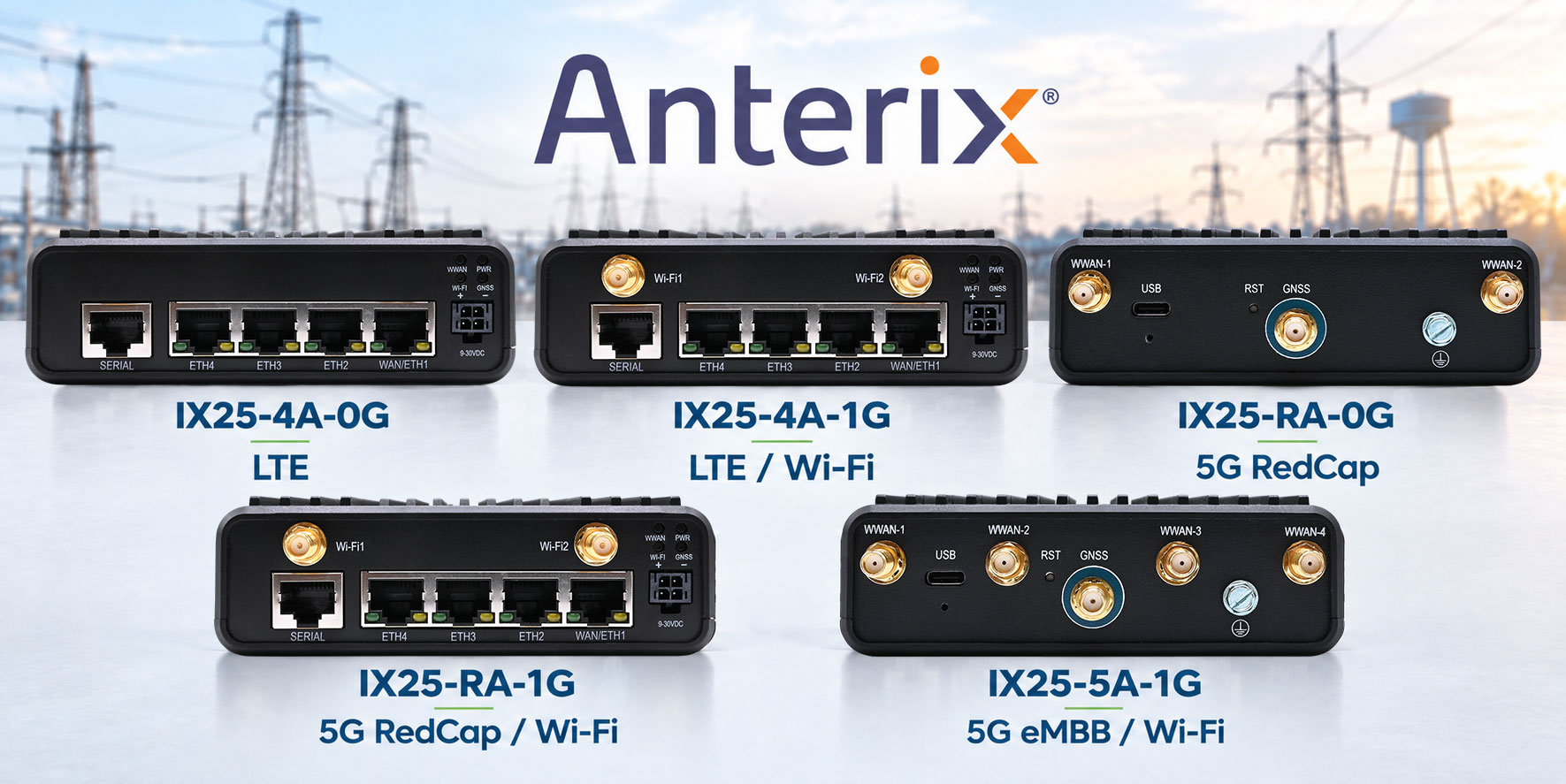 The LTE models support Band 8 (B8_US) for Anterix 900 MHz connectivity. The 5G RedCap and 5G eMBB models support Band 106 (B106) and are designed to support n106, pending enablement by the Qualcomm chipset. Once n106 is enabled, units already deployed in the field are expected to require only a software update to activate n106 capability, in addition to existing B106 support.
Why choose Digi IX25? Utilities today are dealing with a wide range of pressures—from upgrading outdated systems and enhancing service reliability to defending against cyber threats and complying with strict regulations. At the same time, increasing electrification is putting additional strain on the power grid. To keep up, organizations need communication networks that are not only secure and resilient but also adaptable to future demands. Digi IX25 addresses these needs by supporting public, private, and hybrid network environments, while delivering the security, dependability, and edge intelligence required for critical operations.
How Do Private Networks Support the Critical Needs of Utilities?
As utilities continue upgrading their infrastructure, the need for dependable and secure communications has become more urgent than ever. Conventional public networks often fall short of supporting the rigorous demands of modern grid systems — especially in terms of consistent uptime, strong security, and comprehensive coverage.
As a result, many utilities are adopting private network solutions that offer dedicated capacity and full operational control. Private networks, for instance, provide access to exclusive spectrum, helping ensure reliable connectivity even during emergencies when public systems may become overloaded or unavailable.
Beyond reliability, private networks allow utilities to give priority to essential communications while extending connectivity into rural or difficult-to-access locations. They also strengthen cybersecurity by enabling customized protections that exceed what shared networks typically provide. As distributed energy resources grow and smart grid initiatives expand, private networking is quickly becoming a cornerstone for maintaining secure, resilient utility operations.
Digi IX25 with Anterix: Designed for Secure and Resilient Utility Grids
Collaborations like the one between Digi and Anterix bring together complementary strengths to deliver a unified solution. Digi’s rugged, C1D2-certified IX cellular routers and advanced remote device management and built-in security combined with Anterix’s 900 MHz private wireless broadband spectrum, provides utilities with a highly capable and secure communications platform.
This combined approach delivers a low-band, 900 MHz edge computing solution that is especially effective for covering large, remote grid environments. Thanks to the strong propagation characteristics of lower-frequency spectrum, utilities can achieve broader reach with less infrastructure, including in areas where higher-frequency signals often fall short.
Using this technology, utilities can expand coverage across their networks more efficiently, reducing both upfront investment and rollout time. It also enables consolidation of older communication systems — such as land mobile radio (LMR) and narrowband networks — into a streamlined, modern broadband architecture.
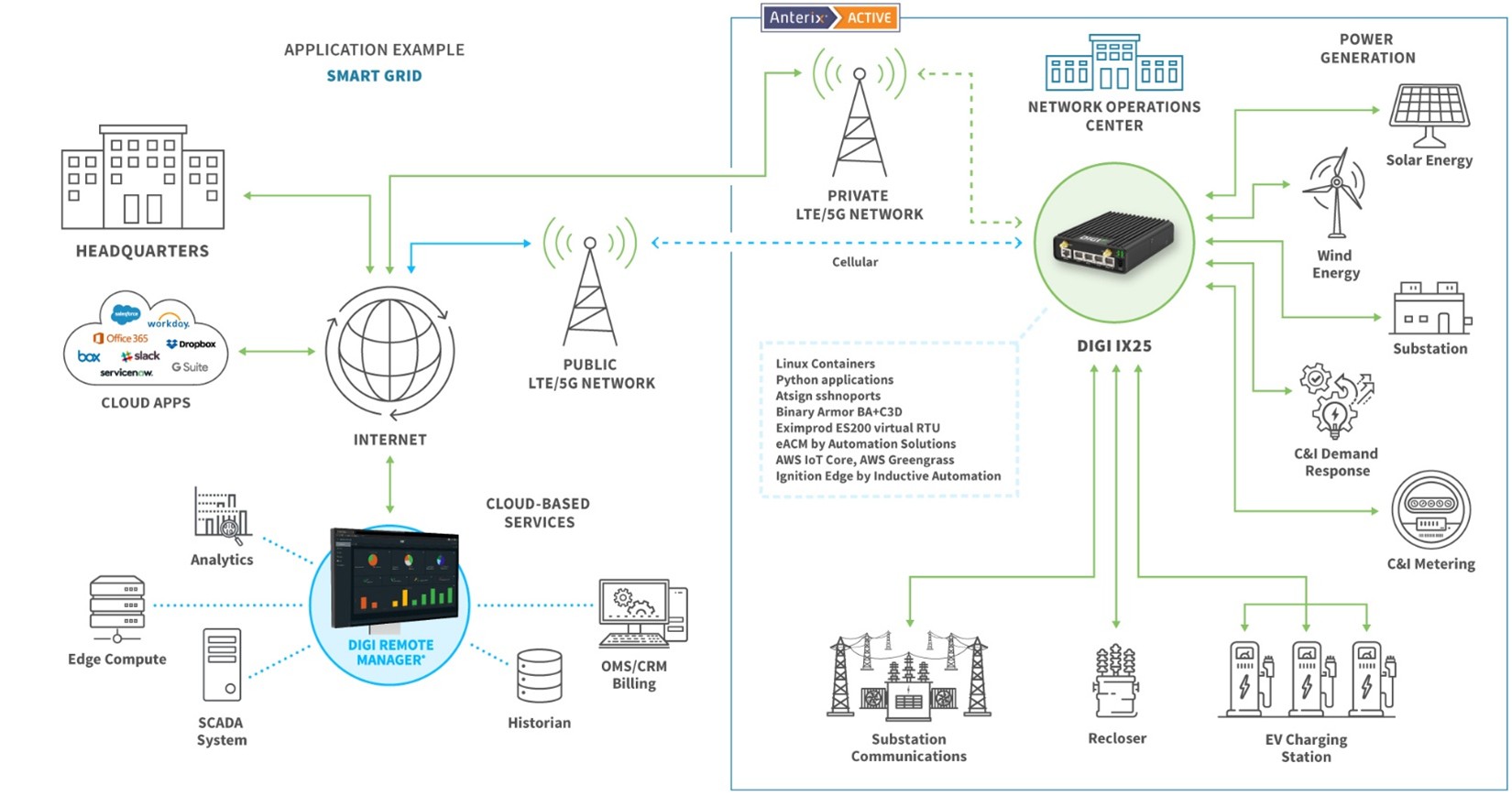
Key Benefits of Digi IX25 with Digi Remote Manager and Anterix 900 MHz Spectrum
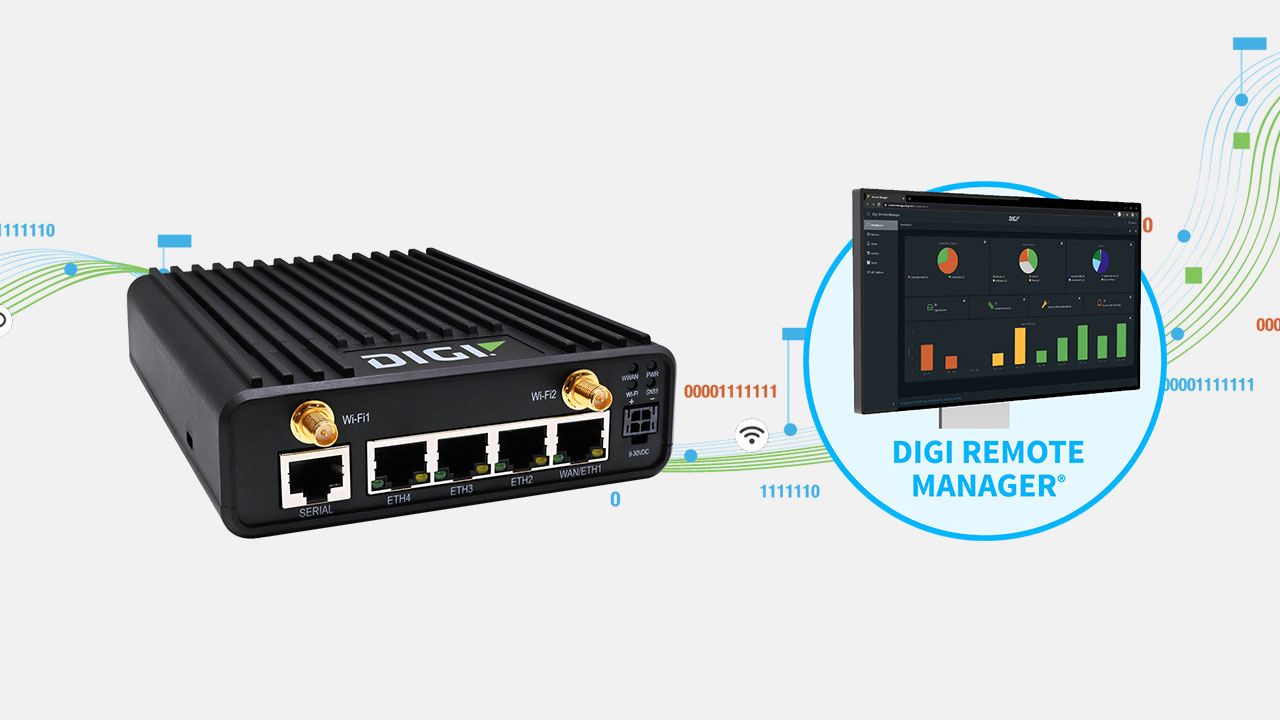
Digi cellular router solutions include remote monitoring and management, via Digi Remote Manager (DRM) — the command center of your secure and reliable network. Fully integrated via Digi 360, DRM enables rapid configuration as well as secure, network-wide remote visibility and control.
In this section we explore some of the capabilities this complete, integrated solution offers to utilities.
Deploying Secure and Reliable Private Networks at Scale
Rolling out a large network often requires significant time and expense. DRM streamlines this process by enabling devices to be pre-set and ready for quick, plug-and-play installation within a secure private network. Once deployed, teams gain real-time visibility into network performance, allowing them to quickly respond to disruptions or proactively establish predictive maintenance strategies to address issues before they lead to outages. This level of insight also helps reduce unnecessary site visits, ensuring field crews are dispatched only when truly needed, saving both time and operational costs.
Enhancing Reliability Through Built-in Redundancy
Pairing Digi IX25 cellular routers with Digi Remote Manager creates a highly dependable foundation for utility communications. The IX25 supports multi-carrier connectivity, enabling automatic transitions between different cellular networks — including both private and public options — so operations remain uninterrupted even if a network issue arises.
At the same time, Digi Remote Manager delivers a centralized platform for visibility and control, with real-time monitoring and automated alerts based on device conditions. This allows teams to quickly detect and resolve potential issues before they impact operations. Together, these capabilities form a resilient, fault-tolerant system that helps maintain consistent performance and uptime, even in remote or demanding environments.
Enhancing Connectivity for Remote and Mobile Service Teams
Utility operations frequently extend into remote and hard-to-reach locations, where maintaining consistent connectivity can be a challenge for field personnel. As technicians move between sites, signal interruptions are common. Digi’s multi-carrier cellular routers address this by automatically transitioning between available carriers, as well as public and private networks, to help ensure continuous, reliable communication for teams working in the field.
Ensuring Your Solutions Are Secure Over Their Lifecycle
Private networks offer an inherent security advantage by keeping organizational data contained within controlled environments, isolated from public network exposure. Building on this foundation, Digi cellular routers are engineered with security at their core and incorporate the Digi TrustFence framework—delivering advanced protections such as secure boot processes, hardened hardware interfaces, and strong network authentication.
Ongoing protection is equally critical, and that’s where Digi Remote Manager plays a central role. Included with Digi cellular solutions, it provides continuous oversight of connected devices through remote monitoring, real-time alerts, and the ability to push firmware updates across deployments to maintain the latest security standards. Even when devices are offline, secure out-of-band access allows teams to troubleshoot, restart systems, and manage security remotely — helping ensure networks remain protected at all times.
Use Case Highlights: Enhancing Utility Networks with Privacy and Security
Below are four key ways Digi IX25 industrial cellular routers, combined with Anterix’s 900 MHz spectrum, help utilities strengthen private networking, cybersecurity, and operational reliability.
1. Dependable Connectivity for Remote Grid Oversight
Digi IX25 routers, equipped to operate on Anterix’s 900 MHz spectrum, enable utilities to maintain steady communication across distant and hard-to-access grid locations. The low-band frequency provides strong signal reach, even in rural or wide-area environments where higher-frequency networks may struggle. This allows utilities to continuously track grid performance, identify issues as they arise, and manage energy delivery efficiently without disruption.
2. Secure, High-Throughput Data for SCADA Operations
Supervisory Control and Data Acquisition (SCADA) systems depend on reliable, secure data exchange. Digi IX25 routers support high-bandwidth communication between field devices and central control systems, ensuring timely and accurate data flow. Leveraging dedicated 900 MHz spectrum, these connections are protected with strong encryption and secure channels, helping safeguard sensitive operational data while enabling real-time system control.
3. Strengthened Protection for Distributed Energy Resources
As distributed energy resources (DERs) become more widespread, utilities must manage a more complex and decentralized network. Digi IX25 routers, paired with private 900 MHz spectrum, create a secure communications backbone for linking DERs with centralized systems. With features like VPN support and advanced authentication, these routers help protect data exchanges and reduce the risk of unauthorized access across the network.
4. Resilient Communications in Emergency Situations
During outages or natural disasters, maintaining reliable communication is critical. Digi IX25 routers operating on 900 MHz spectrum provide a dedicated, resilient network that remains operational even when public networks are congested or unavailable. With rugged C1D2 certification and FirstNet® compatibility, these solutions enable field teams to stay connected and coordinate response efforts effectively — supporting faster recovery and improved grid resilience.
FAQ: Digi IX25 Cellular Routers Support for Anterix 900 MHz Spectrum
What are the use cases for the Digi IX25 cellular router support?
Anterix support in Digi IX25 cellular router enables a range of applications in utilities and enterprise computing. The result is private, secure, and reliable communication networks, even in remote or challenging environments. The Anterix spectrum is particularly beneficial because it offers enhanced signal propagation and can cover larger areas with fewer cell towers.
What are the Digi IX25 SKUs and what bands do they support?
The Digi IX25 platform includes five SKUs, all supporting Anterix:
- IX25-4A-0G and IX25-4A-1G – LTE and LTE/Wi-Fi variants
- IX25-RA-0G and IX25-RA-1G – 5G RedCap and 5G RedCap/Wi-Fi variants
- IX25-5A-1G – 5G eMBB/Wi-Fi variant
The LTE models support Band 8 (B8_US) for Anterix 900 MHz connectivity. The 5G RedCap and 5G eMBB models support Band 106 (B106) and are designed to support n106, pending enablement by the Qualcomm chipset. Once n106 is enabled, units already deployed in the field are expected to require only a software update to activate n106 capability, in addition to existing B106 support.
How does Digi IX25 benefit from the Anterix 900 MHz spectrum?
With compatibility for Anterix’s 900 MHz spectrum, the Digi IX25 cellular router delivers dependable, secure connectivity across large and widely distributed service territories. It integrates smoothly into private network environments, offering consistent, dedicated communication for critical assets, sensors, and field equipment in remote areas. By combining the long-range advantages of low-band spectrum with advanced routing capabilities, Digi IX25 enhances both network reach and overall performance, helping ensure continuous data flow even in challenging conditions.
How does edge computing improve Digi IX25 performance?
Edge computing shifts data processing closer to where information is generated, rather than sending everything to a centralized cloud. This approach reduces delays, supports faster decision-making, and lessens dependence on continuous cloud access. Digi IX25 incorporates this capability by handling data locally, making it well-suited for use cases that demand immediate responsiveness — such as industrial automation or real-time monitoring. By analyzing and acting on data at the source, the router helps boost system speed, efficiency, and overall performance.
How does Digi IX25 strengthen privacy and security in private networks?
The Digi IX25 router, designed to operate with Anterix’s 900 MHz spectrum, enables deployment within private network environments that are separated from public Internet traffic — helping reduce exposure to external threats. This isolation gives organizations greater control over who and what can access the network, significantly lowering cybersecurity risks.
In addition, the router incorporates advanced security features such as encryption, secure boot processes, and protected tunneling protocols. Together, these capabilities create a strong defense framework that helps safeguard sensitive data, prevent unauthorized access, and support compliance with regulatory standards like HIPAA and GDPR.
How does Digi IX25 ensure low latency for critical communications?
For applications that depend on immediate data exchange — such as grid management or transportation systems—minimizing delay is vital. Digi IX25, when paired with Anterix’s 900 MHz spectrum, delivers a dedicated and reliable communication channel designed for these high-priority use cases.
In addition, its edge computing capabilities allow data to be processed directly at the source instead of relying on distant cloud systems. This localized processing significantly reduces response times, enabling faster decisions and near real-time actions — helping maintain both operational performance and safety.
How does Digi IX25 contribute to reliable private network performance?
Dependability is critical for industrial systems and essential infrastructure. Digi IX25 strengthens private network reliability by maintaining consistent connectivity, even in remote or demanding environments, with the help of Anterix’s 900 MHz spectrum.
It also supports multi-network operation through dual-SIM or dual-radio functionality, allowing it to transition between carriers if one connection becomes unstable. With built-in failover and recovery mechanisms, the router can automatically shift to an alternate network path, helping ensure uninterrupted operations and minimizing downtime.
What advantages do private networks offer for industrial and utility environments?
Private networks deliver several important benefits for industrial and utility use cases:
- Reduced latency: By using dedicated bandwidth and avoiding the congestion common in public networks, private solutions — like those enabled by the Digi IX25 with Anterix’s 900 MHz spectrum — support faster data transmission and improved real-time responsiveness.
- Stronger security and data privacy: Keeping data within a controlled network environment helps limit exposure to external threats, reducing the risk of breaches or unauthorized access — especially important for critical infrastructure and automation systems.
- Greater reliability: With reserved network resources, private networks offer consistent connectivity and uptime, even in remote or challenging locations, helping ensure operations continue smoothly despite disruptions that might affect public networks.
How does Digi IX25 help future-proof industrial and utility networks?
Digi IX25 is designed with flexibility in mind, allowing it to adapt as network requirements evolve. With support for Anterix’s 900 MHz spectrum as well as both private and public network environments, it can accommodate shifting connectivity strategies over time.
Its edge computing capabilities make it well-suited for emerging technologies like IoT, smart grid applications, and industrial automation, while still maintaining strong performance and security. Additionally, the router supports multiple connectivity options, including cellular, Wi-Fi, and Bluetooth, enabling seamless integration with new standards and communication methods as they develop. This adaptability ensures networks remain scalable, resilient, and ready to support future innovations.
Can Digi IX25 Anterix support work with existing systems and infrastructure?
Absolutely. Digi IX25 is built for compatibility, making it easy to incorporate into both established and modern network environments. It supports a wide variety of communication protocols, allowing it to connect with legacy equipment as well as newer technologies.
With flexible configuration options and cloud-based management tools, organizations can simplify the process of integrating different network components. This makes it easier to upgrade infrastructure without disruption, ensuring smooth operation across a mix of old and new systems.
How does Digi IX25 streamline network management for enterprises and utilities?
Digi IX25, paired with Digi Remote Manager, makes overseeing network operations far more efficient by bringing everything into a single, centralized interface. Through this cloud-based platform, organizations can monitor device performance in real time, diagnose issues remotely, and deploy secure updates without needing on-site intervention.
This approach allows teams to efficiently manage large deployments of field devices, control data usage, and maintain compliance with network requirements. By enabling full remote visibility and control, Digi Remote Manager helps reduce downtime, improve responsiveness, and simplify overall network administration.