Summary
Private networks restrict access to authorized users and devices, offering stronger security, better performance, and greater control than public networks, which are open to anyone. For businesses handling sensitive data, supporting IoT devices, or operating in challenging environments, a private network — especially a private 5G or LTE network — is usually the better choice. Transitioning from a public to private network involves defining your use case, securing the right hardware, and implementing access controls.
The differences between a private network vs public network are significant, and include key issues of significance to connected enterprises today, such as security and privacy. How do you decide which one is right for you? Perhaps you're considering the attractive affordability of a public Internet connection. However, your organization might require the greater security of a private network connection.
Either way, it's important to understand how your choices can greatly impact online security and privacy in your enterprise. In this blog post, we will introduce the concept of a private network, discuss the merits of a public network vs. a private network, and explain about how to change from public to private network architectures.
Private Network vs. Public Network at a Glance
| Feature |
Private Network |
Public Network |
| Access |
Restricted to authorized users |
Open to the general public |
| Security |
High |
Lower |
| Control |
Organization-controlled |
Provider-controlled |
| Performance |
Predictable and customizable |
Subject to congestion |
| Cost |
Higher upfront investment |
Lower initial cost |
| Best For |
Enterprises, industrial IoT, and critical operations |
General internet access and public connectivity |
Differences Between Private Network vs Public Network
Ultimately, there are many key differences when looking at a public vs private network. As companies navigate the complexities of digital transformation, understanding these network types is critical for safeguarding assets and ensuring seamless operations. Let's start with some definitions.
- What is a public network? As the name suggests, a public network is accessible to virtually anyone. Open Wi-Fi networks at airports, coffee shops, and similar venues are prime examples of public networks.
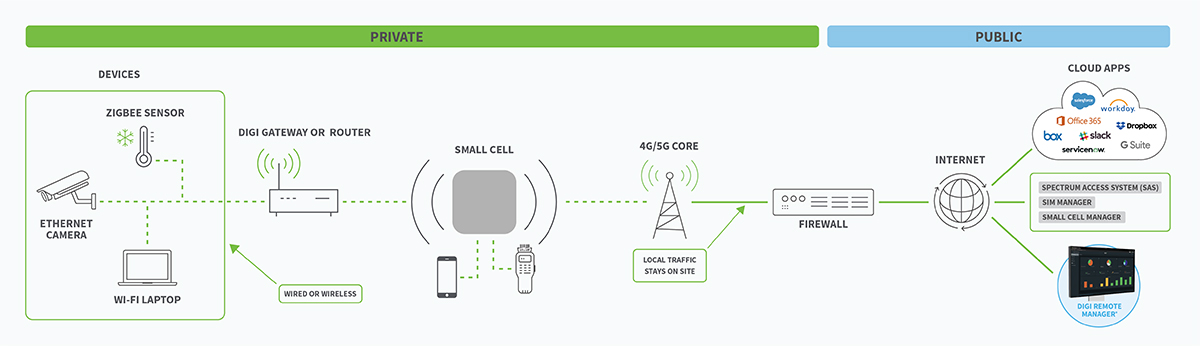
- What is a private network? A private network — including private LTE based on CBRS — restricts access. Only devices, systems, and users with appropriate authorization and authentication can connect, so private networks are best when creating secure networks to enhance your SD-WAN implementation, connect 5G IoT devices and smart cities, or simply prevent unauthorized parties from reaching internal data or assets.
Additionally, here are 5 key differences between a public network vs private network:
- Public networks allow access to virtually anyone, while private networks strictly limit access to authorized users.
- Private networks are more controlled and secure, while public networks are more vulnerable to cyberattacks, intrusions, and malware.
- Public networks offer a higher degree of convenience and accessibility, while private networks require hardware or software to set up, manage, and operate.
- Private networks are traditionally operated by a specific entity, like an individual or company, while public networks are more commonly managed by public organizations, government agencies, or service providers.
- Public networks are congestion-prone and vulnerable to interference due to the lack of user restrictions, while congestion, latency, and speed are controllable on private networks, and interference is mitigated.
Learn more: What Are CBRS and Private LTE, and What Are the Use Cases?
Network Discovery
Network discovery is the process that enables devices on the same network to find, connect, and communicate with one another. On public networks, device discovery carries a degree of risk, since it lets the general public potentially communicate with or connect to any (or all) connected device.
When using 5G private network architecture or another private network setup, network discovery can be beneficial. Users can access shared assets — like networked printers — but since only authorized parties are allowed on the network, there's significantly less risk of unauthorized access or usage.
Get Our eBook
Learn about the Digi IX25 5G Edge Computer Solution
Download PDF
Private Network Firewall
Network firewalls enhance security by preventing unauthorized parties from accessing network resources. Firewalls are inherently part of private 5G network architecture, ensuring only authorized traffic can use the network. This reduces risk dramatically, as firewall settings are customizable, allowing organizations to block undesirable traffic automatically.
Public networks usually lack firewalls. As a result, those networks are open to essentially any kind of traffic, including users with nefarious purposes. This introduces significant risk.
Watch and learn more: The Benefits and Use Cases of Private Networks
What Is a Public Network?
When you're exploring the difference between a private vs a public network, it's helpful to understand precisely what's involved. Public networks are broadly accessible networks with essentially no controls in place to limit access. They're often referred to as unsecured networks, since public networks can lack security features like a private network firewall. That puts any user at risk, since activity on the network is potentially viewable or interceptable by others.
However, highly accessible public networks are also incredibly convenient. They don't require users to enter credentials or take similar steps to connect. Here are some scenarios where a public network can be the best choice:
- Customer Convenience — Providing Internet connectivity or access to specific services to guests, visitors, or customers outside of the company's internal network
- Community Internet Access — Supporting a public-sector need, such as information accessibility or communication among members of the general public
- Temporary Events and Conferences — For attendees at conferences and trade shows, a public network can facilitate connectivity without navigating complex security protocols.
Learn how CBRS is enabling mobile private networks and discover new use cases.
What Is a Private Network?
Private networks — including mobile private networks — are secured networks accessible only to specific users or devices, often businesses or even home Internet users. Unlike public networks, access to a private network requires some form of permission or authentication. At the simplest level, a password provides a user with network entry. However, whitelisting devices or other techniques are useable, as well, limiting the need for manual processes to connect to the network.
This exclusivity ensures a higher level of security and control, making it ideal for handling sensitive information, supporting business operations, and connecting devices within a household. While private networks offer enhanced protection and performance, they may involve more setup and maintenance costs compared to public networks, and their secure nature restricts access to authorized users only.
Here are some example use cases for private networks:
- A construction site that must ensure data security and Internet reliability.
- An industrial complex (e.g., a refinery whose location isn't ideal for accessing public networks.
- A warehouse where dense walls inhibit signal reliability.
- IoT devices used in smart factories or smart cities to streamline operations and ensure proper speeds
Private 5G Networks
A private 5G network is a dedicated wireless network infrastructure that leverage high speed, low latency, dedicated bandwidth and control, and secure device connectivity. Unlike 5G networks offered by telecom carriers to the public, private 5G networks provide businesses with exclusive control over their data traffic, security, and network management. This allows for tailored deployment in environments requiring specialized network performance, such as industrial plants, factories, and warehouses. Private 5G networks support advanced applications like autonomous vehicles, IoT devices, and real-time data analytics, offering significant advantages in security, capacity, and customization compared to public networks. Private networks in a 5G world leverage the advanced capabilities of 5G technology to enhance operational efficiency and enable innovative services that require reliable and fast communication channels.
Still wondering what's different? Read more about the differences between LTE vs 5G.
The Benefits of a Private Company Network
When choosing between a public or private network — including private 5G networks — understanding the benefits of a private company network is essential. For many organizations, private networks are the logical choice for internal connectivity, as they have features that aren't found with public ones.
Here is an overview of the benefits of a private company network:
- Security: Prevent unauthorized access to internal assets and reduce malware or intrusion risk.
- Data privacy: Stop unauthorized individuals from accessing internal data, ensuring information is safeguarded.
- Performance: Offer higher connection speeds with greater reliability by preventing congestion to reduce latency and limiting any strain on the available bandwidth.
- Customization: Design the network to meet specific needs, including what data or assets are accessible through it, which devices can connect, and more.
- Scalability: Update the network to align it with shifting needs, ensuring it offers suitable connectivity and speed to achieve operational goals.
- Control: Keep full control over access and maintain visibility into all network activities.
- Cost efficiency: Achieve lower data transfer costs by choosing a private 5G or LTE network over public 5G or LTE.
- Coverage: Create coverage for mobile or IoT devices where public coverage isn't available.
- Capacity: Manage the network to provide the needed amount of capacity to support company operations.
How to Change a Network from Public to Private
Whether you've explored the 5G applications and use cases and want to build a private mobile network or have an existing network, it's common to ask questions like, "How do I make my network private?" or "How do I make my Internet connection private?"
In many cases, to change a public network to private, the exact path varies depending on your existing infrastructure. However, by understanding how to build a private network, it's easier to see how to change a network from public to a private.
Here's an overview of the steps:
- Outline the use case: Before you set up a private network or change a public network to private, an analysis of your needs will lead to better planning. It creates opportunities to determine the type of connectivity required, the security features needed, and the assets that will be accessible within the network.
- Secure the right technology: Private networks typically require specific technologies, such as firewalls, routers (or cellular routers for 5G private networks), servers, switches, hubs, access points, endpoints, and more. As a starting point, it's critical to design your network architecture by building a network diagram, allowing you to determine where to position security technologies and which assets need connecting.
- Implement access and device controls: Private networks are permissions-based, so you need specific network management tools in place to authorize access to devices or users. For example, Digi Remote Manager simplifies the configuring, deployment, and management of IoT assets by bringing them together onto a centralized platform.
- Authorize access: Once the network is created, you either need to whitelist devices or provide login credentials to authorized users. Both approaches ensure the right devices or users can access the network while preventing access by unauthorized devices or people.
Set Up a Secure Private Network with Digi's LTE Solutions
Ultimately, there are significant differences between a private network vs a public network. In most cases, private networks are the best choice for organizations. Private networks offer enhanced security, greater speed, and more control. Private networks in a 5G world can offer even more, as a 5G private network allows you to leverage C-band connectivity for greater efficiency.
If you're ready to empower SD-WAN with optimized LTE and 5G connectivity, Digi has the technology you need to build a secure, robust, and reliable private mobile network. Take your IoT project to the next level, offer durable connections in vehicles, and much more by leveraging Digi's cutting-edge networking solutions.
Public vs. Private Network FAQs
What is the main difference between a private network and a public network?
A private network restricts access to authorized users and devices, while a public network is accessible to a broader group of users.
Are private networks more secure than public networks?
Yes. Private networks offer greater control over access, security policies, and network traffic, reducing exposure to external threats.
When should a business use a private LTE or private 5G network?
Private cellular networks are ideal when organizations require secure, reliable connectivity for critical operations, IoT devices, or industrial applications.
Can a business use both a private and public network?
Yes. Many organizations use hybrid network architectures that combine private infrastructure with public internet connectivity.
Next Steps
Editorial note: This blog post was first published in May of 2024, and updated in July of 2026.