Summary
Network downtime can cost businesses $20,000+ per hour. Unlike a second wired line, which shares the same physical vulnerabilities as the primary, cellular failover automatically switches to a 4G LTE connection when the primary goes down, keeping transactions, ATMs, POS terminals, and other critical systems online. Paired with out-of-band management, it also eliminates unnecessary truck rolls by enabling remote diagnosis and fixes. As cellular costs drop and reliability improves, many retailers are moving to cellular as their primary connection, not just a backup.
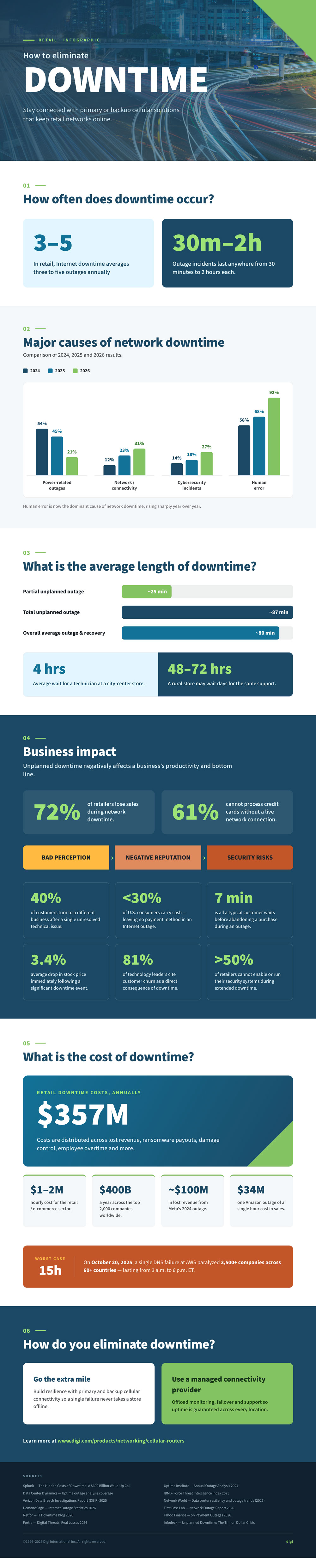
Every Minute of Downtime Costs Retailers Real Money
Every minute a retailer's network is down, money walks out the door. Or, more accurately, it never comes in. Network failures can stem from a surprisingly wide range of causes, from a construction crew accidentally severing a fiber line to a sophisticated DDoS attack. For retail and other transaction-based businesses, the stakes are especially high: a single outage can mean failed payments, frustrated customers, and lasting damage to your brand's reputation.
The good news is that modern 5G cellular networking solutions make it possible to virtually eliminate that downtime automatically, securely, and at a fraction of the cost of traditional redundancy methods.
Key Takeaways
- Network failure is costly to retail businesses in multiple ways, from loss of revenue to network recovery costs and damage to brand reputation
- Retail downtime due to network outages is common, especially for businesses that do not have a reliable failover method established
- 5G cellular failover is emerging as a key strategy for business continuity, ensuring sales transactions can continue in the event of wireline failures
What Causes Network Failures?
Understanding the root causes of outages is the first step toward preventing them. Most retail network failures fall into one of five categories:
- Outages due to storms and damage to infrastructure. Wired broadband and fiber connections are never immune from line cuts. A backhoe, a storm, aging conduit, or scheduled maintenance can sever your connection without warning.
- ISP and upstream failures. Your connection could be perfectly intact, but a failure somewhere upstream in your provider's network or at a peering point can still take you offline.
- Hardware failure. Routers, switches, and modems have finite lifespans. A failed component or a misconfigured firmware update can bring down an otherwise healthy connection without notice.
- Cyberattacks. Distributed denial-of-service (DDoS) attacks against retail networks are attractive targets, particularly during peak shopping periods when the cost of disruption is highest.
- Human error. Misconfigured equipment, an accidental cable disconnection, or an inadvertent change to a routing table can take a network offline as quickly as any physical event.
The Real Cost of Retail Downtime
The financial impact of network outages is well documented and sobering. Research indicates that small retail businesses can lose between $137 and $427 per minute in revenue during an outage, while enterprise-scale downtime can climb to $9,000 per minute. Gartner pegs the average across all business types at $5,600 per minute.
Beyond direct revenue loss, there is the operational chaos of re-syncing transaction data, reconciling inventory discrepancies, and managing customers who couldn't complete their purchases. Under current PCI DSS 4.0 standards, retailers can no longer store cardholder data for offline processing. This means that when the network goes down, payments simply stop.
Customer trust is harder to quantify but no less real. A checkout line that grinds to a halt doesn't just cost a transaction; it can cost a customer relationship.
The Solution: 5G Cellular Failover
5G wireless networks now deliver enterprise-grade performance that rivals and in some cases exceeds fixed-line broadband: latencies around 10–20 ms, throughput up to several hundred Mbps, and near-ubiquitous coverage across urban and suburban markets. Critically, a cellular connection is physically independent of your wired infrastructure. A fiber cut that takes your primary line down has zero impact on a 5G cellular backup running on a separate physical path.
When the wired system fails, a properly configured 5G router automatically switches over in milliseconds, without user intervention — keeping payment terminals, inventory systems, loyalty applications, and back-office tools running without interruption. When primary connectivity is restored, traffic shifts back just as seamlessly.
The availability of 5G networks used for cellular failover is now reaching 99.99%. Many businesses are also discovering that cellular isn't just a reliable failover path — it can serve as a cost-effective primary connection, especially for pop-up retail, seasonal locations, or remote sites where running fiber is prohibitively expensive.
Digi 5G Solutions for Retail
Digi offers a purpose-built portfolio of 5G routers and gateways designed to meet the full range of retail connectivity requirements, from the main store back office to kiosks, ATMs, and distributed edge deployments.
Digi EX50: Enterprise 5G for Store Operations
Digi EX50 is the go-to 5G solution for enterprise retail environments. Its compact form factor makes it ideal wherever the work is happening, whether deployed at headquarters for backup connectivity, at the branch for cost-optimized primary connectivity, or in the back office for secure, all-in-one connectivity with Wi-Fi.
Key capabilities for retail include:
- Remote monitoring and management: Full integration with Digi Remote Manager (DRM) enables complete visibility across your deployment, plus the ability to keep your devices up-to-date and secure with a few clicks
- 5G SA/NSA with LTE Cat 20 fallback: Full-speed 5G where available, with graceful fallback to LTE in areas where 5G hasn't yet fully rolled out
- Dual SIM slots: Automatic SIM-to-SIM failover across carriers for maximum availability, even if one carrier experiences an outage
- Wi-Fi 6: The latest generation of Wi-Fi radios for high-speed, high-capacity local wireless, supporting modern POS devices and customer-facing applications
- Dual 2.5 Gigabit Ethernet ports: Breaks the Gigabit barrier to deliver the full benefit of 5G speeds to wired devices
- Digi SureLink: Continuously probes the WAN using ping, TCP, or DNS tests, automatically triggering recovery actions when issues are detected
- Digi TrustFence security framework: Built-in VPN (IPSec, GRE, WireGuard), stateful firewall, and intrusion prevention, with support for PCI DSS compliance
- PoE+ powered: Can be powered directly by an active PoE+ switch or DC barrel connector, simplifying installation and providing power redundancy
- FIPS 140-3 certified: Meets U.S. government cybersecurity standards, important for retailers handling sensitive payment data
Digi IX25: Rugged 5G for Kiosks, ATMs, and Edge Deployments
For retail environments that extend beyond the back office, such as self-checkout kiosks, outdoor payment terminals, ATMs, digital signage, and distributed vending infrastructure, Digi IX25 delivers rugged 5G connectivity purpose-built for demanding edge deployments.
Launched in March 2026, IX25 is a next-generation industrial 5G router that combines cellular networking, edge computing, and secure remote management in a single hardened device. Key features include:
- Remote monitoring and management: Digi Remote Manager, included with each router, ensures your team can keep tabs on the health of your deployment and keep your device firmware up-to-date and secure with just a few clicks
- 5G eMBB, 5G RedCap, and LTE across a unified platform — Choose the right connectivity tier for each deployment; RedCap delivers right-sized performance and lower power consumption for IoT and telemetry use cases, while eMBB supports high-bandwidth applications
- Active eSIM with GSMA SGP.32 support — Remote carrier provisioning and switching without physical SIM swaps; for retailers managing hundreds of kiosk or ATM deployments across multiple regions, this eliminates truck rolls just to change carriers
- Dual nano-SIM + eSIM — Multi-carrier redundancy ensures the device stays connected even when a carrier's coverage or pricing changes
- Four integrated Gigabit Ethernet ports — Eliminates the need for a separate switch inside space-constrained field cabinets or kiosks
- Quad-core ARM64 processor with Linux container support — Run edge applications like telemetry processing or custom retail analytics directly on the router, reducing latency and bandwidth consumption
- Rated −40 °C to +75 °C, C1D2, ATEX, MIL-STD-810H certified — Built to perform in harsh environments, from outdoor payment terminals to back-of-house utility areas
- TAA-compliant with Western cellular modules — Important for retailers operating in regulated environments or supplying government and public-sector contracts
- Digi SureLink + optional WAN Bonding — Intelligent failover, policy-based routing, and interface bonding to prevent any single network failure from causing downtime
Managing Failover at Scale with Digi Remote Manager
Both Digi EX50 and IX25 are centrally managed through DRM — a SOC 2 Type 2 certified, cloud-based platform that gives IT teams a single point of command over every deployed router, from five locations to five thousand. Key capabilities include:
- Real-time monitoring and alerts: Track device health and connectivity status across the fleet, with automated alerts for outages or configuration drift
- Remote remediation: Trigger fixes instantly from the dashboard, resolving most issues without a truck roll
- Configuration Manager: Automatically detects and corrects unauthorized changes fleet-wide, maintaining security compliance across every device
- Mass firmware updates: Schedule and push updates to any device group in minutes, keeping the network current and secure
- Out-of-band management: Retains secure console access to remote equipment even when the primary WAN is down, enabling diagnosis and repair while the backup cellular link keeps the store running
Digi 360 bundles DRM, a hardware warranty, and 24/7 customer care into a single subscription. Digi 360 is included with every IX25 for the first year and available for EX50.
How Digi SureLink Keeps Retail Running
Both Digi EX50 and Digi IX25 feature Digi SureLink, Digi's proprietary link integrity technology. Rather than waiting for a connection to visibly fail, SureLink continuously probes WAN interfaces using configurable ping, TCP, or DNS tests. If a test fails, SureLink can automatically switch to the backup cellular connection, restart the modem, reboot the device, or execute other customizable recovery actions — all without manual intervention.
Paired with dual-SIM support, SureLink provides a layered failover architecture: If the primary wired connection fails, the system fails over to cellular; if the primary SIM carrier experiences an outage, the device switches automatically to the secondary SIM. Retailers running Digi equipment across hundreds of locations can be confident that no single failure, whether wired or wireless, will take a store offline.
Deployment Scenarios
Multi-location retail chain. A large retailer deploys Digi EX50 routers across 500+ stores, each configured with dual SIMs from different carriers. During a regional ISP fiber cut, affected stores automatically fail over to 5G in milliseconds. Store managers notice nothing. Payments continue, inventory syncs, and loyalty programs stay online. When fiber is restored, traffic shifts back without any intervention.
Kiosk and ATM network. A retailer managing a fleet of self-checkout kiosks and outdoor payment terminals deploys Digi IX25 routers in each unit. Remote carrier provisioning via eSIM means adding a new location or switching carriers requires no site visit. Edge compute on Digi IX25 handles local telemetry and alerts IT to anomalies before they become outages.
Pop-up and seasonal retail. A brand opening temporary locations for the holiday season uses Digi EX50 as a primary 5G connection. No fiber installation is required, and there is no long-term ISP contract. Stores are online in hours, not weeks.
Managed Connectivity: Digi Ventus
For retailers who want 5G cellular failover without the burden of managing the infrastructure themselves, Digi Ventus offers a fully managed alternative. Delivered as a subscription through the Managed Connectivity Platform (MCP) program, Digi Ventus bundles Digi hardware, including Digi EX50 and IX25, with dual-SIM 5G connectivity, Digi SureLink failover, Digi TrustFence security, and 24x7x365 expert support into a single, predictable monthly cost. For retail chains scaling locations, adding seasonal formats, or managing distributed kiosks and ATMs, Digi Ventus delivers the resilience and simplicity that in-house deployments often struggle to match. Learn more at ventus.digi.com.
Getting Started
Network downtime is not inevitable. With the right 5G failover architecture in place, retail businesses can achieve near-zero downtime across every location to protect revenue, maintain PCI compliance, and deliver the seamless customer experience that modern retail demands.
Digi's enterprise solutions, including Digi EX50 and Digi IX25, are backed by industry-leading software, including Digi Accelerated Linux (DAL OS), Digi TrustFence security, and Digi Remote Manager, giving IT teams the tools to deploy, manage, and secure their connectivity infrastructure at any scale.
Frequently Asked Questions
How fast does Digi 5G cellular failover actually switch over when my primary connection fails?
With Digi SureLink actively monitoring your WAN connection, failover to a 5G cellular backup happens in milliseconds — fast enough that payment terminals and POS systems stay online without interruption. Unlike passive failover solutions that wait for a connection to fully drop before responding, SureLink proactively detects degradation through continuous ping, TCP, and DNS tests and acts before a full outage occurs.
Does the 5G failover capability of Digi routers support PCI DSS compliance?
Yes. Digi EX50 and Digi IX25 both include the Digi TrustFence security framework, which provides built-in VPN support (IPSec, GRE, WireGuard), stateful firewall, and intrusion prevention to support PCI DSS compliance. Under PCI DSS 4.0, retailers can no longer store cardholder data for offline processing, making a reliable backup connection not just a convenience but a compliance requirement.
How do Digi routers maintain connectivity if both my primary wired connection and my cellular carrier go down at the same time?
Digi EX50 and Digi IX25 both support dual SIM slots, allowing you to provision SIMs from two different carriers. If your primary SIM carrier experiences an outage, Digi SureLink automatically switches to the secondary SIM on a separate carrier network. This layered failover — wired to cellular, and carrier-to-carrier within cellular — means no single failure point can take a store offline.
Is 5G available everywhere my stores are located?
5G coverage is now near-ubiquitous across urban and suburban markets in the U.S., but availability varies by carrier and location. With Digi cellular routers, you're always covered with always-on connectivity via 4G LTE fallback and dual SIMs for multi-carrier connectivity..
How do Digi 5G routers support retail connectivity when 5G is not available?
Both Digi EX50 and Digi IX25 include LTE fallback, so if 5G isn't available at a specific site, the router automatically connects at LTE speeds — still more than sufficient for payment processing, inventory management, and back-office applications.
How difficult is it to manage Digi 5G failover routers across hundreds of store locations?
Digi Remote Manager (DRM) gives IT teams centralized visibility and control over every deployed router from a single dashboard, whether that's 5 locations or 5,000. You can monitor device health in real time, push firmware updates to device groups in bulk, remotely remediate issues without a truck roll, and automatically detect and correct configuration drift. Out-of-band management also lets you access and troubleshoot a device even when its primary WAN connection is down.
Can I use 5G as the primary connection for my retail site instead of fiber or broadband?
Absolutely. Many retailers are now moving to 5G cellular connectivity as the primary connection for pop-up locations, seasonal stores, kiosks, and remote sites where running fiber is cost-prohibitive or time-consuming. 5G networks now deliver latencies of 10–20 ms and throughput of several hundred Mbps, which is more than capable of handling modern retail workloads. For permanent locations, cellular can serve as a cost-effective primary connection or as part of a dual-WAN architecture alongside a fixed broadband line.
What's the difference between Digi EX50 and Digi IX25, and which one is right for my deployment?
Digi EX50 is designed for enterprise store environments, including back offices, headquarters, and branch locations where you need high-performance 5G connectivity with Wi-Fi 6, PoE+ power flexibility, and a compact footprint. Digi IX25 is purpose-built for more rugged edge deployments: self-checkout kiosks, outdoor ATMs, payment terminals, and vending infrastructure that operate in challenging physical environments. Digi IX25 also adds edge computing capabilities, allowing you to run local analytics and telemetry applications directly on the device. If you're managing a mix of both, Digi Remote Manager handles centralized oversight of the entire fleet.
Next Steps
Editorial note: This blog post was originally published in August of 2019 and was updated in June of 2026.