Summary
Smart transportation uses IoT sensors, 5G connectivity, AI, and edge computing to monitor and manage vehicles, roads, and transit systems in real time, making cities safer, more efficient, and more cost-effective. Real-world deployments — including NYC DOT's 14,000 connected intersections, Portland TriMet's transit signal priority project, Miami-Dade's ATMS, SEPTA's positive train control, and Detroit SMART's dispatch system — show how connected infrastructure reduces congestion, improves emergency response, and cuts maintenance costs. While challenges like sensor power consumption and data privacy remain, smart transportation also strengthens cybersecurity resilience, environmental sustainability, and supply chain reliability, and Digi's transportation cellular routers and Remote Manager platform are powering many of these deployments today.
Smart transportation and smart city traffic management are revolutionizing how cities approach mobility and emergency response, while reducing congestion on city streets. How? With sensors, advanced communication technologies, automation and high-speed networks.
What Is Smart Transportation?
Smart transportation uses connected sensors, communications networks, software and intelligent transportation systems (ITS) to monitor and manage vehicles, roads and transit infrastructure in real time, with the goals of improving safety, mobility, efficiency and reliability.
Common applications include:
- Adaptive traffic signals
- Connected vehicles
- Transit signal priority
- Incident management
- Fleet monitoring
This article will describe the technologies that support smart transportation, how it works, and many of the benefits it brings along with some real-world examples in use today.
Smart Transportation vs. ITS
While Intelligent Transportation Systems (ITS) focus heavily on the engineering, hardware, and data communication of traffic and vehicles, smart transportation is a broader, modern concept that wraps ITS into a total lifestyle, city-planning, and sustainability framework. ITS is the functional toolset (like smart signals and sensors), whereas smart transportation is the broader ecosystem (including electric vehicle integration, shared mobility, and cloud data).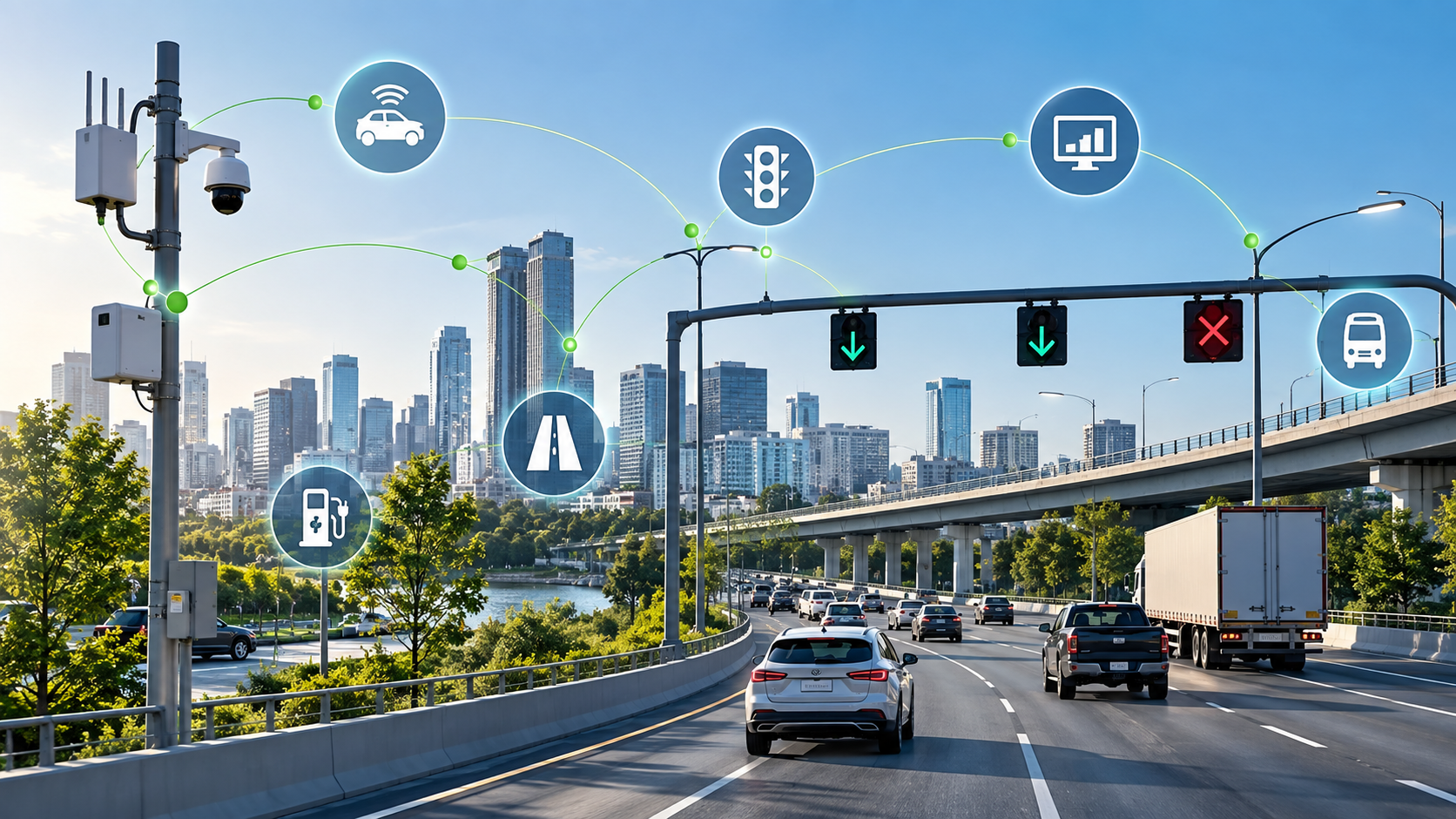
According to the US Department of Transportation, “Intelligent Transportation Systems (ITS) apply a variety of technologies to monitor, evaluate, and manage transportation systems to enhance efficiency and safety.” By contrast, smart transportation uses new and emerging technologies to make moving around a city more convenient, more cost effective (for both the city and the individual), and safer.
What emerging technologies are facilitating these new opportunities? Primarily the proliferation of IoT devices and 5G communication technology. The former provides for inexpensive sensors and controllers that can be imbedded into nearly any physical machine to be controlled and managed remotely. The latter provides the high speed communications needed for managing and controlling transportation systems in real time with minimal latency.
Smart transportation is not just a theory for the future; it is being implemented today in several cities with their successes and failures being used to improve systems in new locations. Some of the cities that are implementing new transportation technologies may surprise you at first. Of course, global hubs like New York City have embraced smart transportation for their ever increasingly intelligent city. However, the rural state of Wyoming is also a leading testbed for connected vehicles. This is because the cowboy state is a major freight corridor, which means autonomous transportation of goods across the country can drastically improve supply chain efficiency and reduce the need for long-haul drivers forced to balance tight timelines with their human need for rest.
The Main Benefits of Transportation Technology
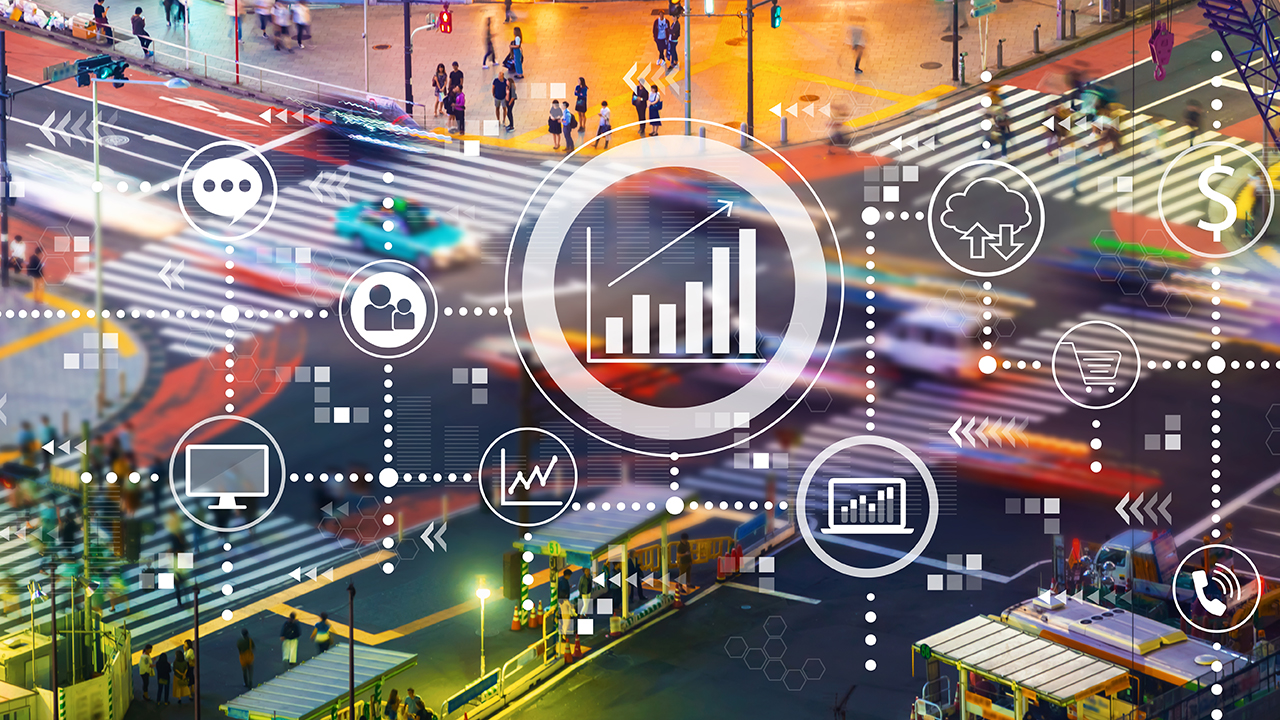 The benefits of smart technology and the advantages they bring to transportation within a smart city are numerous.
- Smart Transportation is safer: By combining machine learning with IoT and 5G, autonomous transportation systems (both in vehicles and in stationary infrastructure such as intersections) have proven to reduce the “human factor” in accidents. Computers don’t get distracted or fatigued or emotional.
- Smart Transportation is better managed: Data collection is an important key to responsible public management of infrastructure. Smart transportation not only provides detailed data points for every aspect of the transportation system, but allows administrators to better monitor operations, track maintenance needs, and identify key sources of problems that need to be fixed.
- Smart Transportation is more efficient: With better management comes more efficient use. Quality data can help to pinpoint areas where efficiency can be improved. Maybe a slight adjustment in train schedules would provide for better fill rates, Or, perhaps bus routes would better serve the community if stops were allocated differently.
- Smart Transportation is cost effective: Because smart transportation makes better use of the resources available, it can cut down costs thanks to preventative maintenance, lower energy consumption, and fewer resources used towards accidents. Cost savings can also be gained by riders when inexpensive public transit is efficient enough to compete with private vehicle ownership.
- Smart Transportation provides rapid insights: City traffic management centers (TMCs) can get rapid visibility and notifications for trouble spots or city-wide issues affecting congestion on city streets, public safety and emergency response systems, in order to take action or communicate more effectively with other agencies and emergency responders.
In addition to benefits such as better management, safety, and efficiency already discussed, there are several additional advantages to smart transportation for the general public, local governments, and the world at large, including:
- Security
- Environmental Considerations
- Supply Chain Resiliency
Security

One major fear among smart city skeptics is its vulnerability to cyber-attacks. After all, as the world grows more connected, cyber-attacks have become nearly commonplace among criminals and even nation states as they target critical infrastructure such as Internet connected power grids and banking systems.
Cyber-attacks are nothing new; however, the tools and methods continue to evolve. Banks, power grids, and other critical infrastructure that include transportation have been vulnerable to physical attacks long before computers have been around. Physical threats such as criminals stealing cars, terrorists using vehicles as weapons (as in the 2025 New Orleans attack), and bad actors holding public transportation hostage can all be mitigated when vehicles and infrastructure are integrated, networked, and autonomous.
As for the risk of cyber-attacks, they are much easier to defend against than the physical threats listed above. Proper software updates, encrypted communications through virtual private network (VPN) tunnels and other multilayered security practices can mitigate the risk of cyber-attacks. This means that smart transportation for intelligent cities can make modern public transport safer overall by reducing the opportunities for both physical and cyber-attacks.
Environmental Considerations
 The history of transportation is inexorably tied to the environment. From steam vehicles that burned coal and wood to today’s gasoline consuming combustion engines, transportation takes a toll on the planet’s resources and atmosphere.
While scientific advances are made every day to find alternative sources of energy to power transportation, another benefit of smart transportation technology is that it allows cities to use their current resources more responsibly.
Mass transit is better for the environment than private vehicles but is not widely used across the US and other countries because it is often impractical in some regions. With the efficiency boosts that come from smart transport solutions, however, modern public transport can be made lucrative for more portions of the population. As urban transportation technology improves in large cities, the proven methods can be replicated and spread to regions that want the benefits of a smart city.
Supply Chain Resiliency
 Global crises such as the Coronavirus pandemic have proven that the world’s supply chains are vulnerable to disruption. When workers and drivers are ill and traveling from one region to another becomes a public health hazard, autonomous transportation of goods can become a literal lifesaver.
Projects such as Wyoming’s connected vehicle project might be the key to forming an autonomous supply chain powered by smart, city-to-city transport and logistics systems to move critical goods such as food and emergency supplies without the need to risk human drivers. Minimally, the human supply chain workforce can be augmented wherever safety and efficiency can be improved using automation, artificial intelligence and robotics. The good news is that experts believe these innovations will support creation of more jobs, and safer ones, as developers, technicians, analysts and administrators help to bring the advancements to market and maintain them.
Are There Disadvantages of Smart Cities?
For all their benefits, some challenges may come to the surface as smart city transportation systems are implemented, from the costs involved in deploying and scaling these systems to issues around power consumption and responsible data management.
Smart cities require a lot of sensors and those sensors all require power. Sensors attached to moving objects typically require batteries. Stationary sensors may be able to use solar power or they need to be wired into the city’s electrical grid. The sheer number of sensors required for the world to transition to smart cities, already estimated in the billions and growing, makes powering so many devices a daunting problem. Even for sensors wired into the power grid, the amount of raw material necessary (such as copper) is significantly high compared to past production levels.
Beyond power, there is significant debate in the world today regarding personal data online. Data is the lifeblood that smart cities need in order to operate. While much of the information needed is anonymous compared to online data, this will require a mental and behavioral shift among populations. Cars will need to collect positional information and sensors around a city will need to passively collect the signals that a smart phone emits throughout the day. Responsible laws and policies for managing data, no matter how anonymous, will need to be enacted in order for smart cities to thrive into the future.
Download our Traffic Management Solution Brief
Discover Digi-powered centralized traffic control.
Download PDF
How Does Smart Transportation Work?
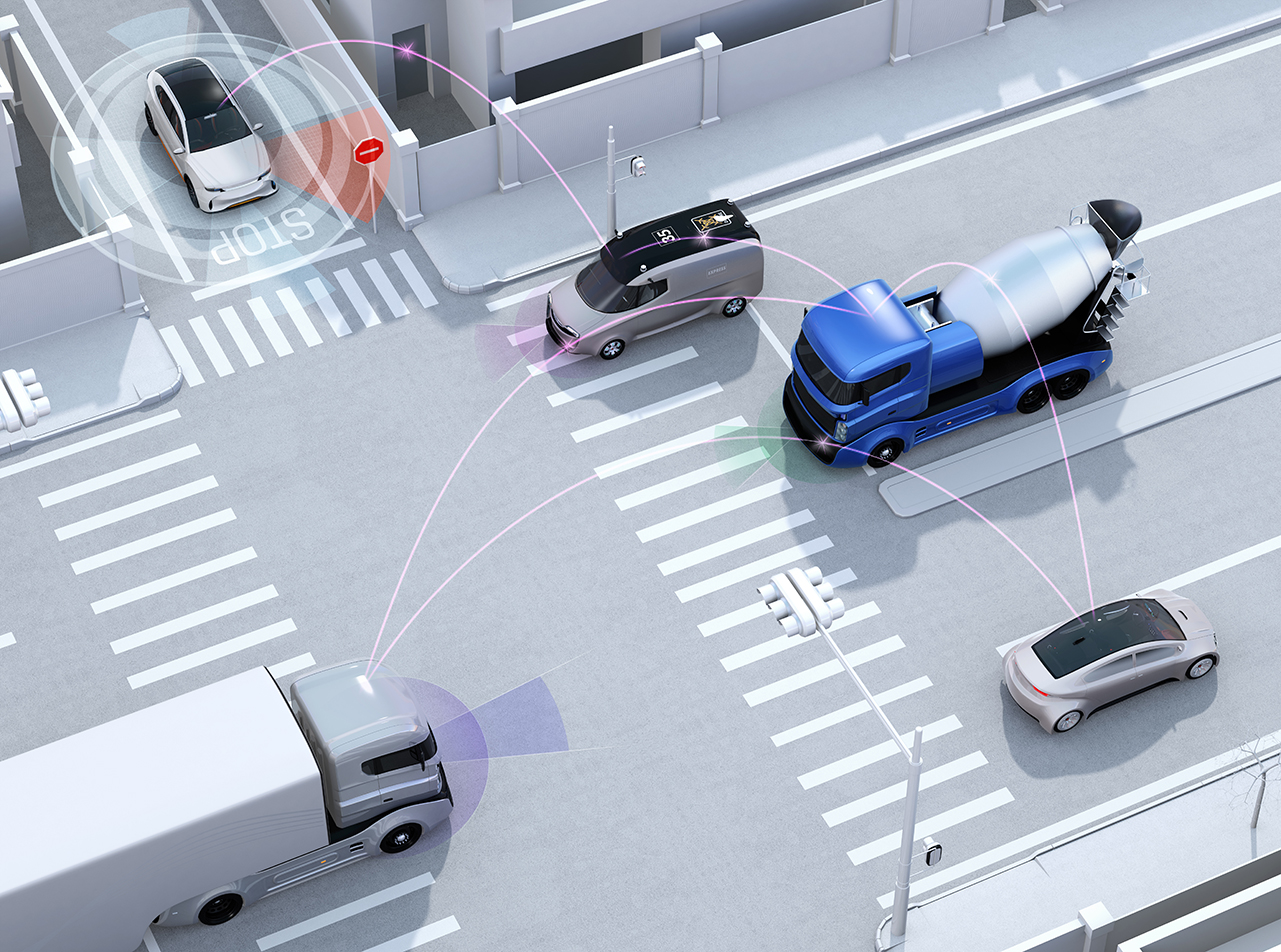 Smart transportation can generally be divided into two broad categories, public infrastructure and the automotive industry. These two sectors become “smart” when networked sensors are integrated into infrastructure and vehicles in an effort to accomplish the goals of remote management and control, safety, and efficiency.
Picture a busy city intersection. Pedestrians are trying to cross. The streetlights are regulating flow of traffic. Drivers in vehicles are busily trying to get to their destination. In traditional transportation systems, the streetlights are triggered either through timers, pressure plates underneath the road, or pedestrian buttons on the curb.
Both the drivers and the pedestrians are responsible for paying attention to (and following) the traffic signals. If any of these nodes fail, however, both efficiency and safety drop. A distracted driver runs a red light. A pedestrian fails to push the crosswalk button, thus missing their turn and having to wait longer. The streetlight refuses to change despite the fact that there is only one car waiting and no traffic.
In an intelligent intersection, however, this all changes. A vehicle may use a combination of Bluetooth and LIDAR (Light Detection and Ranging) to detect pedestrians and can automatically begin breaking to avoid an accident. Streetlights can pick up the individual signals sent from vehicles to determine how many cars are waiting and in which direction far more accurately and efficiently than pressure plates and timers. Cars and streetlights can even communicate to the level that, when the light turns green (or sends the “go” signal to the car’s computer), the car automatically begins moving, and when turning red (or sending a “stop” signal), the car slows down and stops. This is all made possible thanks to the application of technology in transportation such as IoT and 5G communication speeds for real time actions and remote sensing.
The Role of AI and Edge Computing in Smart Transportation
As smart transportation systems mature, two technologies are doing much of the heavy lifting behind the scenes: artificial intelligence and edge computing.
AI adds prediction and decision-making to real-time data. Sensors and connected vehicles generate a constant stream of information such as vehicle counts, speeds, weather conditions and incident reports. But that data only becomes useful when something can act on it quickly. AI and machine learning models analyze these patterns to predict congestion before it happens, flag anomalies that might indicate an accident or infrastructure failure, and continuously adjust systems like traffic signal timing based on actual conditions rather than fixed schedules. This is what allows adaptive traffic signals to do more than react; they can anticipate and act proactively.
Edge computing solves the latency problem. Sending every sensor reading to a centralized cloud server for processing introduces delay, and in transportation, delay can be the difference between a system that prevents a collision and one that simply logs it afterward. Edge computing processes data locally, at the intersection, on the vehicle, or at a roadside unit, so decisions that require millisecond response times (like a vehicle braking for a detected pedestrian) don't have to wait on a round trip to a distant data center. Less time-sensitive data can still be sent to the cloud for longer-term analysis, but the immediate safety-critical decisions happen at the edge.
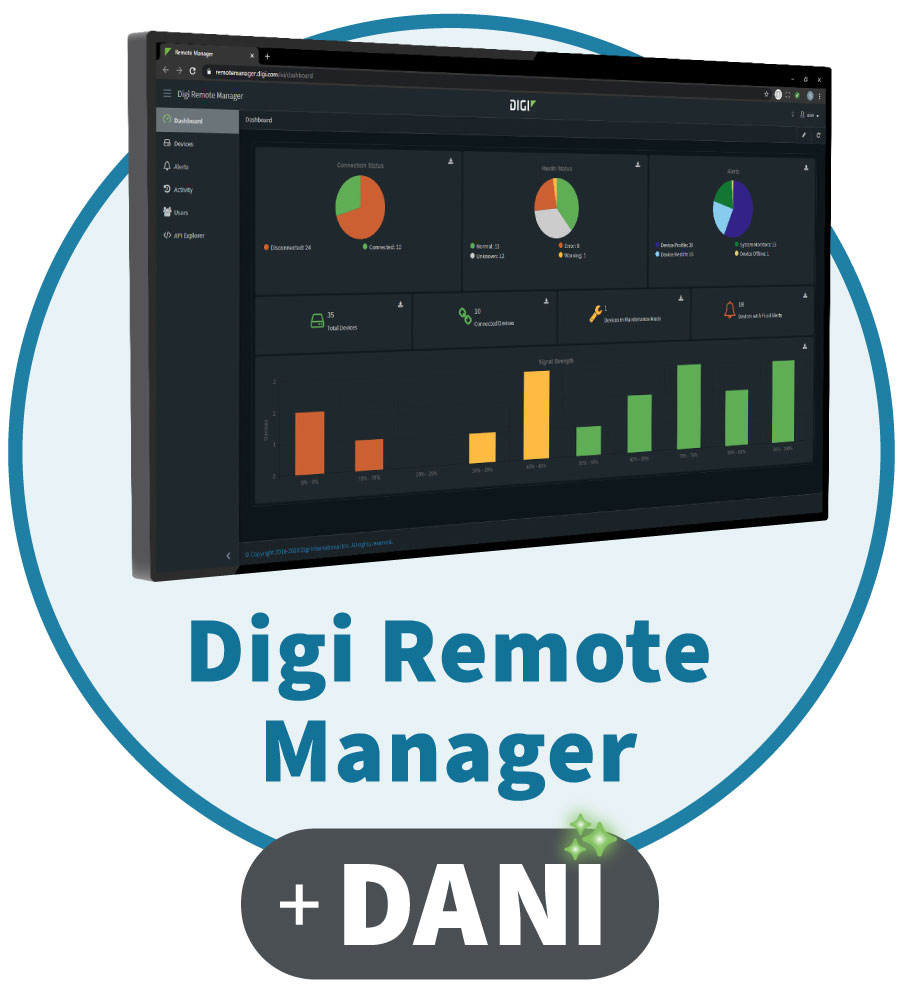 Behind many of these deployments sits Digi Remote Manager (DRM), the cloud platform that keeps the routers, gateways and roadside units powering a transportation network configured, updated and secure. For a city running thousands of connected intersections or a transit agency managing a fleet of onboard routers, DRM is the layer that lets operators push firmware updates, monitor device health, and manage configurations across an entire deployment from a single console, rather than truck-rolling to every cabinet and vehicle.
Digi has recently layered AI directly onto that management platform. DANI (Digi Artificial Network Intelligence) is a value-added service built into DRM that lets operations teams ask plain-language questions about their network, devices and deployments and get answers in seconds. Running on Digi's SOC 2 Type 2-compliant infrastructure with no custom integration work required, DANI can analyze fleet-wide firmware and configuration state, surface cellular signal strength and carrier-switching behavior, and recommend corrective actions, turning what used to be a slow log-diving exercise into a conversation. For an agency managing thousands of roadside units and onboard routers, that means faster incident resolution and less time spent manually correlating alerts.
Digi has also opened this same operational data to outside AI tools through its MCP Server for DRM, a companion capability to DANI that lets enterprise AI assistants such as Claude query device fleets, automate workflows and generate configuration insights directly from an agency's own tools.
Together, AI and edge computing (now reinforced by AI built directly into the management platform itself) make smart transportation systems more autonomous and resilient. A traffic management system, for example, can use edge-based AI to make local decisions instantly even if its connection to a central control center is briefly interrupted, then sync and reconcile data once connectivity is restored, while DANI gives the humans overseeing that network faster visibility into what's happening and why. This combination is increasingly what separates truly "smart" infrastructure from systems that are merely connected; in other words, it is the difference between collecting data and acting on it in real time.
Examples of Urban Transportation Technology
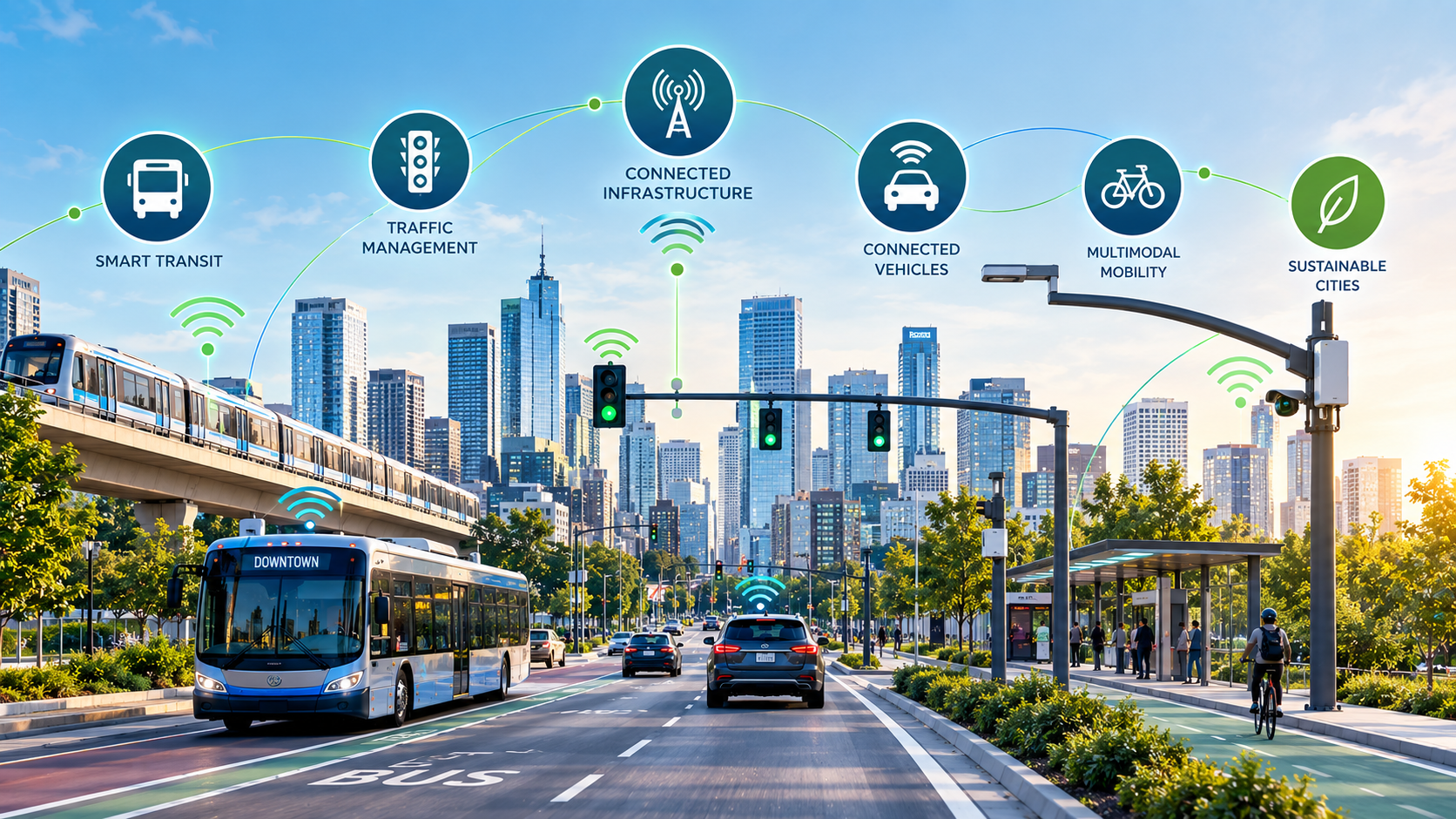
Regardless of the advantages and disadvantages of smart cities, the technology is here and being used today. Across the US and the world, smart sensors and controllers are being implemented in train networks, passenger information systems, and public transport dispatch. Here are some smart city transportation examples:
- New York City smart transportation deployment
- Oregon Tri-Met public transportation and transit signal priority project
- Miami Dade smart traffic management
- Southern Pennsylvania Transportation Authority (SEPTA) Positive Train Control (PTC)
- Suburban Mobility Authority for Rapid Transit (SMART) Dispatch System
New York City Smart Transportation Deployment
New York City DOT manages one of the most complex urban transportation networks in the world, overseeing 6,300 miles of streets and highways and nearly 14,000 signalized intersections. To keep this scale of traffic moving safely and efficiently, NYC DOT completed a citywide upgrade of its Intelligent Transportation System communications network, replacing its aging NYCWiN network with a solution built around AT&T connectivity and Digi hardware.
The rollout equipped each of the city's 14,000 intersections with a Digi transportation cellular router, giving every signal, traffic camera, and vehicle-detection device a reliable, high-speed link back to NYC DOT's Traffic Management Center. The routers use a dual-carrier design that automatically fails over to a secondary network during outages, supporting the 99.99% availability the city requires, and each device connects into Digi Remote Manager for centralized, cloud-based monitoring and configuration across the entire network.
Using zero-touch configuration, field crews were able to install pre-configured devices rapidly, helping the project finish ahead of schedule and under budget.
Oregon TriMet Public Transportation and Transit Signal Priority Project
The Tri-County Metropolitan Transportation District of Oregon (TriMet) operates more than 700 buses across 85 routes, serving a service area of over 500 square miles in the Portland metro region. To modernize aging onboard technology, TriMet equipped its entire bus fleet with Digi transportation cellular routers, replacing components that were 10–15 years old and prone to failure, and centralized management of the fleet through Digi Remote Manager.
The upgrade gave TriMet real-time computer-aided dispatch, automated vehicle location updating every two seconds, and electronic fare collection across the fleet while also enabling its Transit Signal Priority (TSP) initiative along the high-traffic Division Street corridor. By feeding real-time vehicle location data into the TSP system, TriMet's buses receive priority at signalized intersections, reducing delays and supporting larger, higher-capacity buses through the corridor.
Beyond faster, more reliable service, the project delivers a measurable environmental benefit: transit signal priority reduces the idling and stop-and-go driving that contribute to vehicle emissions, supporting Oregon's broader carbon-reduction goals.
Miami Dade Advanced Traffic Management System
The county of Miami Dade is the most populated county in Florida, with a population of over 2.5 million residents. Managing the flow of traffic across urban area that makes up the city of Miami and its surrounding areas, including the operation of over 2,700 signalized intersections, is the responsibility of the County of Miami Dade. In fact, the number of signalized intersections and mid-block crossings, is increasing by dozens every year, according to their Traffic Management website.
The Miami Dade Advanced Traffic Management System (ATMS), which includes Digi transportation cellular routers as part of the communications infrastructure in county-wide traffic cabinets, is designed to reduce congestion and delays and improve mobility, county-wide.
SEPTA PTC
SEPTA (Southeastern Pennsylvania Transportation Authority) manages the light rail, subway, and bus services for Philadelphia. With over one million riders daily, these services need to be reliable and safe each and every time a vehicle departs. This is why SEPTA built a positive train control system (PTC) to signal trains, prevent derailments and crashes, and monitor speed and signal violations.
SEPTA accomplishes this with Digi transportation routers. When integrated onto a train, this device allows for remote communications with wayside sensors over a radio link. The device sends signals with train movement data while receiving information regarding closures and other factors that would necessitate a change in plan. This keeps trains from chugging forward into a dangerous situation.
SMART Dispatch System
Public transport in smart cities is a key area for advancement in connected technologies. In Detroit, SMART (Suburban Mobility Authority for Rapid Transit Authority) manages and dispatches over 300 buses across the city. As an integral part of how the population gets around, it is important for these buses to be on time, safe, and breakdown free. To manage the dispatch and location tracking of buses, the city used an analog radio network with three radio towers scattered around the city.
When it was time for an upgrade, they utilized Digi mobile transportation routers. This switch from analog to digital allowed for significantly better management and tracking. The new technology allowed SMART to not only see each vehicle's location, but also view their speed and monitor maintenance data for each bus. This allowed for better dispatching if a bus started to run behind schedule as well as preventative maintenance to mitigate breakdowns and major repairs, saving them an estimated $70,000 per year.
Explore Digi's Smart Transport Solutions
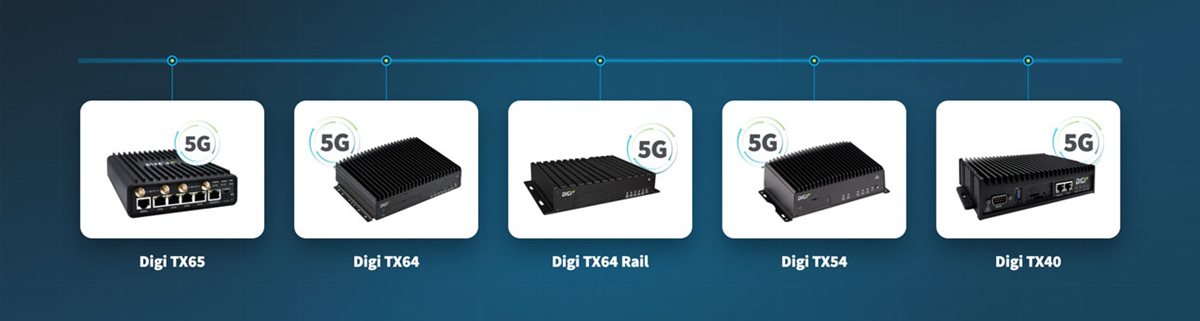
Digi is supporting the rollout of intelligent transportation and connected vehicle systems across the U.S. and the globe, with high-performance, industrial-grade cellular routers including FirstNet Trusted™ 5G solutions for priority and pre-emptive communications.
The smart transportation market is highly promising for society. As intelligent transportation systems for smart cities grow in use around the world, populations can begin to reap the many safety, efficiency, and cost benefits that come with modern public transport. It is exciting to think about how society might interact with their cities with the latest technologies that are becoming available today.
To see more benefits and examples of how Digi's smart transportation IoT solutions can move society forward, visit our Traffic Management page, or reach out today to start the conversation.
Frequently Asked Questions About Smart Transportation
How does smart transportation work?
Smart transportation uses connected sensors, communications networks, software and intelligent transportation systems (ITS) to monitor and manage vehicles, roads and transit infrastructure in real time. Common applications include adaptive traffic signals, connected vehicles, transit signal priority, incident management and fleet monitoring.
What technologies power smart transportation?
Smart transportation relies mainly on IoT sensors and controllers embedded in vehicles and infrastructure, paired with high-speed 5G and cellular communications. Together these enable real-time data collection, remote management, and low-latency communication between vehicles, traffic signals and control centers.
What are the benefits of smart transportation?
Smart transportation improves safety by reducing human error, gives cities better data for managing infrastructure, increases operational efficiency, lowers costs through preventive maintenance and reduced energy use, and gives traffic management centers faster visibility into problems as they happen.
How does a smart intersection work?
In a smart intersection, vehicles and traffic signals communicate directly — for example, using sensors or vehicle-to-infrastructure signals instead of pressure plates or timers. Signals can detect how many vehicles are waiting and adjust in real time, and connected cars can respond automatically to signal changes.
What are real-world examples of smart transportation?
New York City DOT connected 14,000 signalized intersections into a citywide ITS network for centralized traffic management and monitoring. In Portland, TriMet's Transit Signal Priority project uses real-time bus location data to reduce delays at intersections, improving service reliability while cutting emissions along high-traffic corridors.
Is smart transportation secure from cyberattacks?
Smart transportation systems face cybersecurity risk as connectivity increases, but this risk is generally more manageable than physical threats infrastructure has always faced. Practices like regular software updates, encrypted VPN communications and layered security controls help mitigate cyber risk in connected transportation systems.
What are the disadvantages of smart transportation?
The main challenges are power consumption, since large numbers of sensors require reliable power sources, and responsible data management, since vehicles and infrastructure collect positional and behavioral data that requires clear policies to protect privacy while still enabling smart-city functions.
How does smart transportation help supply chains?
Smart transportation supports supply chain resiliency by enabling autonomous or semi-autonomous movement of goods, reducing dependence on human drivers during disruptions like public health emergencies, and using automation to augment the supply chain workforce where safety or efficiency can be improved.
Next Steps
Editorial note: This blog post was originally published in December 2020, and was updated in September 2026.