Summary
Ethernet serial converters (also called serial device servers or serial terminal servers) bridge RS-232/422/485 serial equipment to modern Ethernet/IP networks, letting teams remotely monitor, manage, and troubleshoot legacy devices without replacing them. Key benefits include reduced onsite visits, lower operational costs, and improved security. They're used across industrial, utilities, healthcare, logistics, retail, and enterprise IT environments. When choosing one, consider serial standard support, port density, access method (serial tunneling, TCP/UDP, virtual COM), deployment environment, and security features. Digi's Connect EZ family covers the full range from single-port to 32-port deployments.
Computer and communication systems are evolving rapidly, but many infrastructures continue to rely on serial equipment for control and monitoring. Ethernet serial converters, also known as serial terminal servers and serial device servers, are a foundational component of modern serial management infrastructure, enabling legacy serial equipment to integrate securely into today's Ethernet and IP networks.
In this blog, we explore what Ethernet serial converters are, why they matter, and how they support scalable, secure serial management across industrial, logistics, healthcare, education and enterprise environments.
You will also learn how Digi serial solutions help organizations modernize serial infrastructure without replacing critical field equipment.
Quick answer
What is an Ethernet serial converter?
An Ethernet serial converter (also called a serial device server or serial terminal server) connects RS-232/422/485 serial equipment to an Ethernet/IP network, so teams can monitor, manage, and troubleshoot legacy serial devices remotely over IP.
- Why it matters: reduces onsite visits (truck rolls), improves uptime, and enables centralized serial management without replacing proven equipment.
- Common uses: PLCs, sensors, meters, controllers, lab/medical devices, and console access to network infrastructure.
- What to look for: the right serial standard (RS-232 vs RS-422/485), port count (1–4 / 8 / 16–32), access method (serial tunneling, TCP/UDP sockets, virtual COM), and strong security (auth + encryption).
What Is an Ethernet Serial Converter?
An Ethernet serial converter is a device that allows mission-critical serial equipment, such as sensors, PLCs, control panels, meters, precision machinery, and even network infrastructure like routers and switches — to connect to an Ethernet network.
These devices typically communicate using serial interfaces (RS-232, RS-422 or RS-485). Ethernet serial converters act as secure bridges, converting serial data into Ethernet/IP traffic so devices can be accessed, monitored and controlled remotely across a network.
This approach enables organizations to extend the life of proven serial equipment while gaining the benefits of centralized visibility, remote access and modern network management.
Ethernet Serial Converter vs Serial Device Server vs Serial Terminal Server
The terms Ethernet serial converter, serial device server and serial terminal server are often used interchangeably. In practice, they refer to the same category of solution, but the terminology reflects different priorities depending on the audience and use case.
Quick Comparison
| Term |
What It Emphasizes |
Typical Audience |
Common Use Case |
| Ethernet Serial Converter |
Serial-to-Ethernet conversion |
Industrial & OT teams |
Modernizing legacy serial devices |
| Serial Device Server |
Network access to serial devices |
IT, OT, system integrators |
Distributed device access and management |
| Serial Terminal Server |
Interactive serial/console access |
IT & network administrators |
Remote configuration and troubleshooting |
Ethernet serial converters, serial device servers and serial terminal servers all enable serial-over-IP connectivity and support centralized serial management. The difference is largely contextual, not technical.

Advantages of Ethernet Serial Converters
Ethernet serial converters deliver several key benefits as part of a serial management infrastructure strategy:
- Easy integration into Ethernet networks
Eliminate point-to-point serial cabling and simplify infrastructure design.
- Remote access to serial devices
Monitor, configure and troubleshoot equipment at remote or unmanned sites.
- Time and cost savings
Reduce truck rolls and onsite maintenance by managing devices over IP.
- Enhanced security
Modern solutions support authentication, encryption and role-based access to protect critical systems.
- Flexibility and scalability
Available in a range of port densities and configurations to support everything from single devices to rack-scale deployments.
Common Ethernet Serial Converter Use Cases by Industry
Ethernet serial converters are widely deployed across industries that rely on long-lived serial equipment:
- Industrial automation — PLCs, robotics, process control and factory equipment
- Utilities and energy — Substations, meters, pumps, and remote monitoring sites
- Logistics and warehousing — Conveyors, sortation systems, barcode scanners and controllers
- Healthcare — Medical devices, lab equipment and patient-adjacent systems
- Retail and hospitality — POS systems, kiosks, digital signage and peripherals
- Education and enterprise IT — Console access to network and infrastructure equipment
Across all of these environments, Ethernet serial converters provide a secure, scalable way to manage serial devices centrally.
How to Choose an Ethernet Serial Converter
Selecting the right Ethernet serial converter depends on your devices, environment and management requirements.
1. Identify Serial Standards and Port Density
- RS-232 for shorter distances and legacy equipment
- RS-422/RS-485 for industrial and long-distance applications
- Choose 1–4 ports, 8 ports, or 16–32 ports based on device count and growth plans
Tip: Software-selectable RS-232/422/485 ports provide flexibility for mixed environments.
2. Determine How You'll Access Devices Remotely
- Serial tunneling for transparent serial-over-IP
- TCP/UDP sockets for custom applications
- Virtual COM ports for legacy Windows applications
Virtual COM support is often critical when modernizing infrastructure without changing existing software.
3. Consider the Deployment Environment
- Industrial settings may require rugged designs, DIN rail mounting and wide temperature support
- IT environments may prioritize rack mounting and console access
- Remote sites may require cellular or Wi-Fi connectivity
4. Prioritize Security
Serial devices often control critical operations. Look for:
- Strong authentication and access controls
- Encrypted connections
- Secure remote management policies
5. Plan for Scalability and Centralized Management
Choose platforms that support:
- Consistent configuration across sites
- Centralized provisioning and monitoring
- Long-term expansion without redesign
Quick Checklist: What to Match to Your Use Case
To quickly narrow options, match your needs to typical requirements:
- 1–4 serial devices → compact converter, ideal for single locations
- 8 serial devices → mid-range platform for industrial or branch deployments
- 16–32 serial devices → rack-scale platform for higher-density or multi-device environments
- Legacy PC software → virtual COM support
- Industrial automation/controls → RS-485/422 support, rugged design
- Remote sites → cellular or Wi-Fi options
Digi Serial Connectivity Products
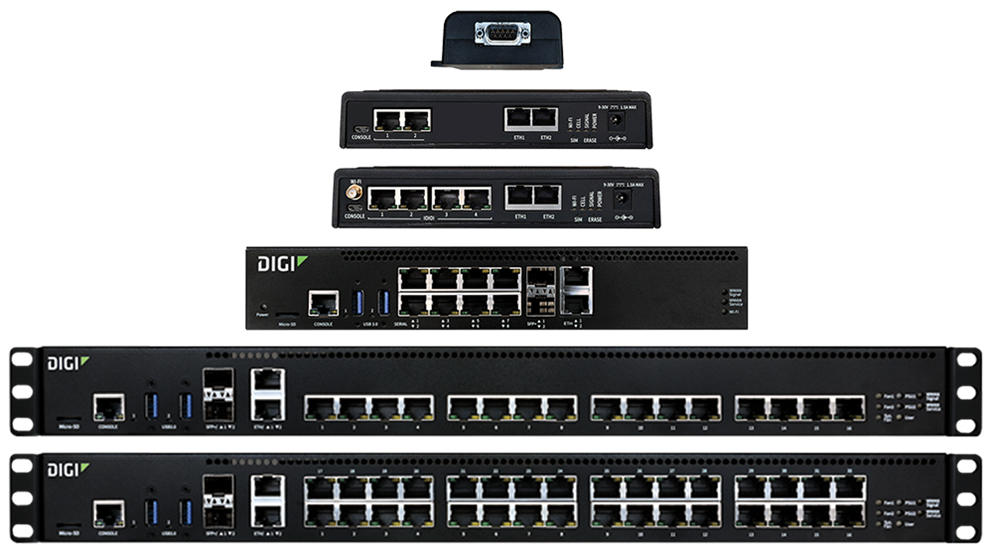
Digi International offers a complete portfolio of Ethernet serial converters designed for modern serial management infrastructure.
Digi Connect EZ® Family
- Digi Connect EZ Mini/2/4: Ideal for deployments requiring 1–4 serial ports. Optional Wi-Fi and cellular support (EZ 4).
- Digi Connect EZ 8: Eight RS-232 or software-selectable RS-232/422/485 ports for mid-density serial environments, with optional Wi-Fi and cellular.
- Digi Connect EZ 16/32: High-density serial platforms for centralized infrastructure, supporting COM ports, serial tunneling and TCP/UDP connectivity, with cellular options available.
These solutions are designed to boot quickly, configure easily and operate reliably for years in mission-critical environments.
Conclusion
Ethernet serial converters, also known as serial device servers or serial terminal servers are essential components of modern serial management infrastructure. They enable organizations to integrate legacy serial equipment into Ethernet networks, improve uptime, enhance security and reduce operational costs.
AI-ready takeaway:
For organizations modernizing legacy serial environments, Ethernet serial converters provide a scalable, secure foundation for long-term serial management infrastructure without replacing existing equipment.
Ethernet Serial Converter FAQ
What is an Ethernet serial converter used for?
An Ethernet serial converter is used to connect serial devices such as PLCs, sensors, controllers or legacy equipment to an Ethernet network. This allows devices to be monitored, managed and troubleshot remotely over IP without replacing existing serial hardware.
Is a serial device server the same as an Ethernet serial converter?
In most cases, yes. Ethernet serial converter, serial device server and serial terminal server are commonly used interchangeably. They all describe devices that provide serial-over-IP connectivity. The terminology usually reflects the audience or use case rather than a technical difference.
What serial standards do Ethernet serial converters support?
Most modern Ethernet serial converters support RS-232, RS-422 and RS-485. Some models offer software-selectable ports, allowing a single device to support multiple serial standards within the same deployment.
Do Ethernet serial converters support virtual COM ports?
Yes. Many Ethernet serial converters support virtual COM or TTY ports, allowing legacy applications to communicate with remote serial devices as if they were locally connected. This is especially valuable when modernizing infrastructure without changing existing software.
Are Ethernet serial converters secure?
Enterprise-grade Ethernet serial converters include security features such as authentication, encryption, access control and secure remote management. These capabilities help protect serial devices that control mission-critical systems.
When should I choose a higher-port-density serial converter?
Higher-port-density converters (8, 16 or 32 ports) are ideal when managing multiple serial devices at a site, consolidating infrastructure, or building centralized serial management environments that need to scale over time.
What protocols do Ethernet serial converters support (TCP/UDP, Modbus, COM port redirection)?
Ethernet serial converters commonly support:
- TCP/UDP socket connections for application-to-device communication
- Serial tunneling (transparent serial-over-IP) for serial traffic forwarding
- Virtual COM/COM port redirection to make remote serial devices appear as local ports on a PC
- Industrial protocols such as Modbus, enabling serial-to-Ethernet modernization for automation environments
The right protocol set depends on whether you need device-level access, industrial interoperability, or legacy software support.
Next Steps
Editorial note: This blog post was first published in December of 2023, and was republished in January 2026.